


Jumeau Numérique Européen de l'Océan
Une représentation numérique interactive et dynamique de l’océan pour une meilleure prise de décision et une action durable
What is the European Digital Twin of the Ocean?
Un jumeau numérique est une réplique virtuelle d’un objet, d’un système ou d’un processus réel. Largement utilisés dans les domaines de l’ingénierie et de la fabrication, les jumeaux numériques sont de plus en plus utilisés pour capturer les propriétés et les comportements du monde naturel, ce qui révolutionne nos connaissances et fournit un environnement sûr et contrôlé pour simuler des scénarios, surveiller et analyser les impacts sur les entités existantes.
Dans le même ordre d’idées, le Jumeau Numérique de l’Océan fournira une description virtuelle cohérente, à haute résolution, multidimensionnelle et en temps quasi réel et à venir de l’Océan. Cela comprend ses dimensions physiques, chimiques, biologiques et socio-économiques. Alimenté par des observations continues en temps réel et historiques provenant de milliers de capteurs à travers les Océans du monde et de nombreux satellites, permettant en même temps l’intégration de flux de données alternatifs, le Jumeau Numérique de l’Océan intégrera une modélisation avancée alimentée par l’intelligence artificielle et l’apprentissage automatique, ainsi que par des supercalculateurs.
Les connaissances générées aideront à concevoir les moyens les plus efficaces pour restaurer et protéger les habitats marins et côtiers, soutenir les marchés durables de l’économie bleue, et atténuer le changement climatique et s’y adapter.
How is Europe building a Digital Twin of the Ocean?
At the United Nations Ocean Conference (UNOC) 2025 in Nice, the European Commission announced the European Digital Twin Ocean as a key pillar of the new EU Ocean Pact.
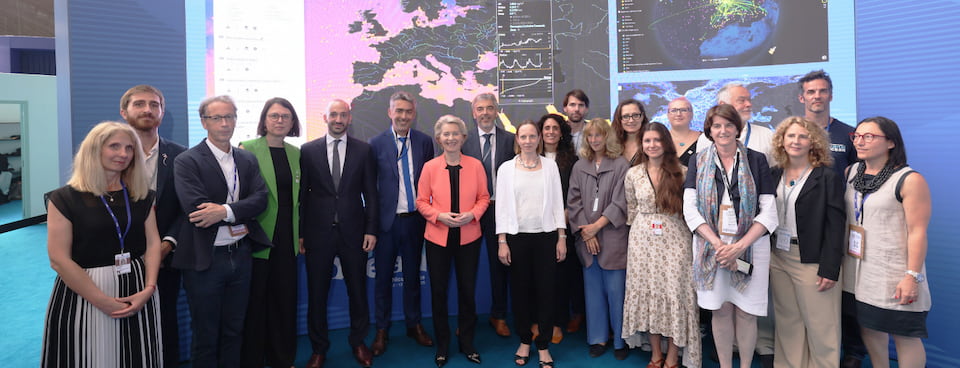
Launched by the European Commission in 2022, the EU DTO is a flagship initiative of the European Digital Ocean Knowledge System, built on decades of European leadership in operational oceanography.
Europe is now entering a new digital era where operational oceanography is powered by high-performance computing, cloud technologies and artificial intelligence. European Digital Twin of the Ocean embodies this evolution by transforming data and models into a living, virtual Ocean able to simulate conditions, test scenarios and inform decisions.
Between 2022 and 2025, the two Horizon Europe projects EDITO-Infra and EDITO-Model Lab developed the first integrated digital environment, combining data from the Copernicus Marine Service, EMODnet and other European observing systems. The new EDITO phase (2025–2028) now scales this platform into a fully operational, user-driven European Digital Twin Ocean.
TheEuropean Digital Twin of the Ocean is designed to be fully compatible with Destination Earth (DestinE), enabling synergy with Europe’s planetary digital twins and supporting major EU priorities including the EU Ocean Pact, the EU Digital Strategy, and the Global Gateway strategy.
L'océan reste un grand mystère pour l'humanité.
Join the Community: Events 2025–2026
Digital Ocean Week 2026
8 - 12 June 2026, Brussels
A week to explore how AI and the European DTO are transforming Copernicus Marine.

European Ocean Vision 2034
12-13 February 2026, Hamburg
A community-driven forum to co-design the evolution of the Copernicus Marine Service and the EU Digital Twin Ocean.
18th European Space Conference
27 & 28 January 2026, Brussels
How the EU Digital Twin Ocean can strengthens Europe’s Space and Security strategies.
Digital Ocean Forum 2025
27 & 28 November 2025 , Brussels
The European Commission’s flagship co-design event shaping the EU Digital Twin Ocean.
Research & Innovation Days 2025
16 & 17 September 2025, Nice
The European Digital Twin Ocean highlighted at the Commission’s annual event uniting Europe’s research and innovation.
UN Ocean Conference 2025 (UNOC3)
2 - 13 June 2025, Nice
The EU Digital Twin Ocean announced as a major outcome of the new EU Ocean Pact.
Contribute: Calls for Tender and Grants
We are offering our community opportunities to contribute to the EU DTO through calls for tenders and EDITO grants, in coordination with National Collaboration Projects.
Mercator Ocean’s leadership in developing the European Digital Twin Ocean
Mission
For more than two decades, Mercator Ocean International has been a driving force in operational oceanography, developing global digital Ocean systems and the scientific capacity to model and predict the marine environment. Under the leadership of the European Commission and together with partners such as the Flanders Marine Institute (VLIZ), Mercator Ocean is now implementing the next-generation, AI-powered European Digital Twin of the Ocean (DTO). Built on mature coordination networks and a fully operational digital Ocean infrastructure, Mercator Ocean is ready to deliver the EU DTO as a fully operational system in close collaboration with partners across Europe. Looking ahead, it will continue to enhance the platform’s capabilities and foster co-creation with Europe’s marine community, ensuring the EU DTO remains a collaborative, user-driven tool for understanding and protecting the ocean.
Future IGO mandate
Mercator Ocean’s mission is fully aligned with the mandate of the future intergovernmental organization (IGO) it is evolving into. The IGO’s purpose is to design, develop and operate world-class Digital Ocean Systems and contributions to a Digital Twin of the Ocean, encompassing marine physics, biogeochemistry and ecosystem sciences and to provide authoritative Digital Ocean Information Services of general interest to Member States and international ocean governance.

The EDITO Project
The EDITO project is a flagship EU initiative, led by Mercator Ocean International and the Flanders Marine Institute (VLIZ) on behalf of the European Commission. It is building the technological infrastructure of the European Digital Twin of the Ocean and fostering co-creation with Europe’s marine community. The project is now entering its second phase of development (2025–2028).
The European Digital Twin of the Ocean
The Digital Ocean Forum
The Digital Ocean Forum (DOF) brings together experts, stakeholders, policymakers, and citizens to co-design and co-create the European Digital Twin Ocean. Initiated by Mercator Ocean, the first Forum took place in Paris in 2022, under the auspices of the European Commission and during the French Presidency of the EU Council The Digital Ocean Forum is now organized by the European Commission’s Directorate-General for Research and Innovation (DG RTD), Directorate-General the Directorate-General for Maritime Affairs and Fisheries (DG MARE), Directorate-General for Defence Industry and Space (DG DEFIS) and the Directorate-General for International Partnerships (DG INTPA), with Mercator Ocean International, Flanders Marine Institute and SeaScape Belgium as the implementation partners in the frame of EDITO.
Two Pioneering Horizon Projects
The new phase of the EDITO project (2025–2028) builds on the achievements of two completed EU projects, EDITO-Infra and EDITO-Model Lab (2022–2025), which integrated Copernicus Marine Service and EMODnet data into a unified digital framework for the European Digital Twin Ocean (EU DTO).
EDITO-Infra established the public infrastructure backbone of the EU DTO by upgrading, combining, and integrating key components of European Ocean observing, monitoring, and data programs into a single digital framework.
EDITO-Model Lab was a three-year project developing the next generation of Ocean models, complementary to the Copernicus Marine Service and fully integrated into the EU DTO public infrastructure via EDITO-Infra.