


Mercator Ocean International (MOi) oceanographers examine marine heatwaves across the global ocean. They analyse a variety of datasets from observations (satellite sea surface temperature maps) to numerical model analyses (assimilating satellite and in situ observations) and derive forecasts for a 7 day period.
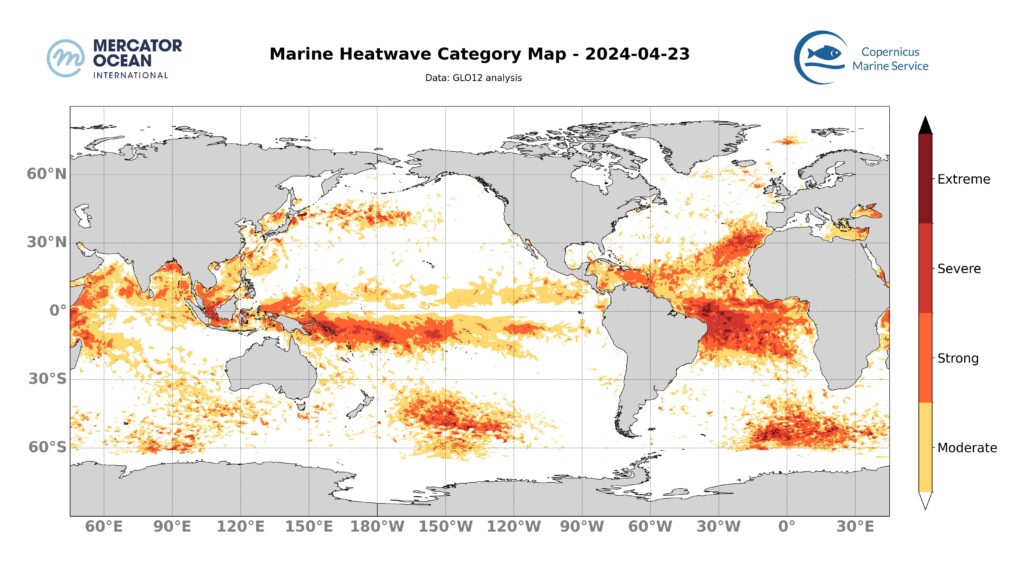
Assessment for April 23th
Marine heatwave categories
Zone Europe
Mediterranean Sea
The western basin is no longer affected by a marine heatwave. In the eastern basin, the marine heatwave intensity decreased a lot and is now mostly of moderate category.
Global Ocean
Atlantic Ocean
North Atlantic Ocean – On the North African Atlantic coast, from the Moroccan coast to the Strait of Gibraltar, the marine heatwave is stable, with categories reaching moderate to strong.
North Tropical Atlantic Ocean – In the North Tropical Atlantic and Caribbean Sea, the marine heatwave is stable, with the majority of the area exposed to events of moderate and strong categories.
South Tropical Atlantic Ocean – In the South Tropical Atlantic and at the equator, the marine heatwave remains stable, with categories ranging from moderate to extreme.
Southern Ocean
The marine heat wave in the Southern Ocean, off the South African coast (between 30°W and 30°E) is stable with categories mostly strong and locally severe.
Pacific Ocean
Tropical Pacific Ocean – In the tropical Pacific Ocean, the area of the marine heatwave due to El Niño condition is stable. West of the basin, under the equator, its intensity increases with a larger area of strong categories, as well as the development of severe categories.
South Pacific, east of New Zealand – The marine heatwave remains stable overall.
Indian Ocean
In the Arabian Sea, the marine heatwave intensifies in the west with the development of strong categories. In the Bay of Bengal, the marine heatwave is decreasing in intensity, with moderate categories replacing strong categories.
Weekly temperature anomalies
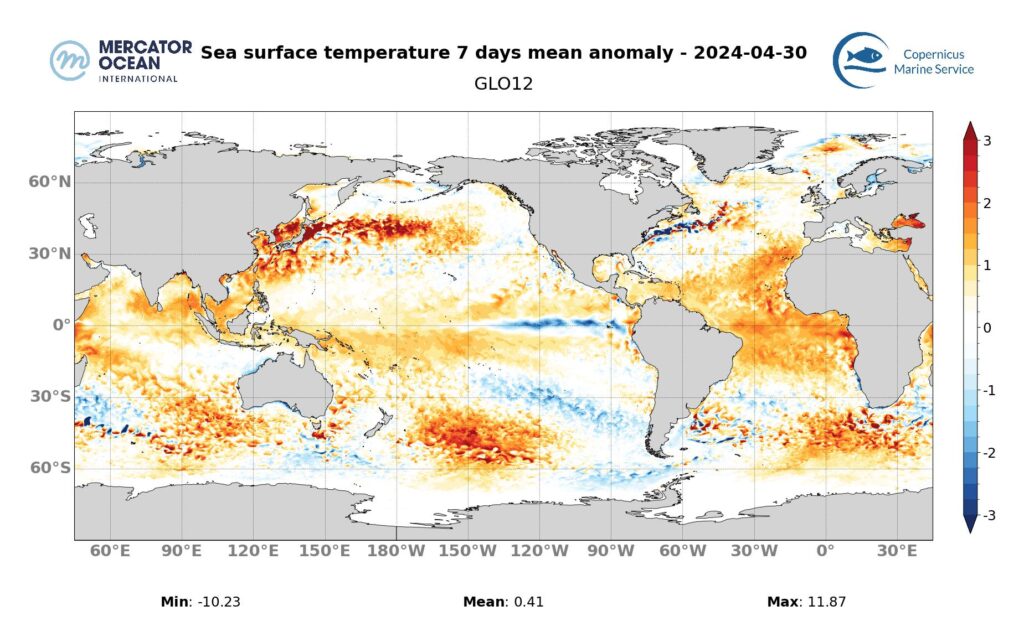
Mediterranean Sea – 0.5°C and 2.5°C.
North Atlantic Ocean– 0.5°C and 1.5°C.
North Tropical Atlantic Ocean – 0.5°C and 1.5°C.
South Tropical Atlantic Ocean – 0.5°C and 1.5°C.
Southern Ocean – 1°C and 3°C.
Tropical Pacific Ocean – 0.5°C and 1°C.
South-East Asian Seas – 0.5°C and 1°C.
South Pacific Ocean – 2°C and 3°C.
Indian Ocean – 0.5°C and 2°C.
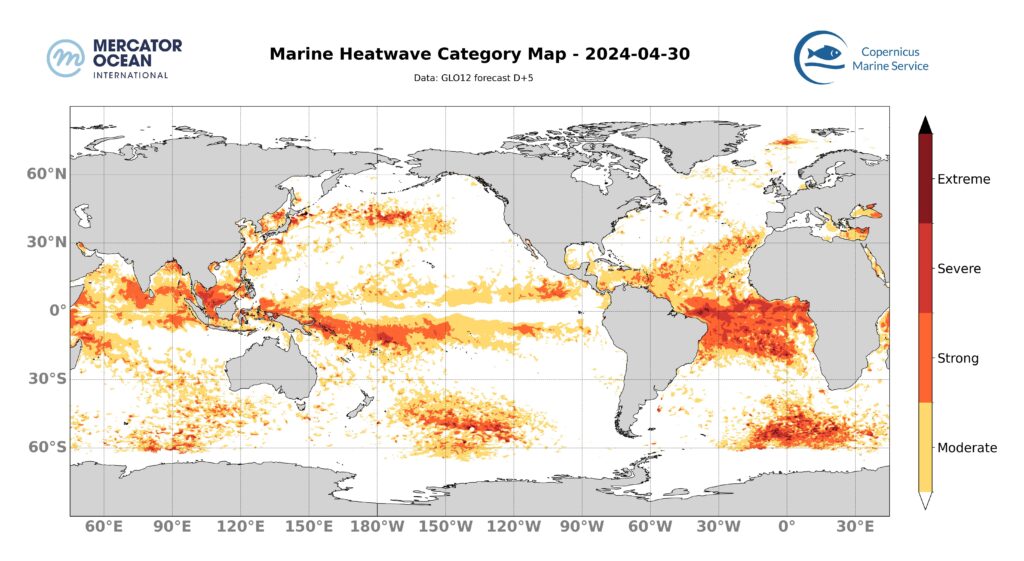
Forecast for April 30th
Zone Europe
Mediterranean Sea
For the 30th of April, Mercator Ocean International forecasts the marine heatwave keeps decreasing in the western basin. Its intensity is moderate, except around Cyprus where strong to severe categories are found.
Global Ocean
Atlantic Ocean
North Atlantic Ocean – MOI forecasts that the marine heatwave on the North African Atlantic coast off Morocco will decrease slightly in intensity but increase in extent.
North Tropical Atlantic Ocean – MOi forecasts that the marine heatwave on the North African Atlantic coast off Morocco will decrease in extent and in intensity, essentially moving to moderate category.
South Tropical Atlantic Ocean – The marine heatwave will remain stable.
Southern Ocean
The marine heatwave in the Southern Ocean, off South Africa (between 30°W and 30°E) remains stable.
Océan Pacifique
Tropical Pacific Ocean – In the tropical Pacific Ocean, the marine heatwave due to El Niño condition will decrease in intensity in the west basin.
South Pacific, east of New Zealand – The marine heatwave intensity decreases slightly.
South-East Asian Seas
In the South-East Asian seas, the marine heatwave is decreasing in intensity, with an increase of the extent of the moderate categories in place of strong categories.
Indian Ocean
In the Indian Ocean, the marine heatwave in the Arabian Sea and in the Bay of Bengal are increasing in intensity, with strong categories development, especially around Indian coasts.
What are marine heatwaves?
Marine heatwaves (MHW) are extreme rises in ocean temperature for an extended period of time. They can occur at different locations in the ocean, and their magnitude and frequency have increased over the last couple of decades, with harmful impacts on ecosystems, and human activities. According to the latest report released by the Intergovernmental Panel on Climate Change (IPCC AR6 SYR), it is found with high confidence that in the near-term at 1.5°C global warming, the increasing frequency of marine heatwaves will increase risks of biodiversity loss in the oceans, including from mass mortality events.
How are marine heatwaves calculated?
A marine heatwave is a heat episode during which the temperature is significantly higher than a certain threshold for at least 5 consecutive days.
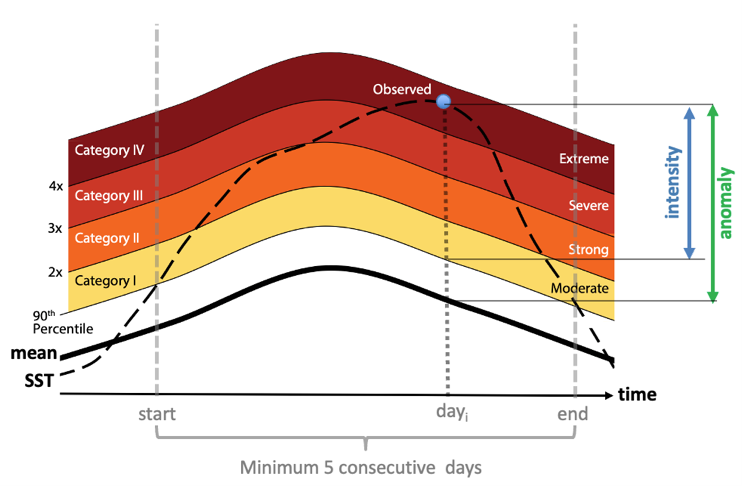
Figure adapted from Hobday et al. (2018)
The seasonally-varying threshold is defined on a daily basis according to a sufficiently long climatic period (in this case 1993-2016). So, for a given place and a given day, knowing all the surface temperatures observed over the last 30 years, a heatwave situation is defined as one where the temperature measured is within 10% of the maximum values observed (i.e. above the 90th quantile, see diagram), for at least 5 consecutive days.
The main characteristics of heatwaves are their duration and intensity. The intensity for a given day corresponds to the value in degrees above the 90th quantile (blue arrow), which can either be calculated as the cumulative intensity throughout the heatwave event, or the maximum intensity.
Heatwaves are categorised on the basis of their deviation from the mean temperature or anomaly (green arrow): a deviation of more than 2 times the difference between the 90th quantile and the mean corresponds to a heatwave in the strong category; a deviation of more than 3 times corresponds to a heatwave in the severe category; and a deviation of more than 4 times corresponds to a heatwave in the extreme category.
Analysis of datasets: SST OSTIA (Copernicus Marine Service), OISST (NOAA), GLO12 (Copernicus Marine Service / Mercator Ocean International), PSY4 (Copernicus Marine Service / Mercator Ocean International), and GLO12 et PSY4 forecasts.
IPCC AR6 SYR chapter 4.3 https://www.ipcc.ch/report/ar6/syr/downloads/report/IPCC_AR6_SYR_LongerReport.pdf