
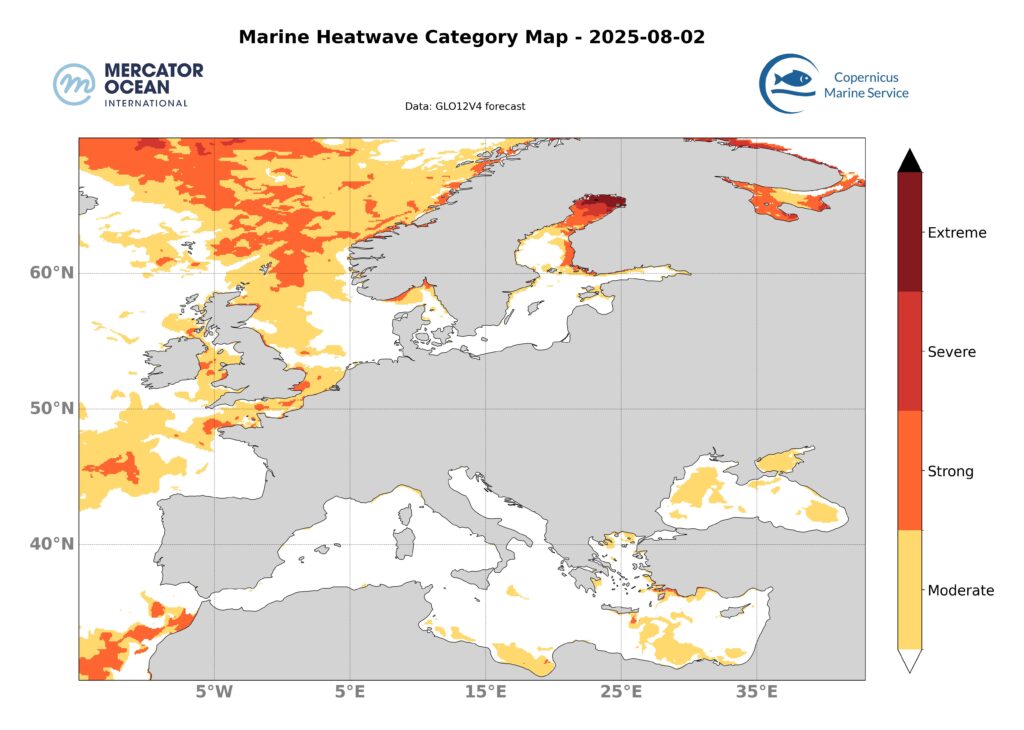
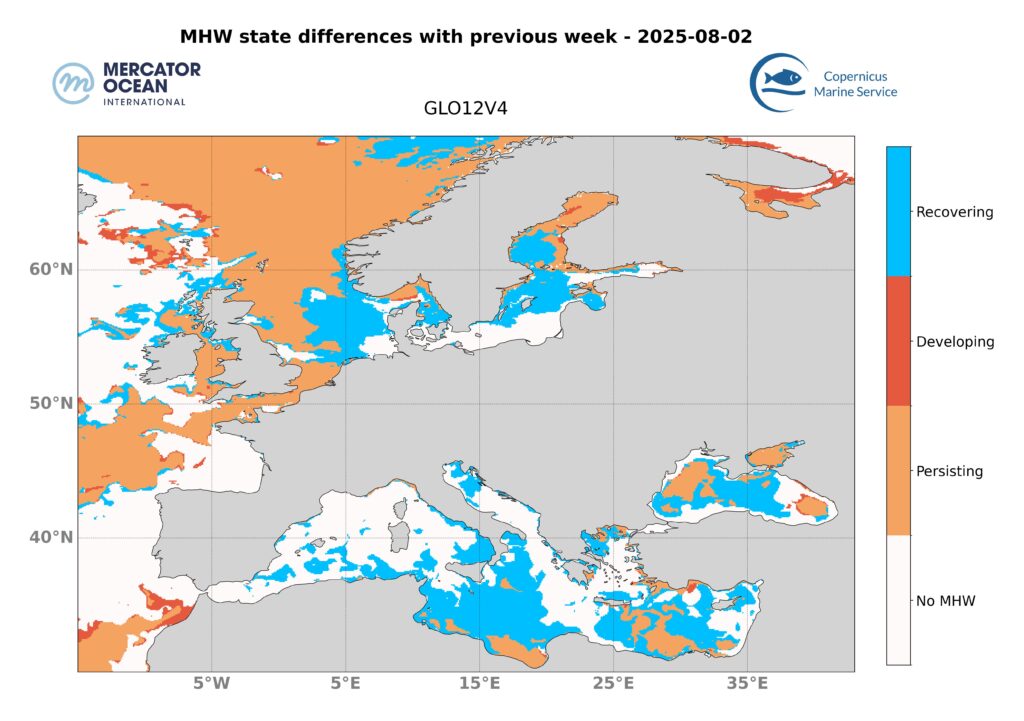
The western basin is no longer impacted by a marine heatwave. The majority of the eastern basin is also free from marine heatwave, except some areas in moderate categories.
In North Sea and in the Norwegian Sea, the extent and the intensity of the marine heatwave is decreasing. These areas are still in marine heatwave conditions of moderate to strong categories.
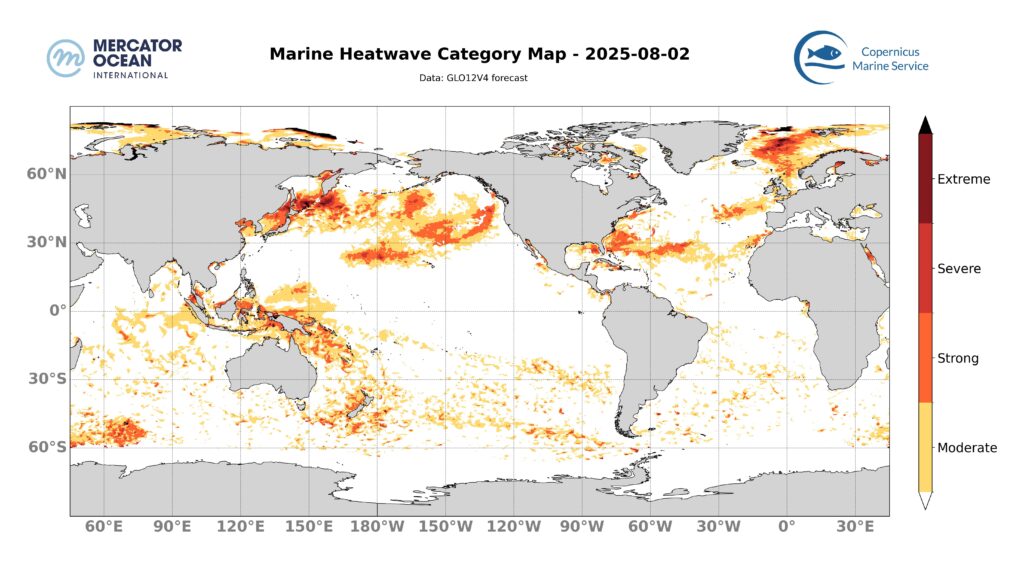
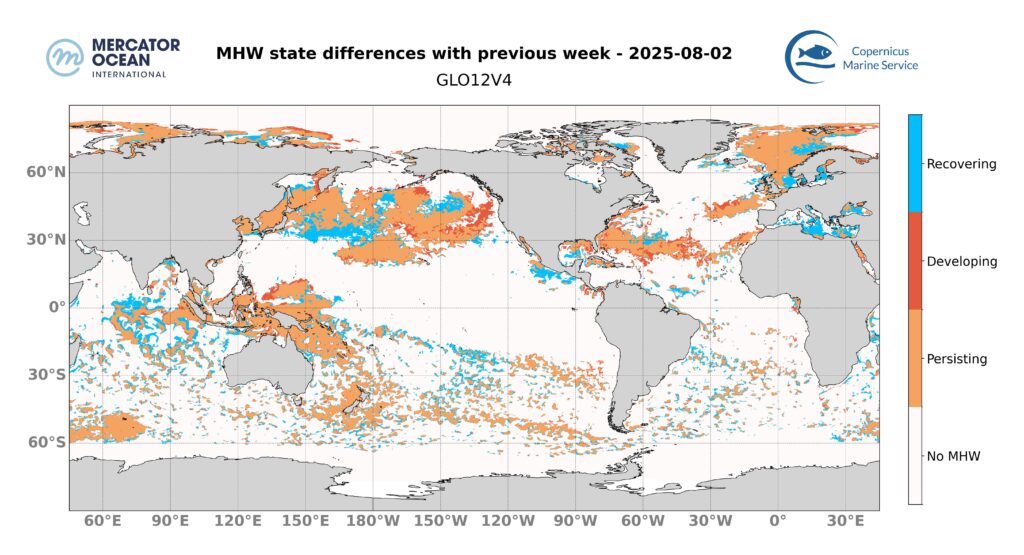
A marine heatwave of moderate to strong categories is developing off the European coasts between 10°W and 30°W. The area around the Tropic of Cancer is impacted by a marine heatwave of mainly moderate category in the east of the basin, and mainly in strong category in the west of the basin.
The extent and the intensity of the marine heatwave in the centre of the basin at around 30°N is increasing in the east as well as in the west of the basin, with moderate to strong categories, and locally severe to extreme in the west. The marine heatwave in the Sea of Japan and the Sea of Okhotsk is increasing in intensity, and is now mainly in strong to severe and locally extreme categories.
The marine heatwave around the island of New Guinea is stable in intensity, with moderate to strong categories, but its extent increases and now impacts the seas of Indonesia.
The marine heatwave in the central basin is decreasing in area and in intensity, and is now in mainly in moderate category. The Bay of Bengal, which was impacted by a marine heatwave of moderate to severe category in the north, is no longer in marine heatwave conditions.

Mean sea surface temperature for the week 26 July – 2 August 2025
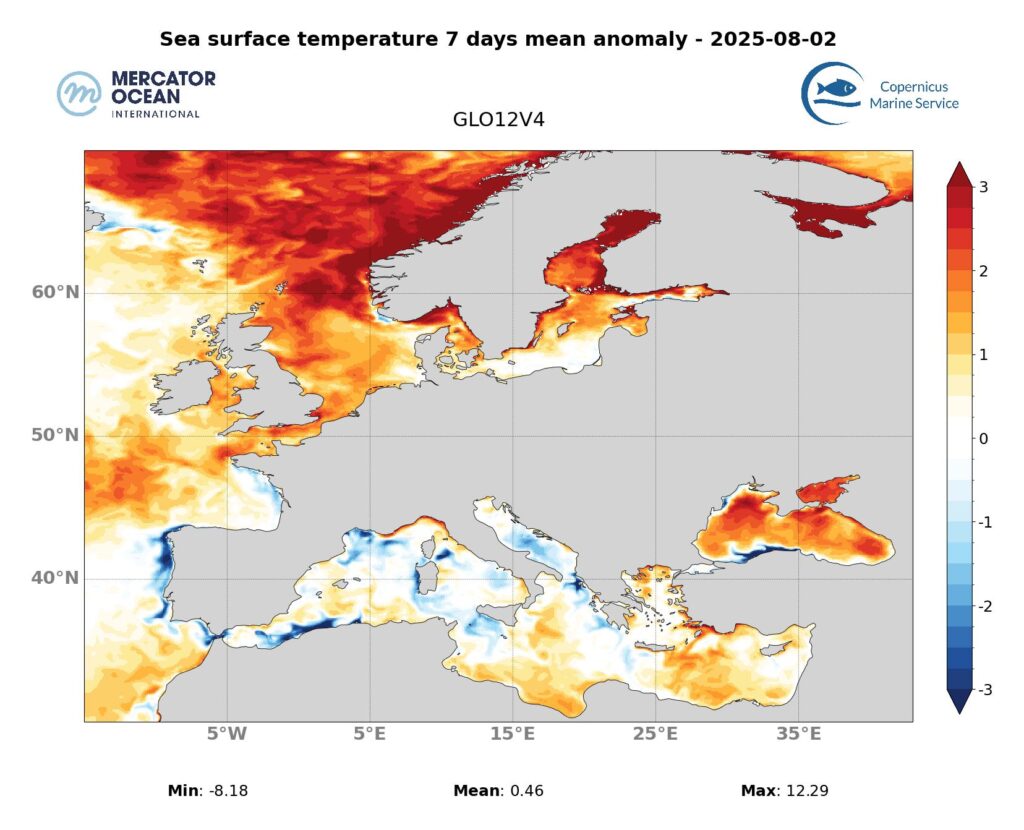
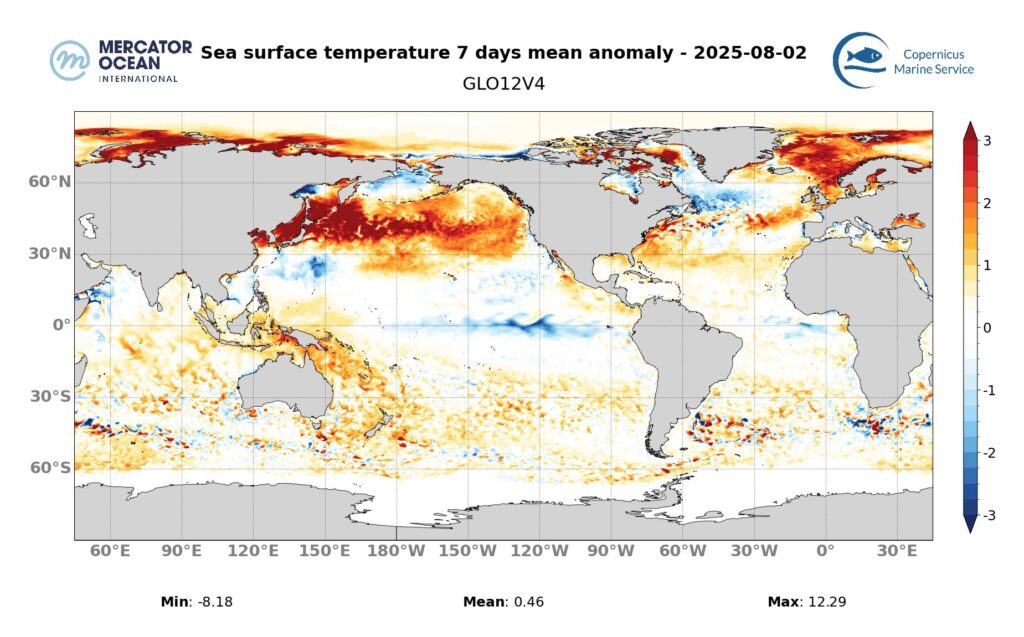
| Mediterranean Sea | -1°C à 1.5°C |
| North Atlantic | -2°C à >3°C |
| North Pacific | –1.5°C à >3°C |
| Tropical Pacific | –2.5°C à 2.5°C |
| Indien Ocean | -3°C < à 2.5°C |