Ocean Temperature Bulletin Mediterranean Sea highlights 2025
Mercator Ocean International (MOi) oceanographers examine marine heatwaves across the global ocean. They analyse a variety of datasets from observation analyses (satellite sea surface temperature maps) to model analyses (assimilating satellite and in situ observations) and model forecasts.¹
Mercator Ocean International (MOi) publishes an annual surface temperature bulletin reporting on mean temperature and Marine HeatWave (MHW) conditionsfor the year 2025. This bulletin focuses on the global ocean (between 60°S and 60°N) and 2 regions: the Mediterranean Sea and the North Atlantic (between 0°N and 60°N).
2025 was the 2nd warmest year ever recorded for the Mediterranean Sea, with a mean Sea Surface Temperature (SST) of 21.21 ± 0.07°C, surpassed only by 2024 record of 21.32 ± 0.14°C.
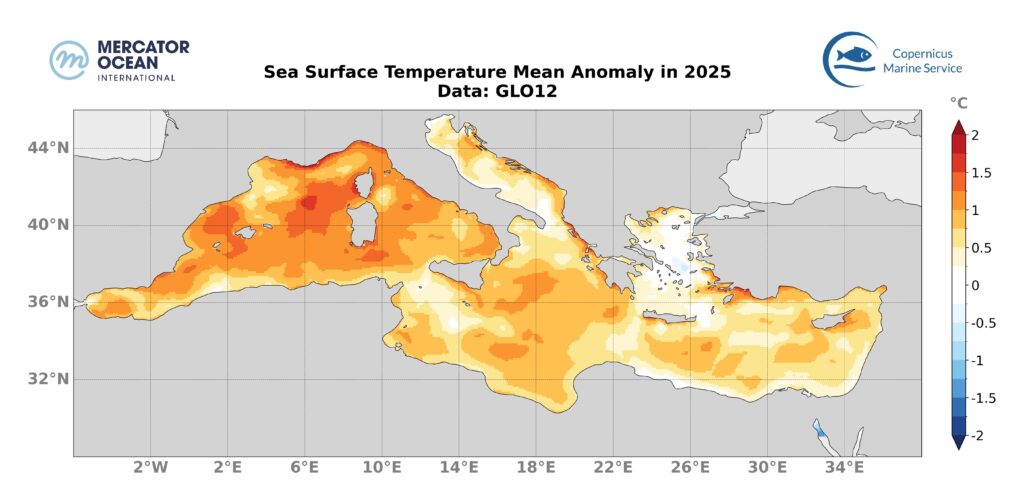
2025 mean SSTs are above average almost the entire of the Mediterranean Sea (98%), with a fourth of the basin exceeding the average by at least 1°C (figure 2). The highest values are reached in the western part.
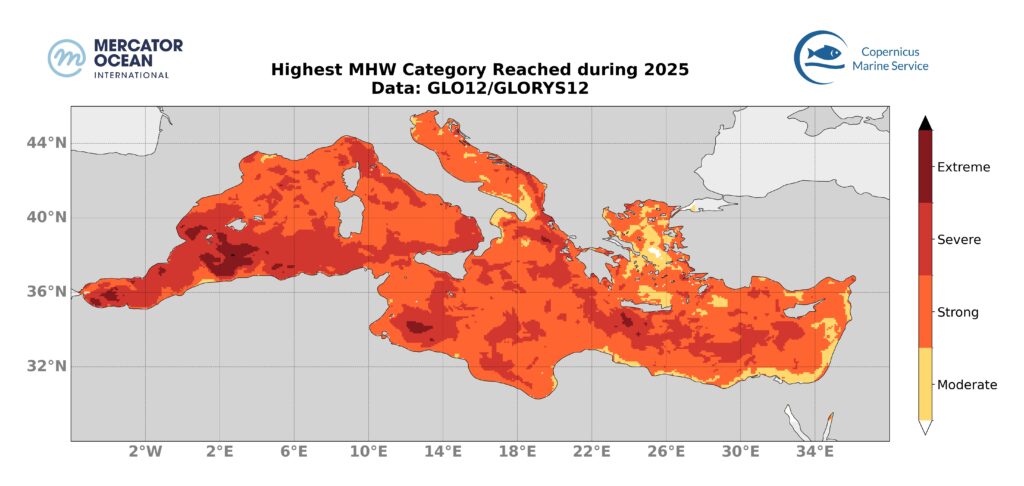
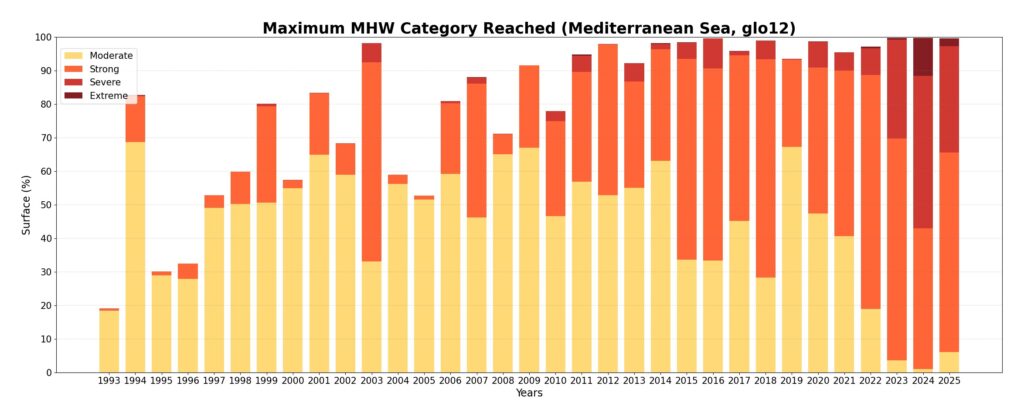
2025 is the third consecutive year where the entire Mediterranean Sea was, at one point during the year, affected by a MHW.
93% of the Mediterranean Sea was affected by intense marine heatwaves of strong, severe and extreme categories – the 3rd widest extent after 2023 (96%) and 2024 (99%).
sea Surface Temperature
2025 Mean SST Anomaly relative to a 30-year climatology (1993-2022), calculated using daily data from Mercator Ocean International’s GLO12 analysis for 2025 and from GLORYS12 reanalysis for the climatological mean.
2025 was the 2nd warmest year ever recorded for the Mediterranean Sea, with a mean Sea Surface Temperature (SST) of 21.21 ± 0.07°C, surpassed only by 2024 record of 21.32 ± 0.14°C.
2025 mean SSTs are above average almost the entireof the Mediterranean Sea (98%), with a fourth of the basin exceeding the average by at least 1°C (figure 2). The highest values are reached in the western part.
Ranking 2025 mean sea surface temperature
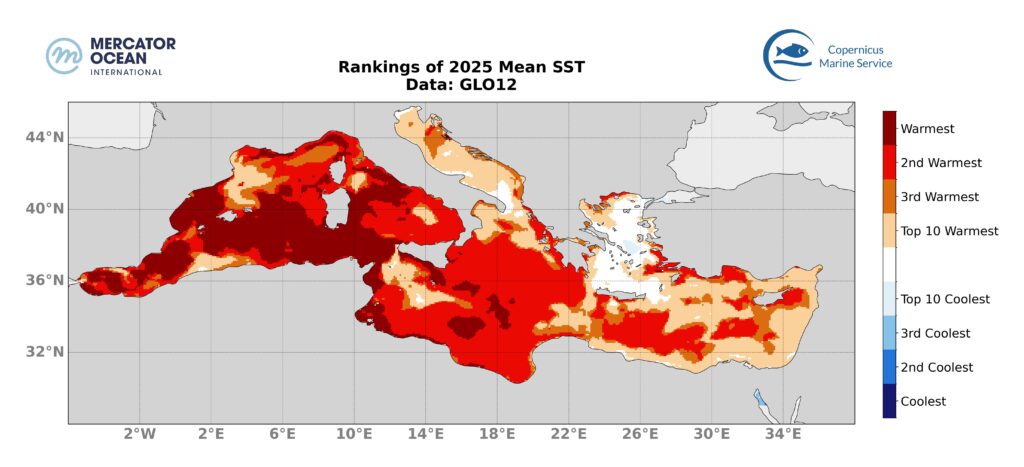
Rankings of 2025 mean SST since 1993 using daily data from Mercator Ocean International’s GLO12 analysis from 2021 to 2025 and from GLORYS12 reanalysis from 1993 to 2020. Blank areas mean that 2025 mean SST doesn’t rank in the 10 warmest or 10 coolest mean SST since 1993.
In 2025, more than 20% of the Mediterranean Sea experienced its warmest year since 1993 (Figure 3). The western part is the most impacted. More generally, 2025 was amongst the warmest 10 years for 93% of the Mediterranean Sea. In contrast, less than 0.7% of the basin ranked among the 10 coldest years.
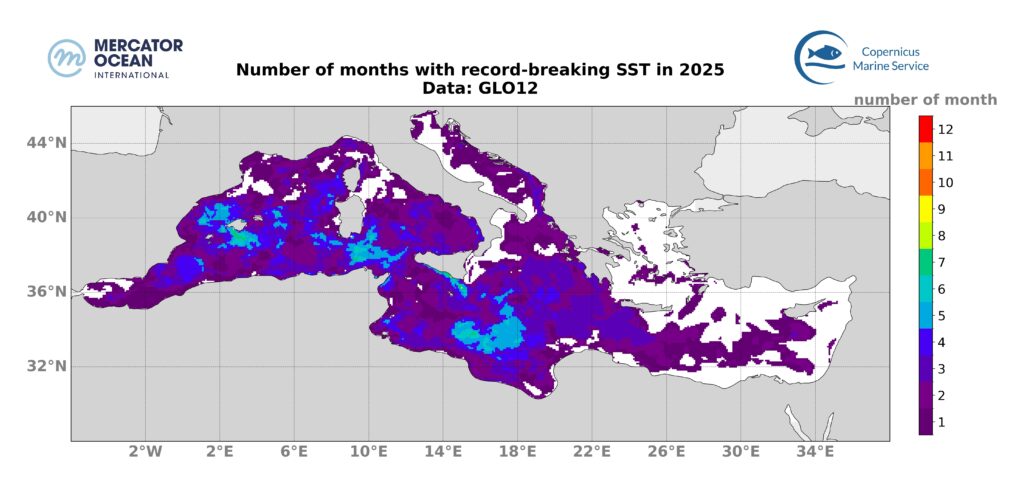
Number of months with record-breaking mean SST in 2025. Blank areas mean that no month ranked as the warmest since 1993. Regions in dark blue correspond to areas where SST records were broken for 4 months between January and December 2025.
76% of the Mediterranean Sea experienced at least one month with a record-breaking mean SST, and almost a third of the basin (31%) experienced at least 3 months of record-breaking mean SST
Ongoing Marine Heatwaves
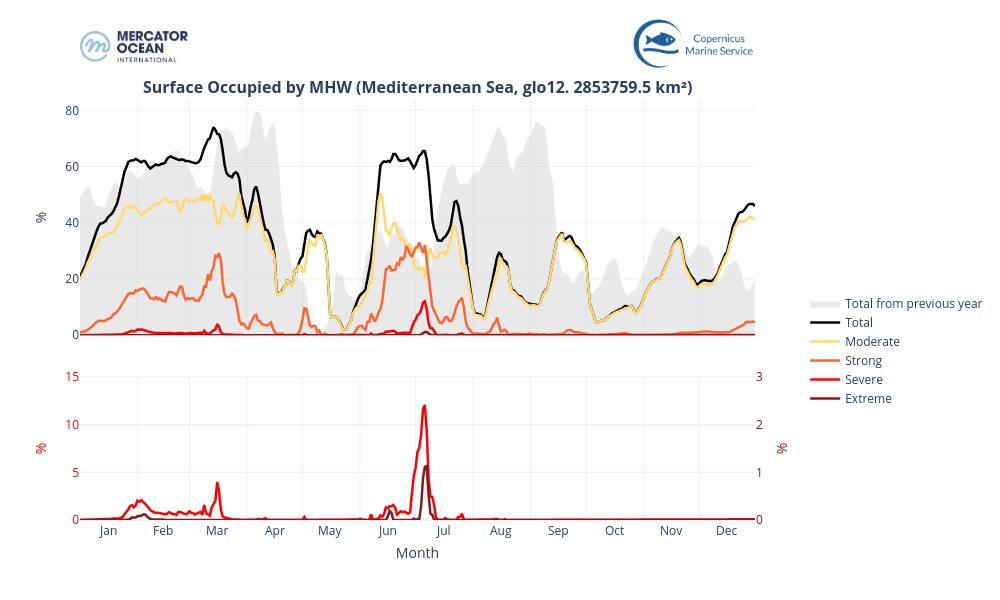
Marine heatwaves (MHWs) are abnormally warm events for which extreme temperatures are observed for at least 5 consecutive days; their occurrence and severity is monitored as MHWs – when prolonged or intense – can have negative impact on the environment and ecosystems. MHW can be classified based on their intensity into 4 categories (moderate, strong, severe, or extreme). We monitor daily the surface occupied by MHWs and show for the entire year the proportion of the Mediterranean Seaexposed to MHWs. The results from 2025 are represented in solid lines. For comparison with the previous year, results from 2025 are represented in shaded area.
Total Surface Marine Heatwaves
Surface occupied by MHWs in the Mediterranean Sea in 2025 based on daily monitoring. The black solid line represents the total surface of MHW, while the colored lines represent the surface of each MHW category for the year 2025. The gray shaded area refers to the total MHW surface from 2024.
During 2025, MHW extent in the Mediterranean Sea fluctuated strongly, affecting daily between 2% and 74% of the basin.
The year started with an important increase of the total MHW extent (black line) to ~60%, reaching up to 74% mid-March. The extent then decreased during the month of April and May. The month of June, a record-breaking month for the Mediterranean Sea (see press release), was marked with another very intense and rapid increase, from 2% to 62% of the basin in only 20 days. This was followed by the year’s highest extent of strong, severe, and extreme categories (up to 33%, 12%, and 1%, respectively) in early July. During the second half of the year, the total extent varied between 5% and 40%, with mainly moderate categories, to reach 46% by the end of the month.
Highest Marine Heatwave categories reached in 2025
Highest MHW Category reached in 2025. Blank areas mean that no MHW occurred in these regions in the first semester of 2025.Evolution of the extent of the highest MHW category in the Mediterranean Sea. For each year, the length of the bar represents the percentage of the Mediterranean Sea impacted by MHW, while the colors indicate the proportion of the highest categories reached within that region. The horizontal dotted line represents the average surface of the region impacted by MHW between 1993 and 2025.
2025 is the third consecutive year where the entire Mediterranean Sea was at one point during the year affected by a MHW.
Focusing on strong or higher category MHW events, 93% of the Mediterranean Sea was affected by such MHWs, the 3rd widest extent after 2023 (96%) and 2024 (99%).
Total Number Marine Heatwaves
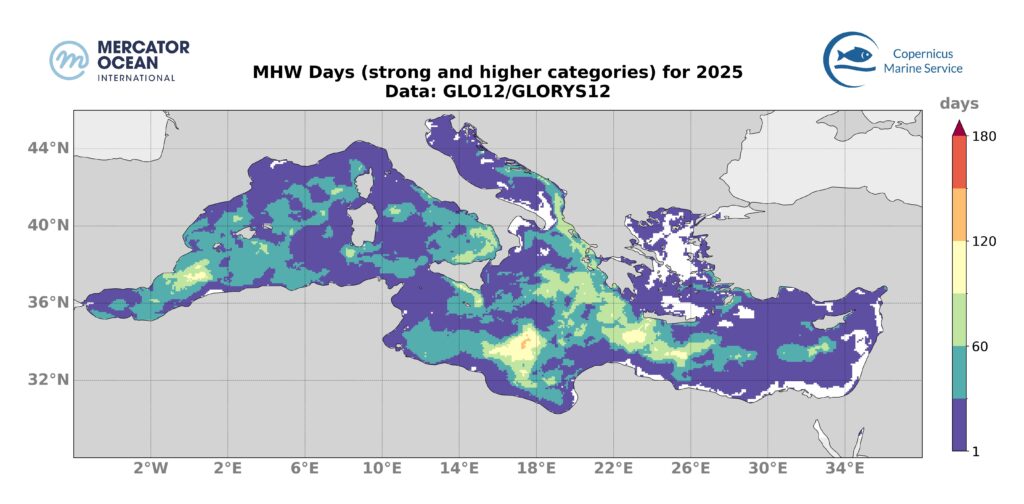
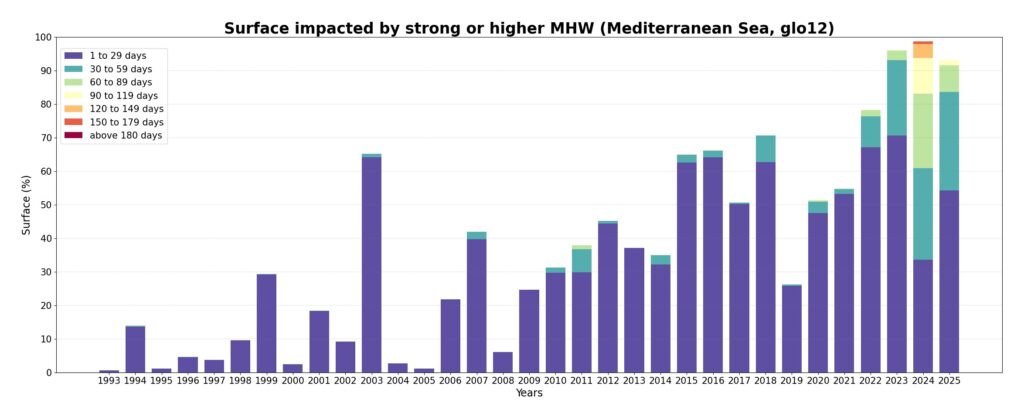
2025 MHW days of strong and higher category. Number of days during which a MHW of category strong, severe or extreme occurred in 2025. Blank areas mean that no MHW of strong or higher category happened in 2025.Year by year evolution of the surface impacted by strong and higher MHW. The size of the bar represents the proportion of the Mediterranean Sea exposed to a strong or higher MHW. The colours indicate the number of days impacted by such MHW.
In 2025, almost 40% of the Mediterranean Sea was exposed to intenseMHW conditions (i.e. strong or higher category) for more than 30 days (not necessarily consecutive days).
Statistics
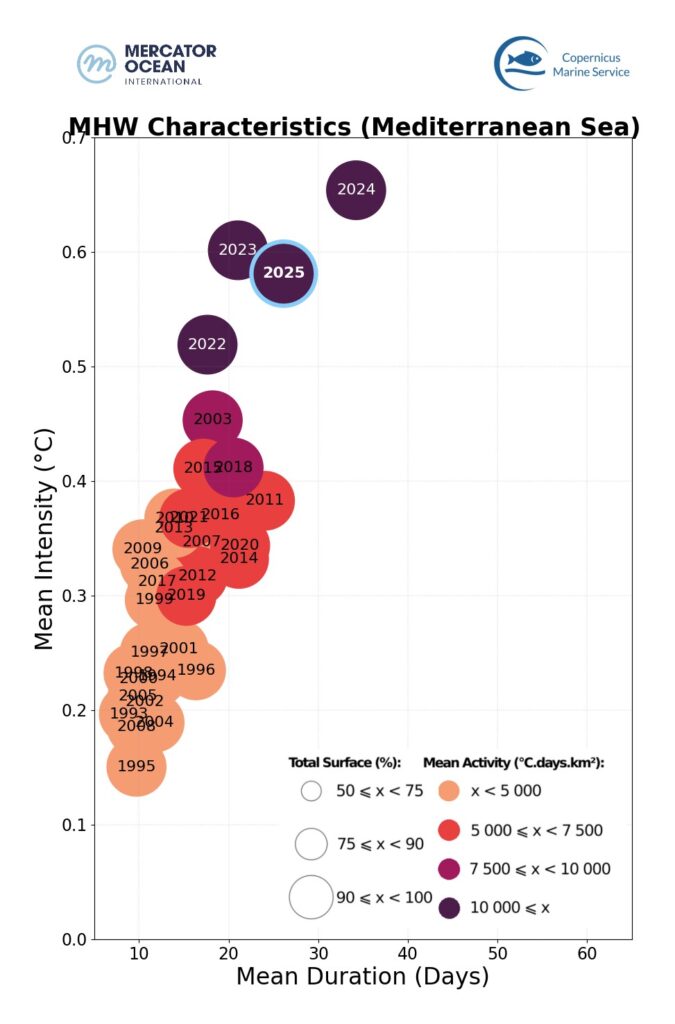
Annual MHW Characteristics from 1993 to 2025. Duration, intensity, extent, and activity averaged for each year between 1993 and 2025 for the Mediterranean Sea. 2025 is highlighted with a blue edge.
2025 was the 3rd most extreme semester in terms of MHWs intensity (after 2023 and 2024) and the second most extreme in terms of duration (after 2024).
About the Bulletin
Datasets
Sea Surface Temperature
The results are obtained using the Copernicus Marine Service global analysis and forecasting system together with observation-based products.
GLOBAL_ANALYSISFORECAST_PHY_001_024 Global Ocean Physics Analysis and Forecast sea surface temperature. U. Copernicus Marine Service Information (CMEMS). Marine Data Store (MDS). DOI: https://doi.org/10.48670/moi-00016
ESA SST CCI reprocessed sea surface temperature analyses. E.U. Copernicus Marine Service Information (CMEMS). Marine Data Store (MDS). DOI: https://doi.org/10.48670/moi-00169
NOAA OI SST V2 High Resolution Dataset data provided by the NOAA PSL, Boulder, Colorado, USA, from their website at https://psl.noaa.gov, Huang, B., C. Liu, V. Banzon, E. Freeman, G. Graham, B. Hankins, T. Smith, and H.-M. Zhang, 2021: Improvements of the Daily Optimum Interpolation Sea Surface Temperature (DOISST) Version 2.1, Journal of Climate, 34, 2923-2939. doi: 10.1175/JCLI-D-20-0166.1
Global Ocean OSTIA Sea Surface Temperature and Sea Ice Analysis. E.U. Copernicus Marine Service Information (CMEMS). Marine Data Store (MDS). DOI: https://doi.org/10.48670/moi-00165
ODYSSEA Global Sea Surface Temperature Gridded Level 4 Daily Multi-Sensor Observations. E.U. Copernicus Marine Service Information (CMEMS). Marine Data Store (MDS). DOI: https://doi.org/10.48670/moi-00016
Notes: The global analysis system was used to study the ocean surface temperature from 2021 and 2025. To study surface temperature for previous years (1991 to 2020), it was used the ESA CCI data. The other observation-based sea surface temperature products (OSTIA, OI SST and Odyssea) were used for calculating monthly mean and uncertainty values for March 2025.
Marine Heatwaves
The results are obtained using the Copernicus Marine Service global systems including the analysis and forecasting system together with the reanalysis product.
GLOBAL_ANALYSISFORECAST_PHY_001_024 Global Ocean Physics Analysis and Forecast sea surface temperature. U. Copernicus Marine Service Information (CMEMS). Marine Data Store (MDS). DOI: https://doi.org/10.48670/moi-00016
GLOBAL_MULTIYEAR_PHY_001_030 Global Ocean Physics Reanalysis sea surface temperature. E.U. Copernicus Marine Service Information (CMEMS). Marine Data Store (MDS). DOI: https://doi.org/10.48670/moi-00021
Notes: The global analysis system was used to study MHWs for 2024 and 2025. To study MHWs for previous March (1993 to 2023), it was used the reanalysis system. The reanalysis product was used for generating a daily climatology using the 30-year period from 1993 to 2022.