

Greece signs Convention establishing Mercator International Centre for the Ocean, advancing creation of new intergovernmental organization
Greece becomes third signatory, moving closer to entry into force of world’s first intergovernmental organization dedicated to operational digital ocean systems and information services.
Toulouse, Athens, 27 April 2026 – Greece has signed the Convention to establish the Mercator International Centre for the Ocean during the official visit of the President of the French Republic, Emmanuel Macron, to Athens.
With this signature, Greece becomes the third signatory of the Convention, after France and Norway, and confirms its commitment to the establishment of a new intergovernmental framework for trusted ocean information services supporting climate resilience, maritime safety and sustainable ocean management.
This step follows Greece’s endorsement of the Lympia Declaration at the United Nations Ocean Conference, where 12 countries expressed support for strengthened international cooperation on ocean knowledge, digital innovation and science-based decision-making.
A new intergovernmental organization for digital ocean systems
The Mercator International Centre for the Ocean is being established to deliver advanced environmental and climate services through state‑of‑the‑art numerical modelling, digital twins and AI.
This evolution will transform today’s Mercator Ocean International – currently operating key European services on behalf of the European Commission – into an organization governed by its Member States, where strategic direction, service development and scientific priorities are defined collectively at intergovernmental level.
The Centre will provide ocean intelligence services supporting climate adaptation, marine and coastal risk management, environmental protection, sustainable blue economy development, and evidence-based policymaking. It will also ensure continuity of major European capabilities, including the Copernicus Marine Service, while contributing to international initiatives such as the UN Ocean Decade and global ocean prediction efforts.
Strengthening digital ocean governance in Europe
Operational oceanography is now an essential service that allows governments to understand and manage the ocean and its resources. By combining satellite observations, in situ measurements, and advanced modelling, digital ocean systems deliver continuous, high-resolution information on ocean conditions as well as the ability to forecast future conditions.
These capabilities are increasingly used for climate adaptation, maritime safety, environmental monitoring and the sustainable management of marine resources. With the development of AI-enabled modelling and the European Digital Twin of the Ocean, ocean information is becoming more accessible and directly usable for decision-making across multiple maritime sectors. The creation of the Mercator International Centre for the Ocean will help consolidate Europe’s leadership in this field, in line with broader European ambitions for digital sovereignty, scientific excellence, and resilient maritime infrastructure.
Greece’s contribution to the emerging intergovernmental framework
As a major maritime nation, Greece brings strong expertise in ocean science and coastal resilience, combined with growing capabilities in artificial intelligence and high-performance computing.
As a founding Member State, Greece will contribute to shaping the strategic priorities of the future organization, which will support Greek marine stakeholders including research centres, maritime industries and start-ups, port authorities the coast guard and government agencies, through applications such as maritime routing and safety, aquaculture monitoring, coastal risk assessment, environmental surveillance and enhanced maritime security.
Statements
Emmanuel Macron, President of the Republic: “Going well beyond defence, this partnership is taking on a new dimension by strengthening cooperation between our diplomatic services, in the field of the environment, with Greece’s decision, which I warmly welcome, to join the Mercator international organization for digital ocean systems and information services.”
Dimitris Papastergiou, Minister of Digital Governance and Artificial Intelligence of Greece, said: “Greece intends to play a substantive role within Mercator International Centre for the Ocean and in the development of the Digital Twin of the Ocean, building on key national capabilities such as the PHAROS AI Factory, the Daedalos supercomputer and our national microsatellite programme. This ambition is supported by Greece’s leading position in global maritime transport and its strategic role in the Eastern Mediterranean. It reflects our strong commitment to data governance, scientific excellence and the delivery of high-quality digital services, fully aligned with Mercator’s mission.”
Pierre Bahurel, Director General, Mercator Ocean International, reflected: “We warmly welcome Greece’s signature of the Convention and thank Minister Dimitris Papastergiou for his strong commitment. Greece will be a major asset to the Mercator International Centre for the Ocean, and this signing marks a decisive step towards the entry into force of the organization. As a founding Member State, Greece will play a leading role in shaping its priorities, and advancing science-based ocean governance, supported by trusted digital ocean services.”
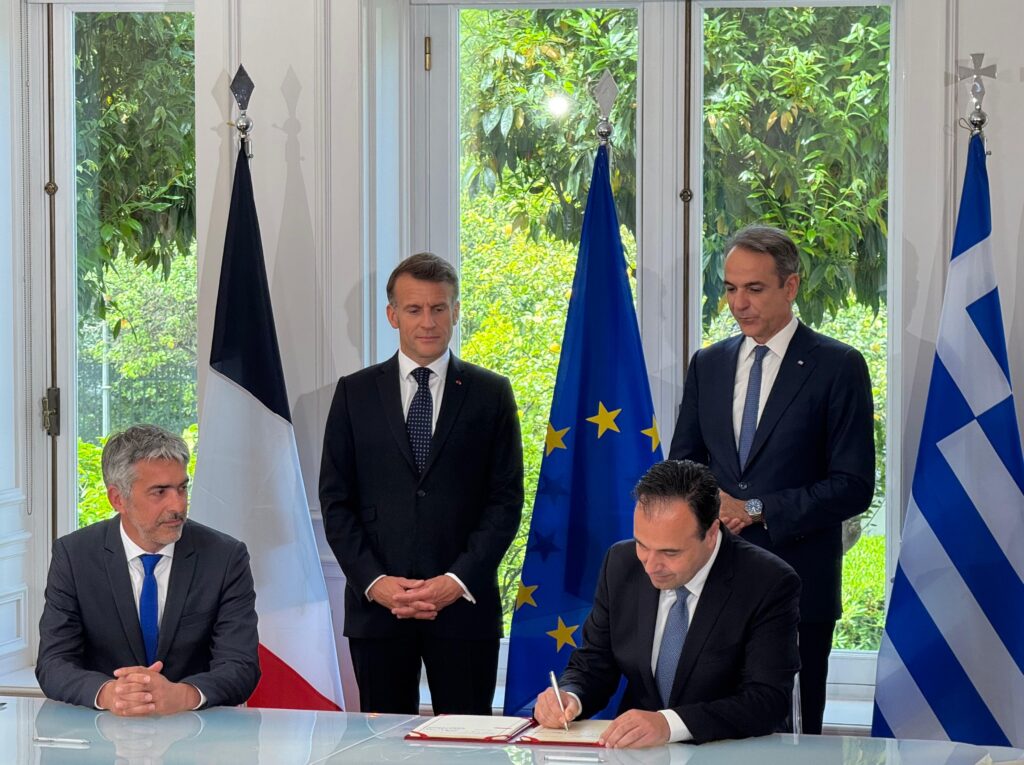
From left to right: Pierre Bahurel, Director General of Mercator Ocean, Emmanuel Macron, President of the French Republic, Dimitris Papastergiou, Minister of Digital Governance and Artificial Intelligence of Greece, and Kyriákos Mitsotákis, Prime Minister of Greece.