

Toulouse, France, 27 April – Early estimates by the Copernicus Marine Service indicate that April 2026 is likely to become the second-warmest April on record for the global ocean, with average sea surface temperatures of 21.07°C—following closely the April 2024 record (21.10°C). These estimates are based on the analysis and 10-day forecast system from the European Union’s Copernicus Marine Service, implemented by Mercator Ocean International.
April 2026 saw a rapid increase in ocean temperatures globally, with daily forecasts suggesting that sea surface temperatures are approaching the record levels observed at this time of the year in 2024.
“Following March, we are once again seeing a very warm April with surface temperatures approaching levels similar to the records observed in 2024 : above average temperatures in the Pacific, particularly in the equatorial band, a region which we will be monitoring closely in the coming weeks”, said Simon van Gennip, oceanographer leading the Ocean Monitoring Service at Mercator Ocean International.
Near-record sea surface temperatures in April 2026
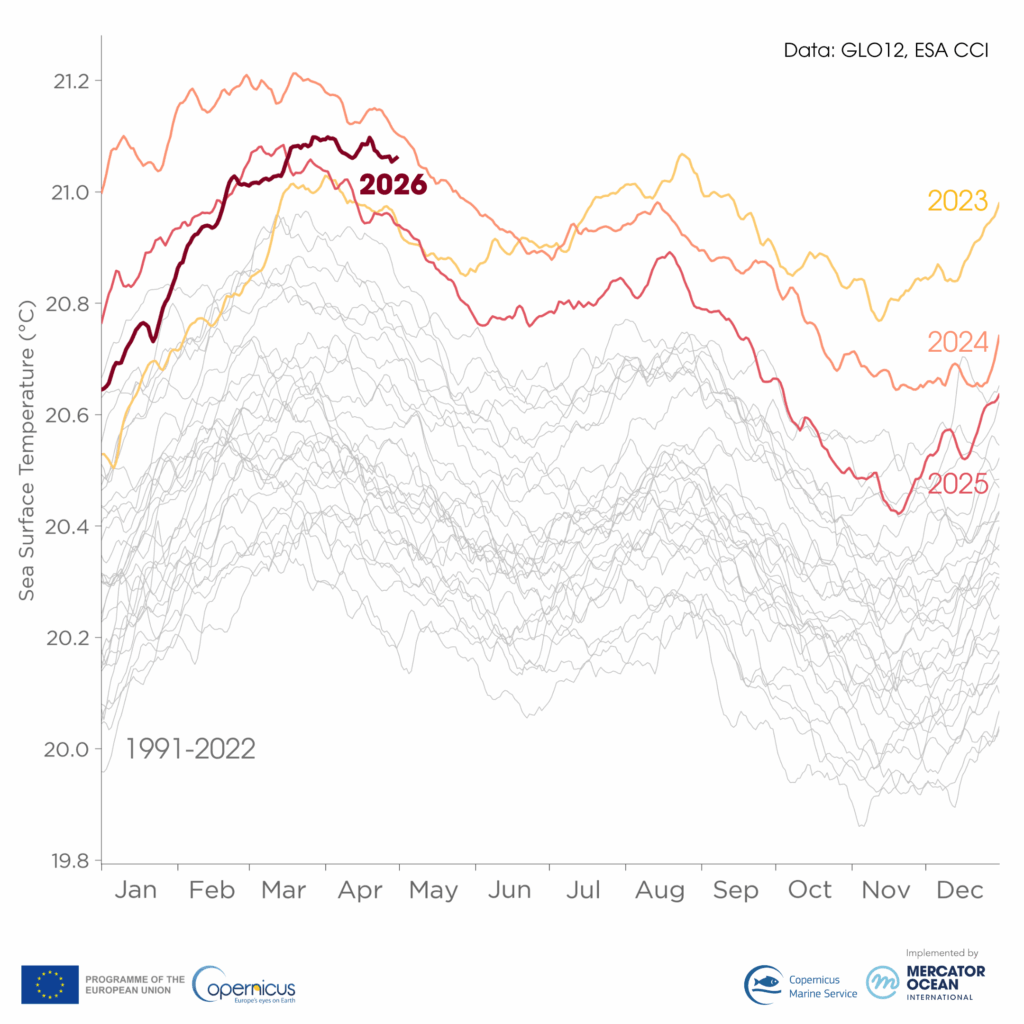
Daily sea surface temperatures averaged for the global ocean. Data: ESA Climate Change Initiative (1991-2020); Global Ocean Physics Analysis and Forecast (GLO12) (2021-2026). Credit: European Union, Copernicus Marine Service/ © Mercator Ocean
April 2026: the warmest April in the equatorial Pacific
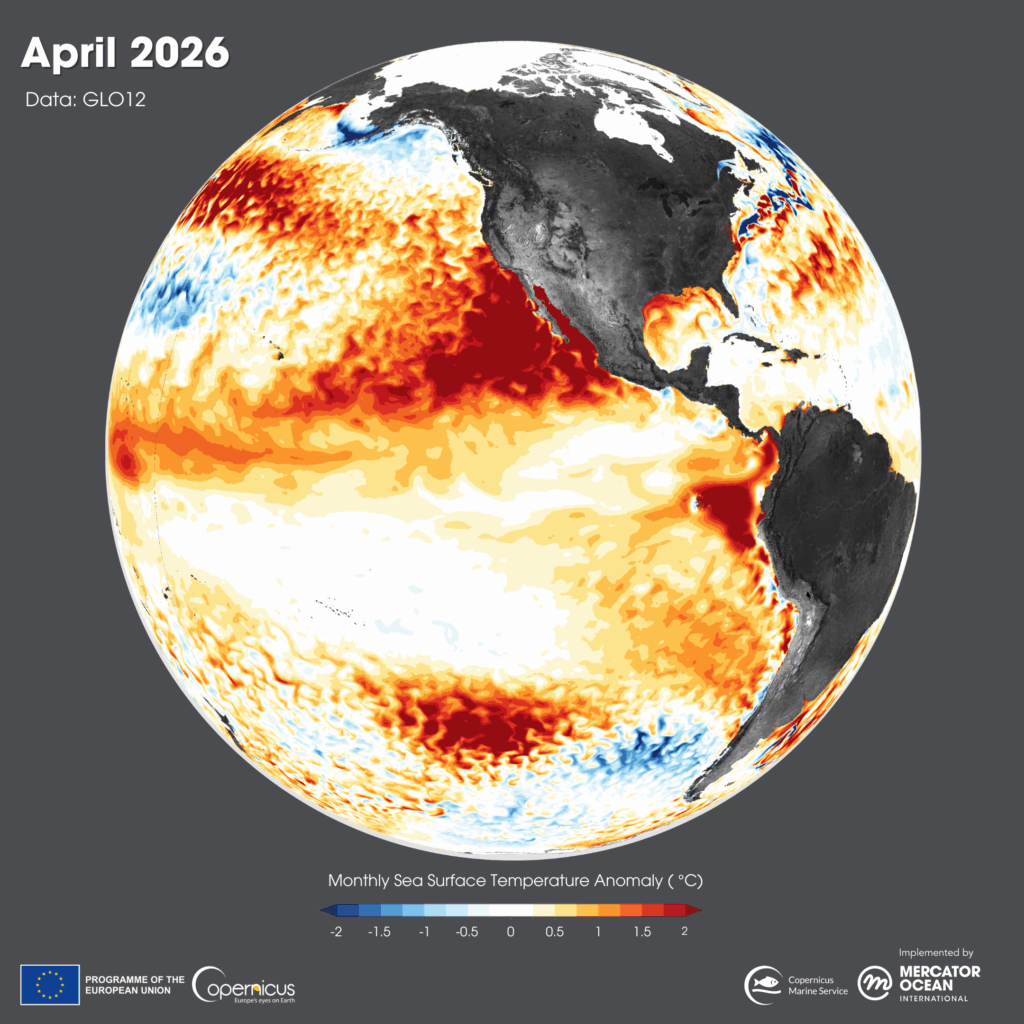
Average sea surface temperature anomalies in the eastern and equatorial Pacific for April 2026. Data: Global Ocean Physics Analysis and Forecast (GLO12). Credit: European Union, Copernicus Marine Service/ © Mercator Ocean
In the equatorial Pacific (30°S–30°N), which is the core region of El Niño–Southern Oscillation (ENSO) dynamics, surface waters that began warming in January have continued to warm through April. There are no longer cooler-than-average areas in the central Pacific, indicating that ENSO conditions are currently neutral.
Seasonal predictions produced by several climate centres, including the Copernicus Climate Change Service (C3S), forecast a transition to El Niño conditions for the second half of the year.
Key numbers for April 2026
(these numbers remain strong estimates and will be updated with the monthly analysis once the month concludes)
Global Ocean
- 2nd warmest April on record with an average SST of 21.07°C (after April 2024: 21.10 ± 0.07 °C).
- 46% of the global ocean was impacted by marine heatwaves (MHW), the 3rd widest extent after 2016 (48%) and 2024 (53%)
Pacific Ocean
- Widespread record sea surface temperatures in the northeast upwelling region (off the coast of North America), in the northwest region and in the Southeastern region, on the west coast of South America.
- Large persistent marine heatwaves of strong or higher category present across April in the western part of the equatorial Pacific and in the eastern North Pacific
Equatorial Pacific (30°S-30°N)
- Average SST hit 26.99°C — the warmest April on record (above 2017: 26.86°C).
- 57% of the region was impacted by MHW, the widest extent, surpassing 2024 (56%).
Europe
- In the Mediterranean Sea, the average SST was 17.16°C - the 4th warmest April (after 2025, 2016 and 2023).
- Nearly the entire basin has experienced above-average sea surface temperatures (89%)
- In the North Atlantic region, the average SST was 20.61°C - 9th warmest April on record
About the Copernicus Marine Service – The Copernicus Marine Service is one of the six services of Copernicus, the European Union’s Earth Observation Programme. The service operates ocean analysis and forecasting and is funded by the European Union. The Copernicus Marine Service delivers regular and systematic reference information on the Blue (physical), White (sea ice) and Green (biogeochemical and biological) ocean at both global and European scales. Its data and products support key EU and international policies, contributing to efforts in pollution reduction, marine protection, maritime safety and routing, sustainable resource management, marine renewable energy, blue growth, climate monitoring, and weather forecasting. The service also seeks to raise public awareness by providing citizens in Europe and worldwide with accessible information on ocean issues.
About Mercator Ocean International – Mercator Ocean International is one of the world’s leading ocean prediction centres and a key pillar of Europe’s digital ocean infrastructure. It is the entrusted entity of the European Commission for the Copernicus Marine Service, delivering free, open-access ocean data and forecasts as a public service to governments, authorities, scientists, and strategic users worldwide. Mercator Ocean also leads the development of the European Digital Twin Ocean, a flagship European initiative developed with partners under the leadership of the European Commission to support scenario-based ocean decision-making. In 2025, Mercator Ocean took a major step toward becoming an international organization, with twelve European countries endorsing the international convention establishing the Mercator International Centre for the Ocean.