



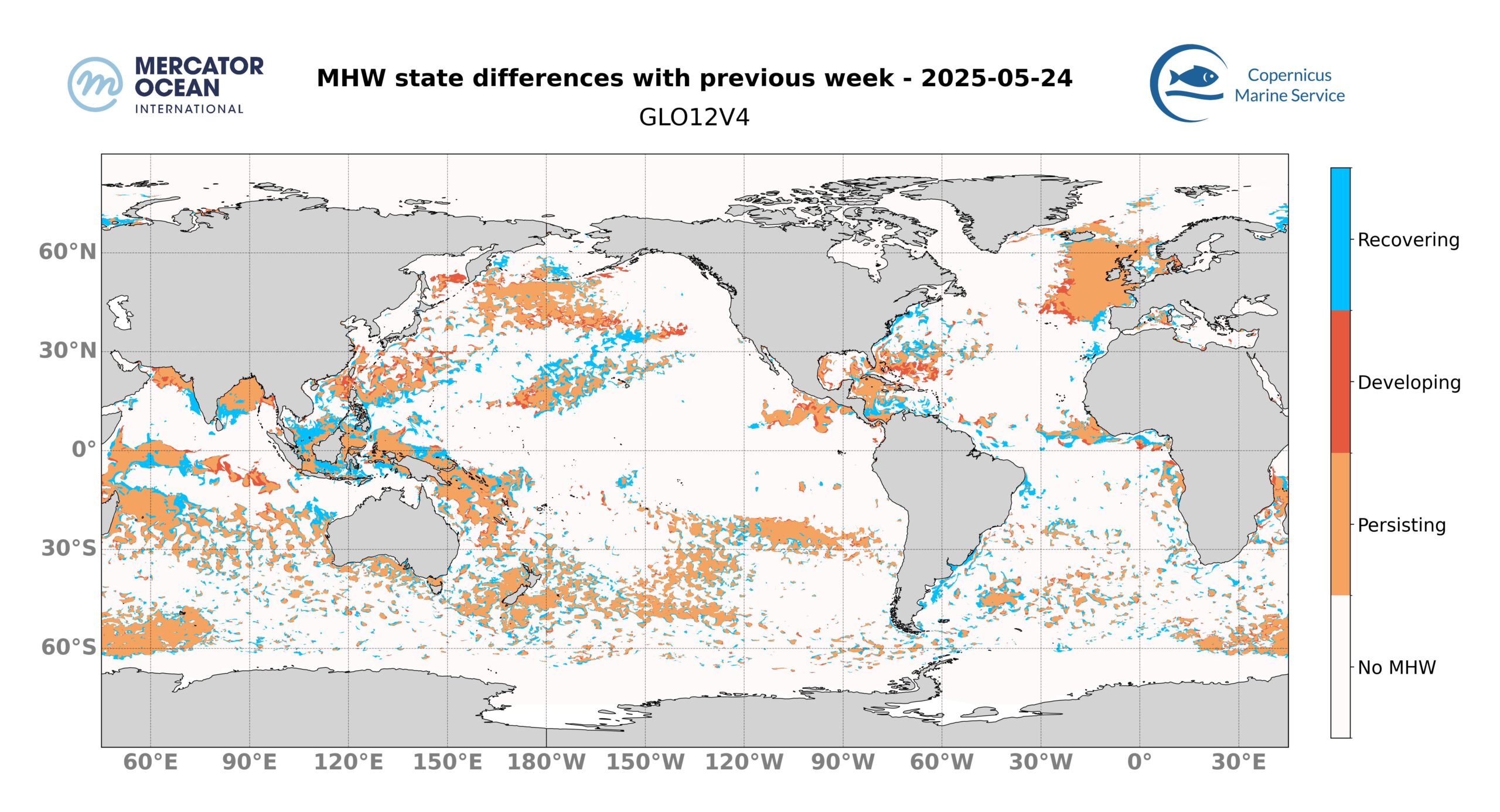
The marine heatwave bulletin provides forecasts and analysis of marine heatwave events across the globe and throughout the year. Used datasets include observations (satellite sea surface temperature maps) and numerical model analyses (assimilating satellite and in situ observations) to derive marine heatwave forecasts for a 10-day period. This week’s forecasts were produced using as a comparison the marine heatwave situation on 13/05/2025.
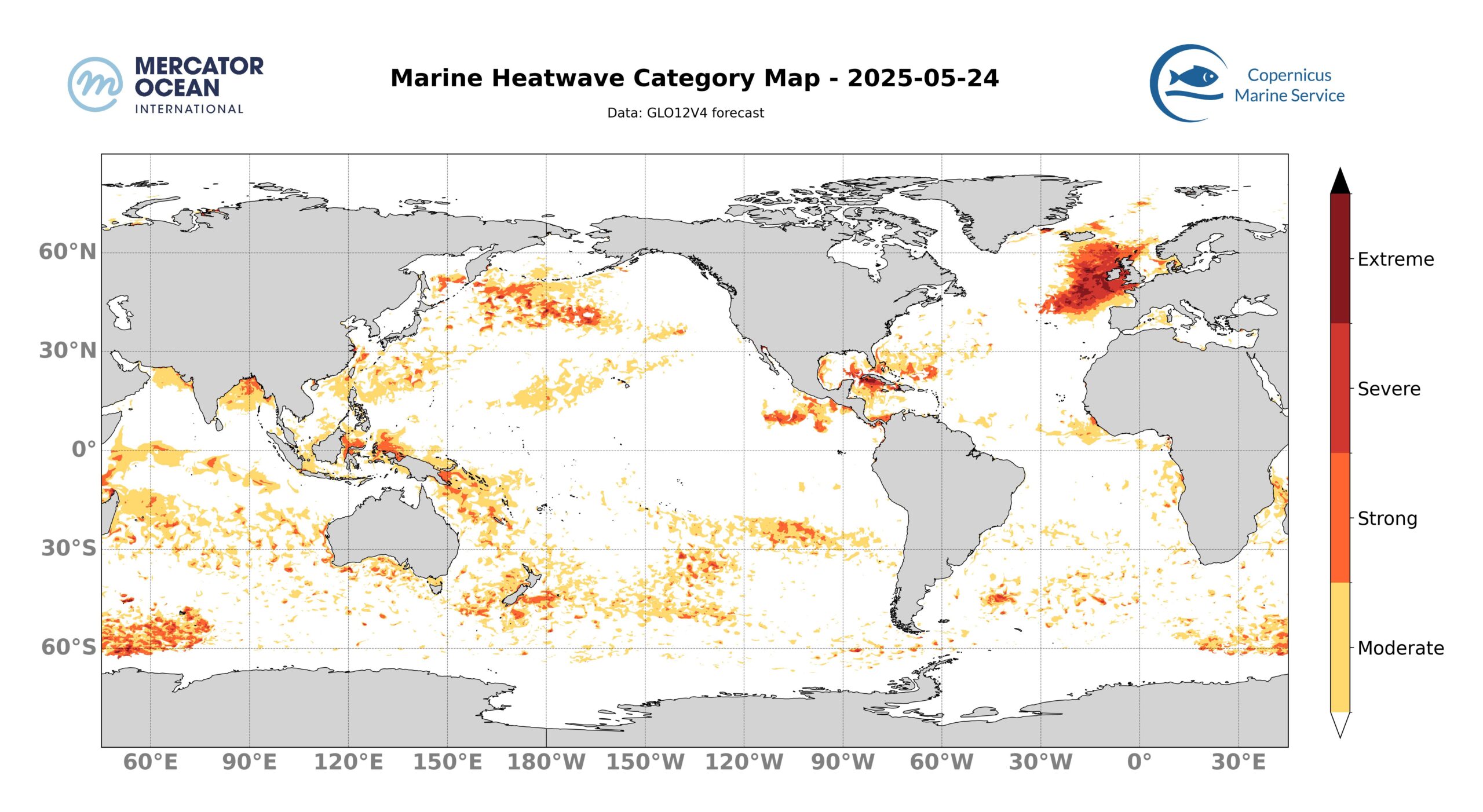
Forecasts for 24 May
Tropical Atlantic
Around the equator, the extent of the few areas affected by marine heatwaves of moderate category is diminishing. Marine heatwaves are developing in the Caribbean Sea, in the moderate to strong and locally severe and extreme categories, as well as to the north of the Antilles, in the moderate and strong categories.
Tropical Pacific
To the west of the Tropical Pacific Ocean and in the seas of South-East Asia, the extent and intensity of marine heatwaves of moderate and strong categories are decreasing. Off the coast of Central America, a marine heatwave of moderate to strong categories is developing.
Indian Ocean
The marine heatwave in the Bay of Bengal is decreasing in both area and intensity, moving from mainly strong categories to moderate ones.
European Zone
North Atlantic Ocean
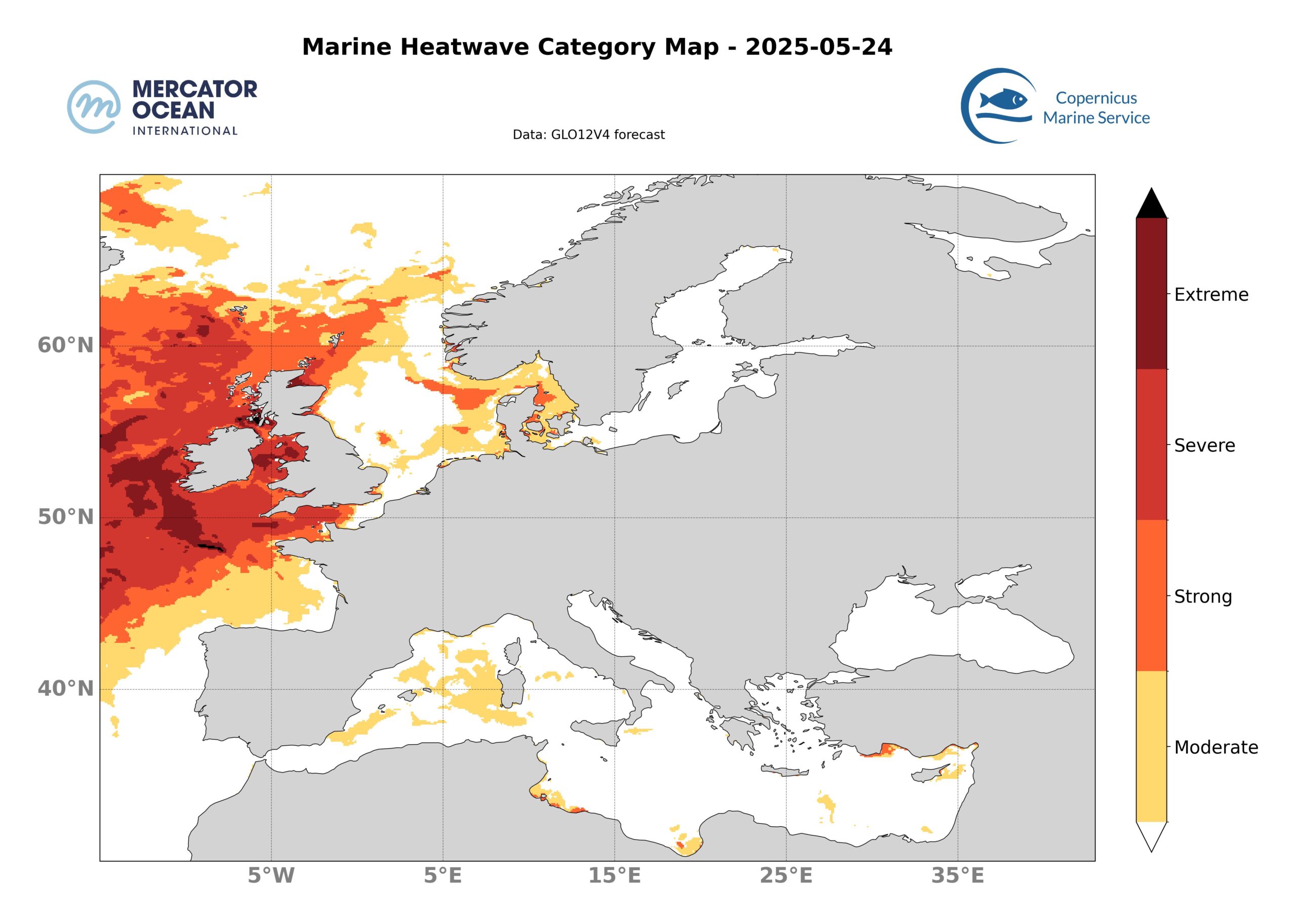
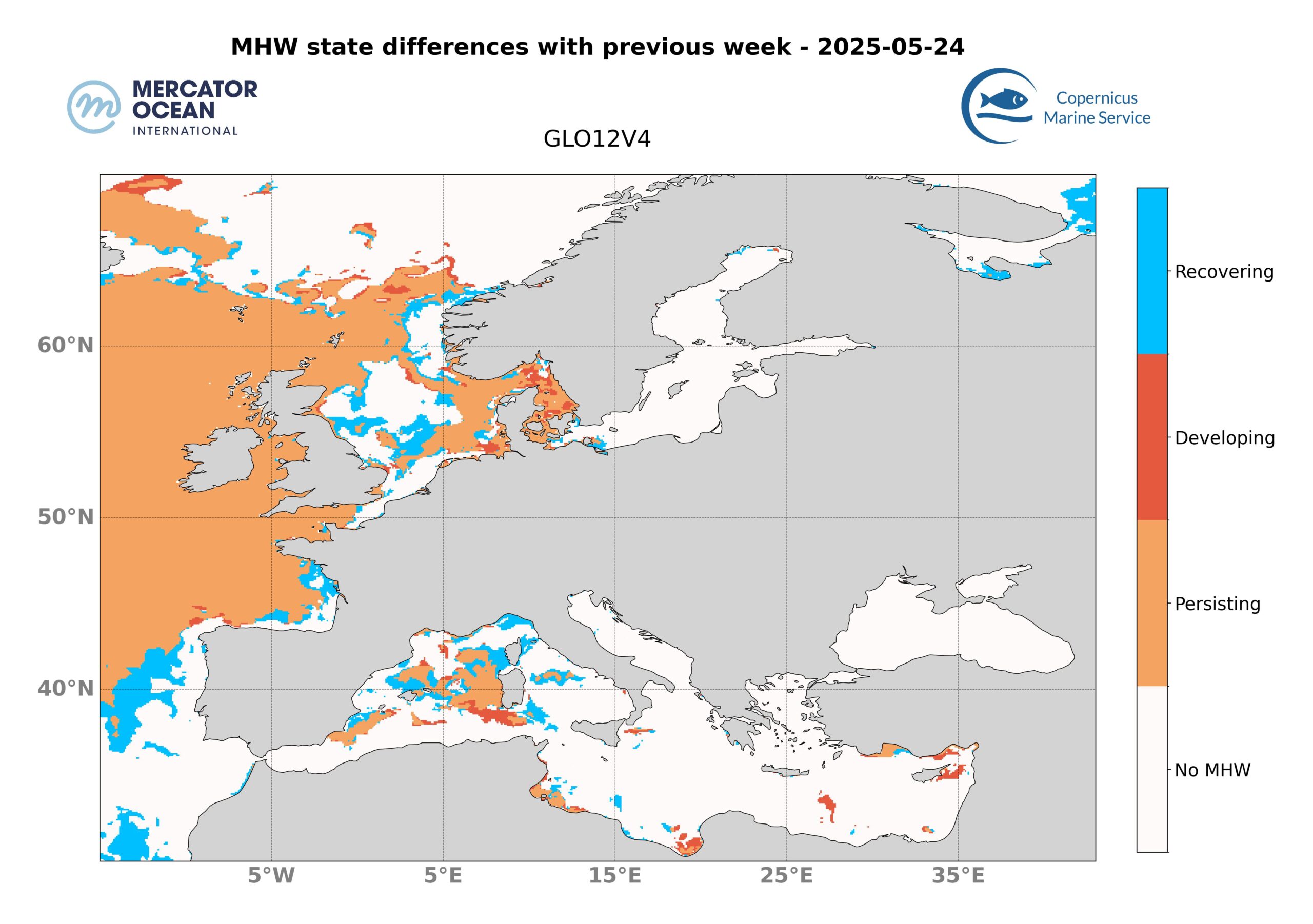
The marine heatwave in the European region is diminishing in extent and increasing in intensity, going from mainly moderate and strong categories to strong and severe categories, and locally extreme categories.
Mediterranean Sea
The marine heatwave in the Mediterranean Sea is mainly gone and only a few areas in the middle of the eastern basin remain in moderate category.
Weekly Temperature Anomalies
18 – 24 May 2025
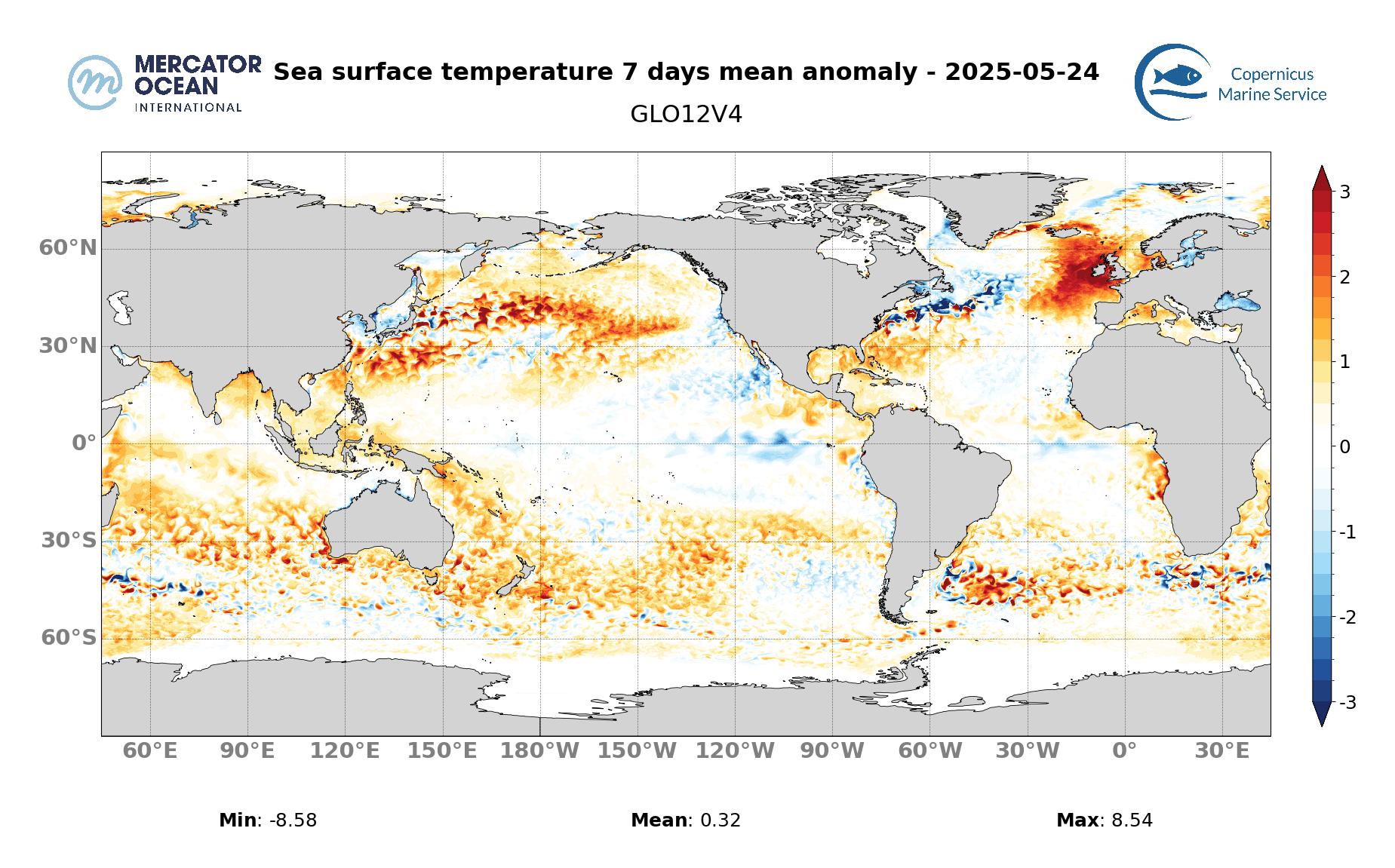
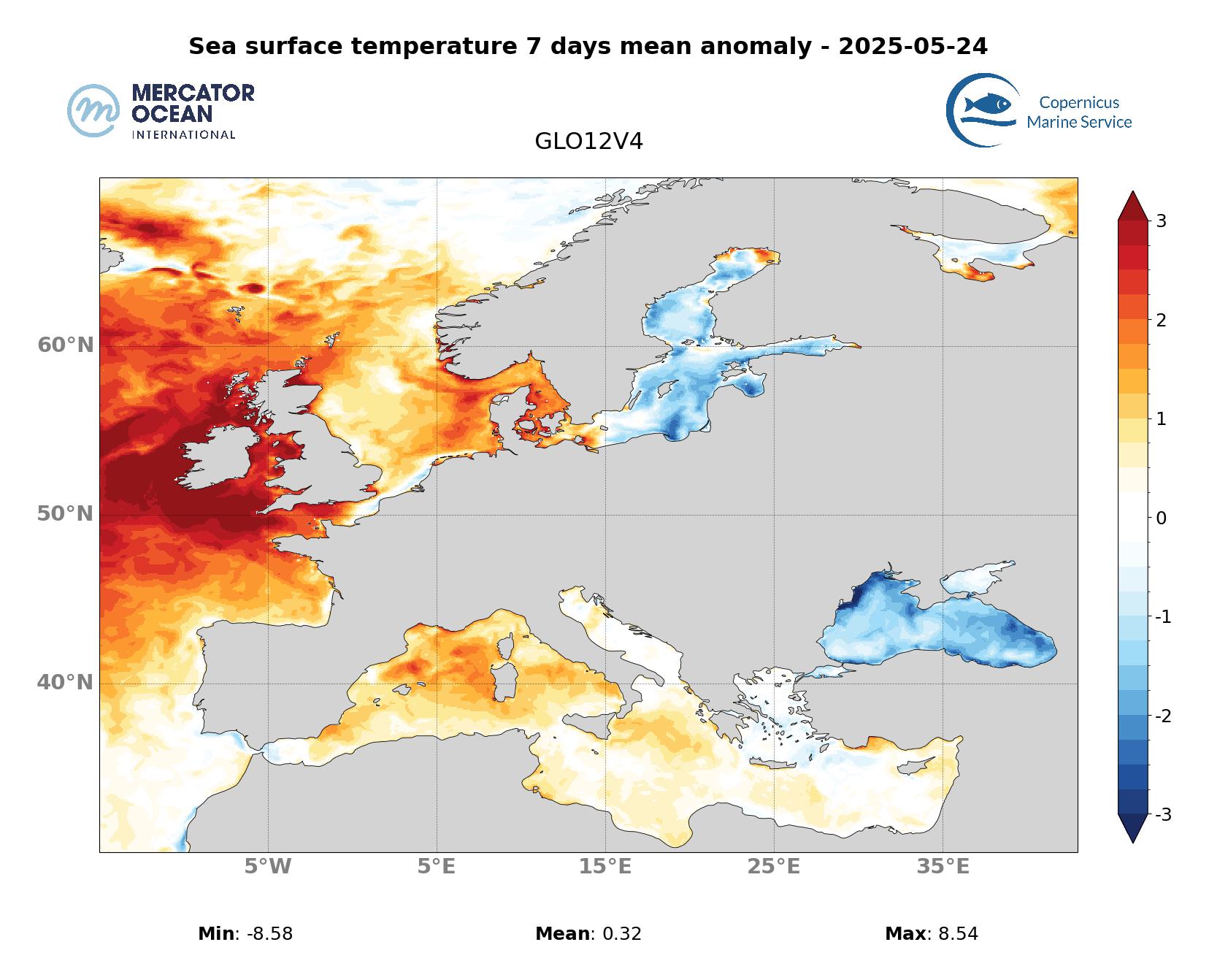
Mean sea surface temperature anomalies in each global ocean region for the week 18 to 24 May , 2025.
| Mediterranean Sea | 0.5°C to 1.5°C |
| North Atlantic Ocean | -3°C to 3°C |
| Tropical Atlantic | -0.5°C to 1.5°C |
| Tropical Pacific | -1°C à 2.5°C |
| Indian Ocean | 0°C to 2.5°C |
Access the Daily Global Physical Bulletin for a 9-day forecast here.
SURVEY
Help us improve our content! Answer a quick survey about this bulletin here.
What are marine heatwaves?
Marine heatwaves (MHW) are extreme rises in ocean temperature for an extended period of time. They can occur at different locations in the ocean, and their magnitude and frequency have increased over the last couple of decades, with harmful impacts on ecosystems, and human activities. According to the latest report released by the Intergovernmental Panel on Climate Change (IPCC AR6 SYR), it is found with high confidence that in the near-term at 1.5°C global warming, the increasing frequency of marine heatwaves will increase risks of biodiversity loss in the oceans, including from mass mortality events.
How are marine heatwaves calculated?
A marine heatwave is an episode during which the ocean temperature is abnormally warm for at least 5 consecutive days.
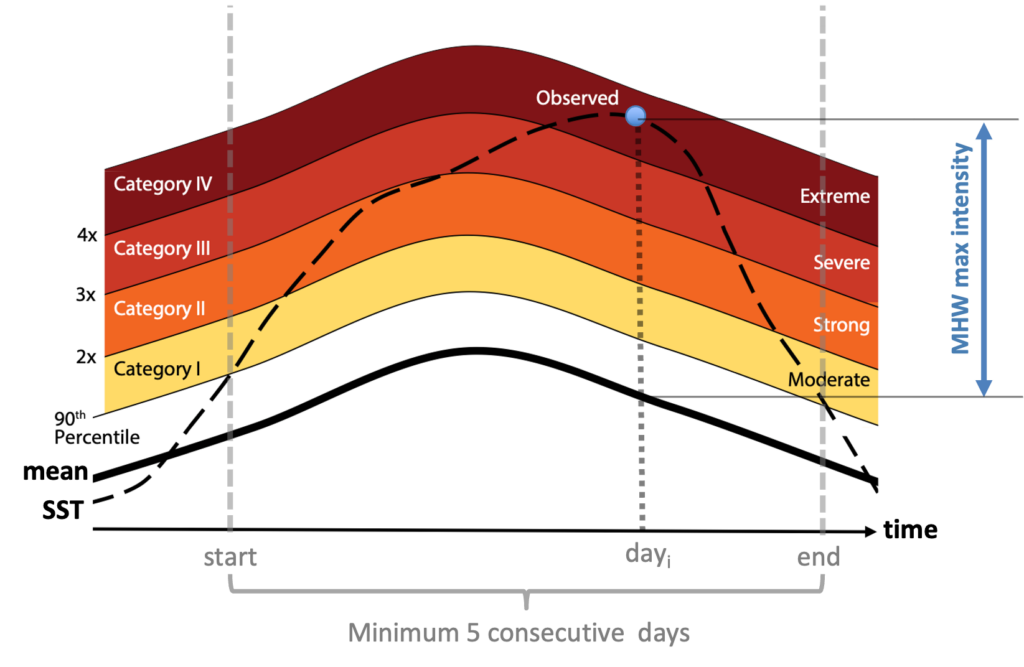
Adapted from Hobday et al. (2018)
For any location in the ocean, the normal temperatures are defined for every day of the year using a climatological period (here 1993–2016). A heatwave is identified when the measured daily temperature is within the top 10% of the highest recorded values for that day (i.e., above the 90th percentile, see diagram), and with this condition persisting for at least five consecutive days.
The intensity of the heatwave on any given day is measured as the number of degrees above the climatological average (represented by the bold black line) indicated by the blue arrow. We can either calculate the cumulative intensity over the entire heatwave or record the maximum intensity.
Heatwaves are classified based on their intensity level. To do this, the intensity is compared to the difference between the climatological value and the 90th percentile value. A mhw intensity between 1 and 2 times this difference corresponds to a heatwave of moderate category; between 2 and 3 times, to a strong category; between 3 and 4 times, to a severe category; and a difference greater than 4 times corresponds to an extreme category.
Notes
Datasets and products :
Global Ocean Physics Analysis and Forecast (sea surface temperature) E.U. Copernicus Marine Service/ Mercator Ocean International. https://doi.org/10.48670/moi-00016
IPCC AR6 SYR chapter 4.3 https://www.ipcc.ch/report/ar6/syr/downloads/report/IPCC_AR6_SYR_LongerReport.pdfarine
Rechercher
Search for:
Categories
Categories Select Category Events Marine Heatwave Bulletin News Non classé @en Ocean Temperature Bulletin presse Sea Ice Bulletin Spotted in the media
Tags
altrimetry Antarctique Argo Climate Change CMEMS Connaissance de l’environnement océanique COP21 Copernicus copernicus marine Copernicus Marine Environment Copernicus Marine Service Decade Collaborative Centre digital ocean Digital Twin Ocean EUDTO EUMETSAT European Space Solutions GEO Blue Planet GMMC GOOS IGO international ocean governance IOC-UNESCO jason-3 Jason-3 data Jean-Louis Etienne Météo France North-West Shelf Ocean Decade ocean governance ocean observation Ocean Observing System Ocean prediction Ocean State Report Oil Spill OSR partnership plastic pollution S-100 satellite sea level Sentinel Sentinel-3A UN Ocean Decade