


Brussels, 20th of November 2025 — The European Digital Twin Ocean, a flagship EU initiative turning ocean data into actionable knowledge, has entered its second phase with a €14 million investment. Led by Mercator Ocean International and the Flanders Marine Institute (VLIZ) on behalf of the European Commission, this new stage — known as EDITO2 (2025–2028) — will both enhance the platform’s technological capabilities and expand co-creation with Europe’s marine community.
Key developments include:
- Enhanced digital infrastructure with new datasets, tools, and computing power to support more advanced simulations and applications.
- Engagement with Horizon Europe and national DTO projects, including NECCTON, to strengthen collaboration and interoperability across Europe.
- €2 million in grants to onboard community-driven data, models, and applications on the EDITO platform.
This new phase marks a strategic step from building the foundations of the European Digital Twin Ocean to co-constructing it with the scientific, innovation, and policy communities, fostering a shared European ecosystem for ocean knowledge and action.
Turning knowledge into action
The European Digital Twin of the Ocean is a dynamic virtual replica of the ocean, integrating data from multiple sources, models, and AI to simulate and protect marine environments. By making ocean information more accessible and actionable, it empowers decision-makers, scientists, innovators, and citizens to better understand and protect the ocean.
At the United Nations Ocean Conference 2025 in Nice, European Commission President Ursula von der Leyen described the European Digital Twin Ocean as “an amazing tool that helps us understand the ocean, from pollution to navigation, from risks for our coasts to biodiversity. It will give vital data to everyone who relies on the ocean, and it will help to make Europe a global leader in ocean science, technology and security.”
Examples of current simulations on the platform include:
· Turtle Drift Tracker, supporting biodiversity protection by modelling endangered species’ movements and risks.
· Coastal Risk Projections, providing localized data on populations and assets exposed to climate-driven hazards.
· A Plastic Pollution Tracker, mapping marine plastic pathways and testing mitigation scenarios.
EDITO2 (2025-2028): Building the community of the Digital Twin Ocean
Building on the achievements of EDITO-Infra and EDITO-Model Lab (2022–2025), which integrated Copernicus Marine Service and EMODnet data into a unified digital framework, EDITO’s new phase will consolidate the platform’s digital infrastructure and foster an open ecosystem for co-development.
To do so, the project will actively engage with Horizon Europe initiatives such as NECCTON — which is enhancing Europe’s capacity to model and monitor marine biodiversity — as well as national Digital Twin Ocean projects, encouraging knowledge sharing and interoperability across Europe. In parallel, €2 million in open calls (2025–2026) will support the integration of new community-driven data, models, and applications into the EDITO platform.
EDITO is coordinated by Mercator Ocean International and the Flanders Marine Institute (VLIZ), on behalf of Copernicus Marine Service and EMODnet, with the support of Seascape Belgium as EMODnet Secretariat.
Alain Arnaud, Head of Digital Ocean at Mercator Ocean International, said:
“With the new phase of EDITO, we’re moving from building the foundations to expanding a truly collaborative ecosystem. Our goal is to make the European Digital Twin Ocean a shared space for co-creation, where science, technology, and policy converge to accelerate ocean solutions. This next phase will strengthen partnerships and empower communities across Europe to innovate together. The Digital Ocean Forum 2025 will be a key moment to showcase the achievements and drive the next developments of the European Digital Twin Ocean.”
Lennert Tyberghein, Director of the Science Support Department at the Flanders Marine Institute (VLIZ): “The second phase of EDITO will turn the European Digital Twin Ocean from promise to practice by investing in robust data capacities — quality-controlled, interoperable, and reusable datasets and products under clear governance. As a long-standing and trusted EMODnet partner, VLIZ connects in-situ marine observations, models, and applications on the EDITO platform, enabling users — from policymakers to innovators — to test scenarios and act with confidence. DOF 2025 marks the start of scaling this vision.”
Discover the European Digital Twin Ocean at the Digital Ocean Forum 2025
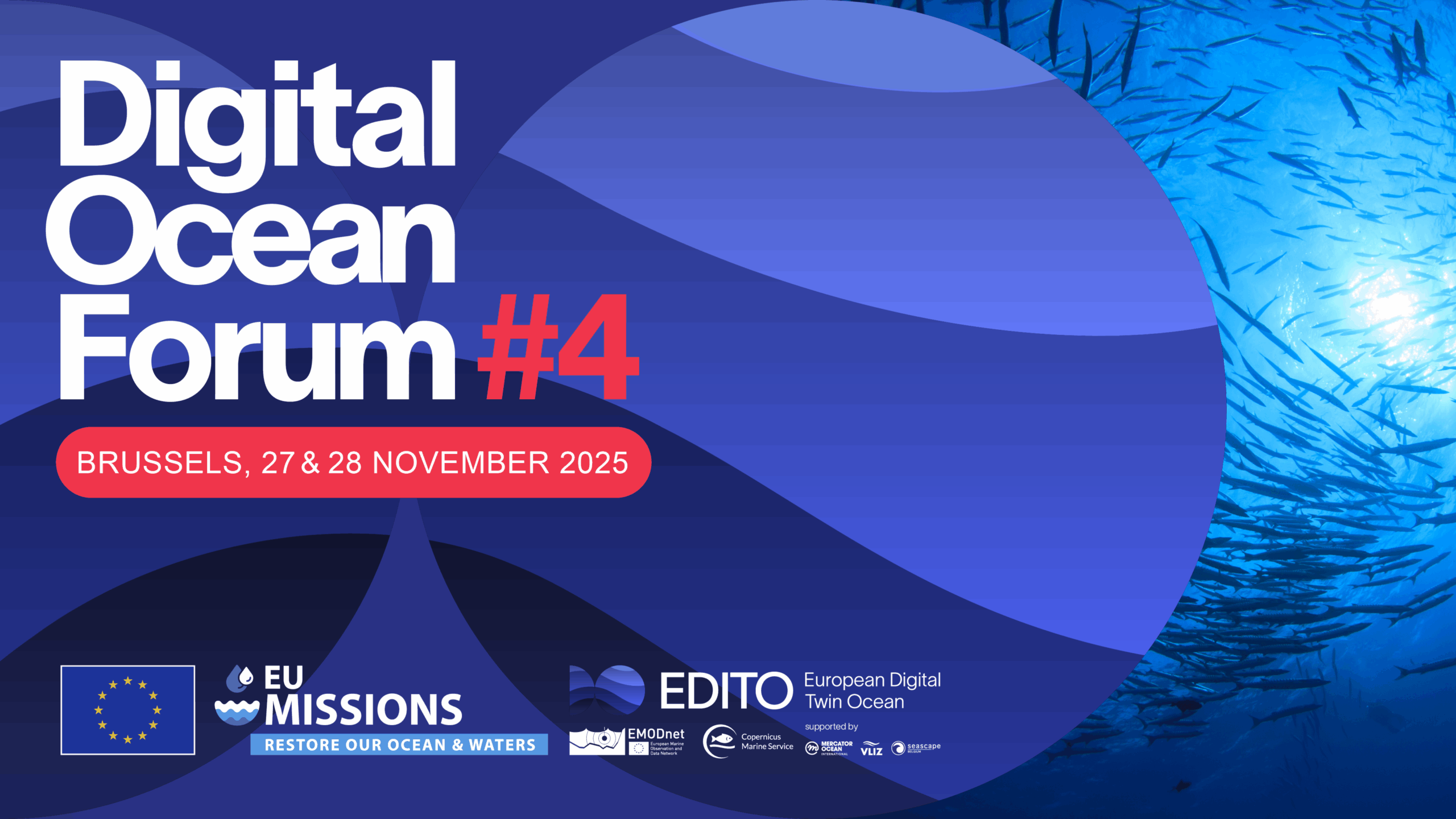
The Digital Ocean Forum 2025 (Brussels, 27–28 November) will gather scientists, policymakers, innovators, and members of the wider ocean community to explore the latest advances of the European Digital Twin Ocean, including live demonstrations and collaborative workshops. The agenda is now available.
END
About Mercator Ocean International
Mercator Ocean International is a global leader in digital oceanography and ocean forecasting. Since 2014, it has been entrusted by the European Commission to operate the Copernicus Marine Service, providing free, reliable ocean data and forecasts for the global ocean. Its team of scientific experts designs, develops, and maintains cutting-edge numerical modelling systems that deliver comprehensive 4D ocean representations—including reanalyses, hindcasts, near-real-time analyses, and forecasts—across the Blue (physical), White (sea ice), and Green (geochemical and biological) ocean. Mercator Ocean leads the development of the European Digital Twin Ocean with partners across Europe to support ocean decision-making through advanced predictive scenario exploration. Currently evolving into a new intergovernmental organization, Mercator Ocean is further strengthening its collaboration with European and global partners to advance digital ocean systems and services for a sustainable ocean. www.mercator-ocean.fr
About the Flanders Marine Institute (VLIZ)
The Flanders Marine Institute (VLIZ) is a leading center for marine research, innovation, and data stewardship, dedicated to advancing knowledge of the world’s oceans and coastal environments. Bringing together scientists, policy makers, citizens, and industry partners, VLIZ supports and conducts cutting-edge research, open-science initiatives, and sustainable marine management. Through global collaborations and state-of-the-art facilities, it plays a key role in understanding and protecting marine ecosystems for a sustainable ocean future. VLIZ is an instrumental partner in the European Marine Observation and Data Network (EMODnet) and a key contributor to the development of the European Digital Twin Ocean. https://vliz.be/en
About Seascape Belgium
Seascape Belgium (SSBE) provides advice and services to marine offshore and coastal operators, managers, policy makers and funding organisations, focusing on knowledge-based solutions for sustainable management and development of our seas and oceans. Operating at the interface between marine science, policy and industry, SSBE specialises in the coordination and management of multidisciplinary marine science projects and programmes. Since its establishment in 2017, SSBE has been commissioned by DG MARE to administer the EMODnet Secretariat, which plays a key role in the management and coordination of the European Marine Observation and Data network (EMODnet). SSBE also manages and supports other complex ocean observing and data networks, including at international level, such as the UN Ocean Decade Coordination Office for Ocean Data Sharing. https://www.seascapebelgium.be/