


Toulouse, France, 20 January 2026 – Even with the start of a new La Niña phase, which typically has a cooling influence on global temperatures, 2025 ranked among the three warmest years ever recorded for the surface global ocean, according to Mercator Ocean International.
Following recent global climate findings confirming 2025 as one of the warmest years on record, Mercator Ocean International, the entrusted entity operating the EU Copernicus Marine Service, finds that the global surface ocean remained exceptionally warm throughout 2025, making it the warmest year ever observed under La Niña conditions since records began in 1993. These results are based on Mercator Ocean’s operational ocean monitoring systems, which deliver detailed analyses of sea surface temperatures and the global ocean state.
Summary of key figures for 2025
- Global SST (Sea Surface Temperature): 20.80 ± 0.12 °C, 3rd warmest year on record. 81% of the ocean above average.
- La Niña: 2025 was the warmest La Niña year on record.
- North Atlantic SST: 22.42 ± 0.18 °C, 6th warmest year in 33 years; 69% of the basin in the warmest 10 years.
- Mediterranean SST: 21.21 ± 0.07 °C, 2nd warmest year; 98% of basin above average, 25% at least 1°C above.
- Marine Heatwaves: 89% of the global ocean affected; 97% of North Atlantic and 99.6% of Mediterranean; Mediterranean Sea: 64% simultaneously impacted.
- Sea Ice: Arctic and Antarctic below long-term average; Arctic December sea ice reached record low; Antarctic winter sea ice among lowest on record.
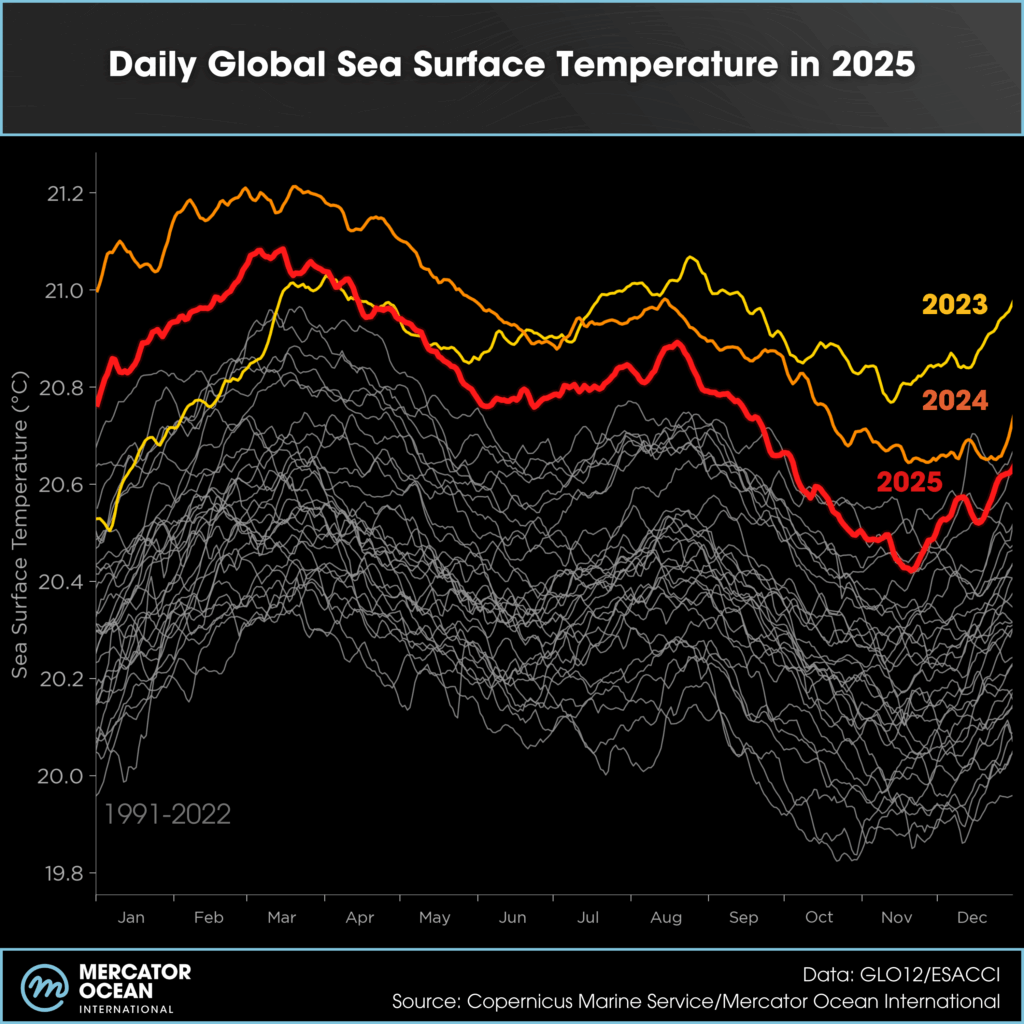
Daily sea surface temperatures averaged for the global ocean (between 60°S and 60°N) between 1991-2025. Data: ESA’s Climate Change Initiative/Mercator Ocean’s GLO12. Credit: Copernicus Marine Service/ Mercator Ocean International
Ocean heat content reached a new record
“ In 2025, ocean heat content, the total amount of heat stored in the ocean, reached its highest level on record, confirming the continued accumulation of heat in the ocean as part of long-term global warming,” said Karina Von Schuckmann, senior advisor at Mercator Ocean International and co-author of a new international study on ocean heat content
“Although sea surface temperatures slightly declined compared to 2023 and 2024, the amount of heat stored in the upper 2,000 metres of the ocean reached a new record high. Ocean heat content provides a robust indicator for climate change, as it captures heat stored both at the surface and in deeper layers, integrating short-term variability and long-term trends.”
Global sea surface temperatures remain among the warmest on record
In 2025, the global average sea surface temperature (between 60°S and 60°N) reached 20.80 ± 0.12 °C, ranking as the third warmest year after 2023 (second warmest) and 2024 (warmest).
Overall, 81% of the ocean experienced above-average sea surface temperatures. 2025 was the hottest year for many regions including the eastern North Atlantic, parts of the Southern Ocean (between South Africa and Australia) and the western Pacific.
Regional highlights – Europe
North Atlantic (between 0°N and 60°N)
- Average SST: 22.42 ± 0.18°C, sixth warmest over the last 33 years.
- 2025 was the amongst the hottest 3 years for nearly a quarter of the basin (23%)
- Record annual mean temperature observed in the Gulf of Mexico, and on the eastern side in the Bay of Biscay and around British Isles.
- These regions also experienced multiple monthly records across the year (as high as 6 to 8 monthly records for large parts of the Bay of Biscay)
Mediterranean Sea
- Average SST: 21.21 ± 0.07°C, making 2025 the second warmest year after 2024 (21.32 ± 0.14°C).
- 98% of the basin was above average, with 25% of the basin reaching at least 1°C above average.
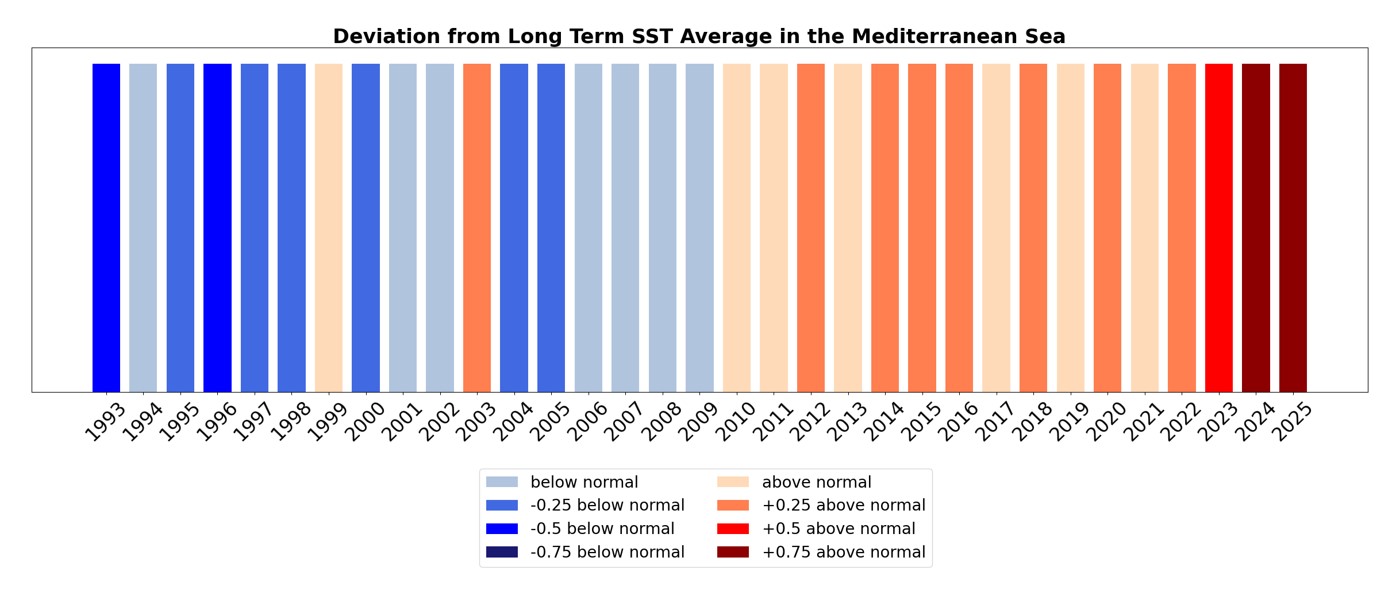
Annual sea surface temperature anomalies in relation to the long-term average (1993-2022) in the Mediterranean Sea. Data: Mercator Ocean’s GLO12, GLORYS12. Credit: Copernicus Marine Service/Mercator Ocean International.
The warmest La Niña year on record
Sea surface temperatures in the central equatorial Pacific Ocean dropped below average (below −0.5 °C) from August to December 2025, indicating the start of a La Niña event, the cold phase of the El Niño–Southern Oscillation (ENSO).
Despite this natural cooling influence, 2025 was warmer on average than the strong El Niño years of 2015 and 2016. This apparent paradox is largely explained by the long-term rise in global sea surface temperatures driven by human-induced climate change (WMO; IPCC AR6).
“Despite being a La Nina year, 2025 ranks among the three warmest years ever recorded. In fact, what was considered “warm” ten years ago has effectively become the new “cool” in today’s climate baseline – further evidence of the long-term rise in global sea surface temperatures driven by human-induced climate change,” said Romain Bourdalle-Badie, oceanographer at Mercator Ocean International.
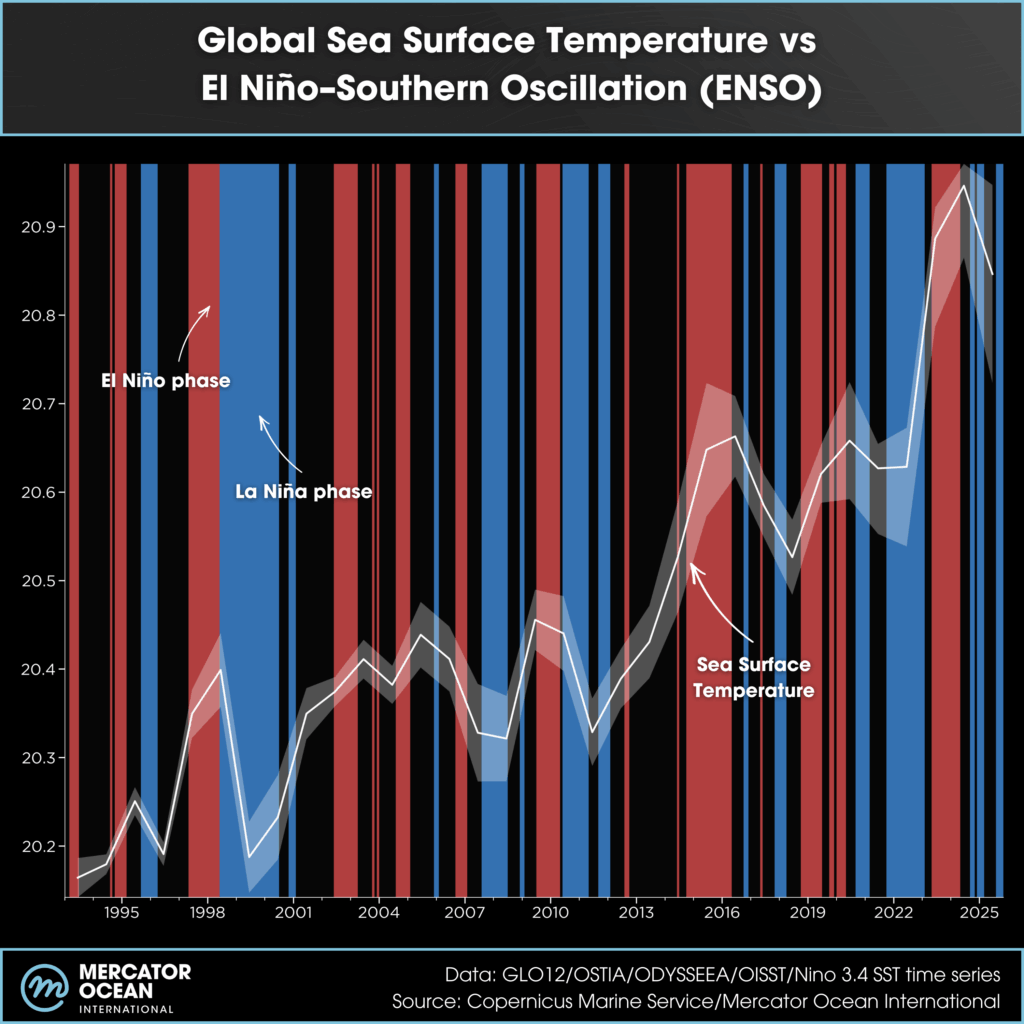
Average sea surface temperature per year since 1993 (white line) and El Nino and La Nina event duration (red and blue bars respectively). Annual SST values are plotted at mid-year (June) for visual alignment with the monthly ENSO index. Data: Mercator Ocean’s GLO12/ OSTIA/ODYSSEEA/ OISST/ Nino 3.4 Sea Surface Temperature time series. Source: Copernicus Marine Service/Mercator Ocean International
Marine heatwaves affected most of the ocean
In 2025, 89% of the global ocean (between 60°S and 60°N) was impacted by at least one marine heatwave event, making it the sixth-largest extent since 1993. More than half of the global ocean (55%) experienced intense marine heatwaves, classified as strong, severe or extreme.
Regional highlights – Europe
North Atlantic
- 97% of the basin was impacted by marine heatwaves, the third-highest extent on record.
- Intense events covered 63% of the region.
Mediterranean Sea
- The entire Mediterranean Sea was impacted by a MHW in 2025 (99.6%).
- 93% of the basin was affected by intense marine heatwaves, ranking third after 2023 and 2024.
- June 2025: 64% of the Mediterranean simultaneously affected — a record-breaking June month for the basin.
“In 2025, Europe’s coasts faced extreme sea surface temperatures, with intense marine heatwaves affecting nearly the entire Mediterranean Sea, and with long-lasting events along the Atlantic coast. Over the past three years, these prolonged and exceptionally warm events have reached unprecedented levels, heightening the risk to marine ecosystems.” said Simon van Gennip, oceanographer at Mercator Ocean International.
Sea ice remains below average in both hemispheres
In 2025, sea ice extent in both the Arctic and Antarctic remained significantly below the long-term average (1993–2010). 11 out of 12 months of the year global sea ice ranked within the top 5 lowest extents.
In the Arctic, winter sea ice formed later than usual, with sea surface temperatures exceeding the 2 °C above average in regions such as the Barents Sea and Kara Sea during November, leading to a record low in sea ice in December. Sea surface temperature records in the region are another evidence of the rapid warming happening in the Arctic.
In Antarctica, sea ice formation was delayed over unusually large areas, particularly in the Indian Ocean sector. Significant sea ice loss occurred even during the maximum extent period. As a result, sea ice extent remained well below average for most of the winter, from June to October, and 2025 followed 2023 and 2024’s patterns very closely
“The continuous planet and ocean warming are having a direct impact on polar sea ice. 2025 marked another stark year with nearly the entire year ranking among the lowest extents on record, a record low in the Arctic for December and one of the lowest winter values for the Antarctic, the polar regions continued to signal profound and ongoing change,” said Gilles Garric, polar oceanographer at Mercator Ocean International.
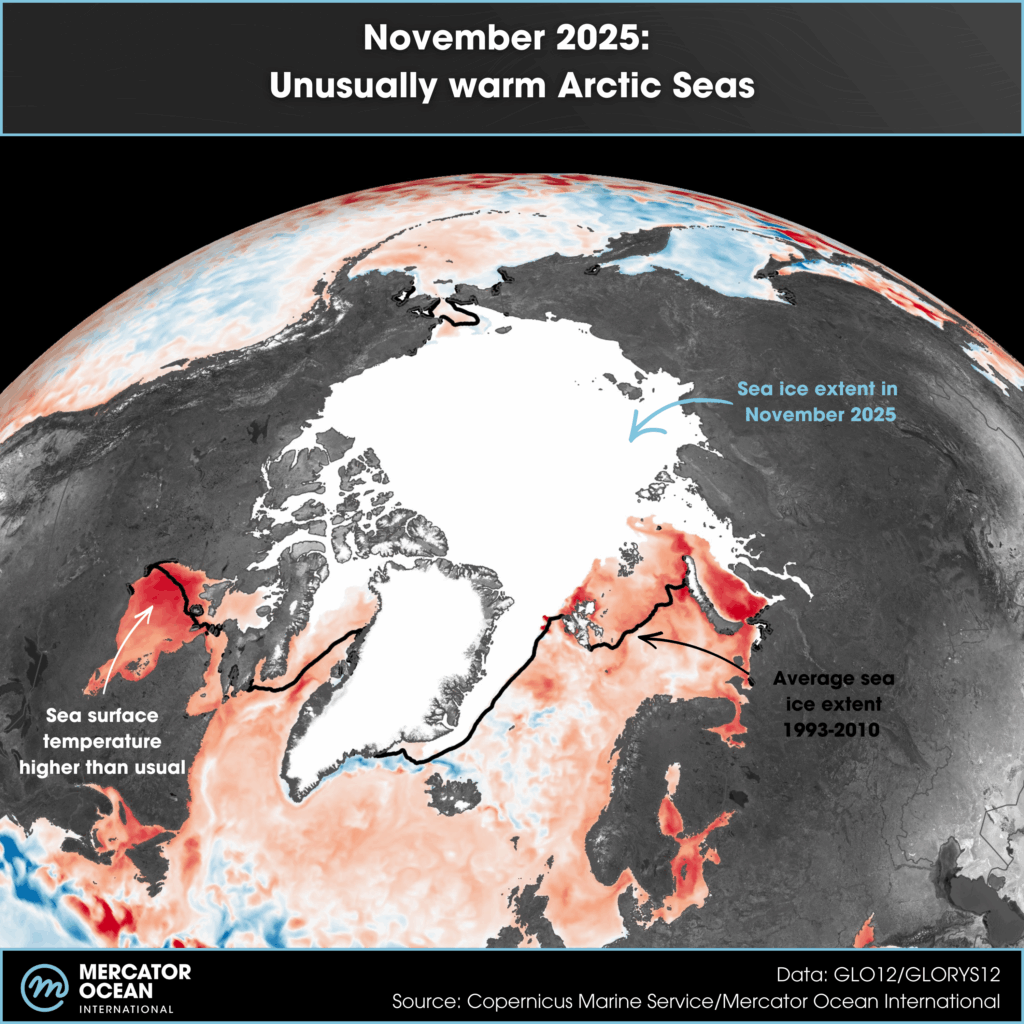
Sea surface temperature average anomalies in the Arctic region for November 2025, and sea ice extent (white) for November 2025. Climatology for November (1993-2010) is represented with the black line. Data: Mercator Ocean’s GLO12/GLORYS12. Credit: Copernicus Marine Service/ Mercator Ocean International
About Mercator Ocean International – Mercator Ocean International is one of the world’s leading ocean prediction centres and a key pillar of Europe’s digital ocean infrastructure. It is the entrusted entity of the European Commission for the Copernicus Marine Service, delivering free, open-access ocean data and forecasts as a public service to governments, authorities, scientists, and strategic users worldwide. Mercator Ocean also leads the development of the European Digital Twin Ocean, a flagship European initiative developed with partners under the leadership of the European Commission to support scenario-based ocean decision-making. In 2025, Mercator Ocean took a major step toward becoming an international organization, with twelve European countries endorsing the international convention establishing the Mercator International Centre for the Ocean. www.mercator-ocean.fr
About the Copernicus Marine Service – The Copernicus Marine Service is one of the six services of Copernicus, the European Union’s Earth Observation Programme. The service operates ocean analysis and forecasting and is funded by the European Union. The Copernicus Marine Service delivers regular and systematic reference information on the Blue (physical), White (sea ice) and Green (biogeochemical and biological) ocean at both global and European scales. Its data and products support key EU and international policies, contributing to efforts in pollution reduction, marine protection, maritime safety and routing, sustainable resource management, marine renewable energy, blue growth, climate monitoring, and weather forecasting. The service also seeks to raise public awareness by providing citizens in Europe and worldwide with accessible information on ocean issues.