

New science tool today presented to Heads of States and Governments at UNOC3
Nice, France – 8 June 2025 – The Starfish Barometer, first annual, science-based bulletin on global ocean health, is published today in the journal State of The Planet and unveiled at the 3rd UN Ocean Conference (UNOC3) in Nice. Developed by a multidisciplinary team of leading experts and overseen by the international scientific committee of the One Ocean Science Congress, the Starfish Barometer delivers – for the first time – a comprehensive, peer-reviewed overview of global ocean health, human pressures, and societal impacts.
As ocean governance faces mounting uncertainty and scientific evidence is increasingly contested, the Starfish Barometer equips world leaders and policymakers with reliable, up-to-date data to guide urgent action. The 2025 edition, led by Dr. Marina Lévy (Research Director, CNRS/IRD/Sorbonne University) and Pierre Bahurel (Director General, Mercator Ocean International), is presented today at 5PM CEST to heads of states and government during a dedicated recommendations session at UNOC3.
The Ocean is undergoing rapid and alarming changes
This first Starfish Barometer reveals an Ocean in declining health, with record heat, rising seas, widespread species decline, and threatened major ecosystems.
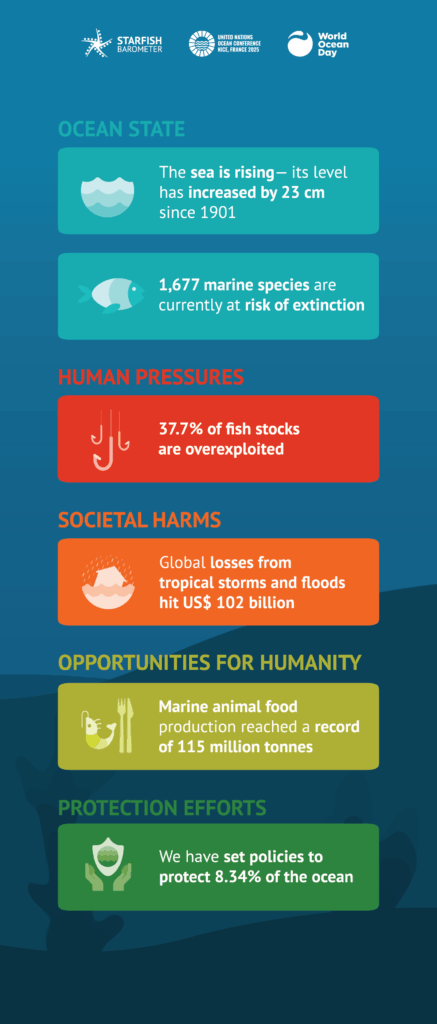
Global Sea level has increased by 23 cm since 1901. In 2024, it reached the highest level ever recorded.
Record heat: Ocean heat content now at its highest in 64 years of global records, with 2024 surpassing the previous record by 0.25°C at the surface.
Biodiversity in crisis: 1,677 marine species now threatened with extinction. One third of sharks, rays, and chimaeras are threatened, and 26% of cetaceans are at risk.
Coral reefs under stress: The fourth global coral bleaching event was recorded in 2024, with 44% of reef coral species now threatened with extinction and live coral cover on reefs nearly halved over the past 150 years.
Human Pressures are increasing
All human pressure indicators reported in the first edition of the Starfish Barometer – fossil fuel emissions, unsustainable fishing, and plastic pollution – are on the rise.
Fossil fuel CO₂ emissions rise: Projected at 37.4 billion tonnes in 2024, up 0.8% from 2023. Shipping emissions rose 2.7% to 0.6 billion tonnes, representing 1.6% of global emissions.
Unsustainable fishing persists globally: 37.7% of marine fish stocks were overexploited in 2021, up from 10% in 1974. In 2022, 75% of large vessels (>15 m) remain untracked.
Mounting pressures on marine habitats: Since 1950, coastal hypoxia has increased tenfold. Currently, 50% of mangrove ecosystems are at risk of collapse, over half of World Heritage seagrass habitats are highly vulnerable to climate change, and 33% of sandy coastlines are hardened by man-made structures.
Plastic pollution escalates: Global plastic production reached 413.8 million tonnes in 2023, up from 2 million tonnes in 1950. Plastic waste accounts for over 80% of aquatic debris, with 75–199 million tonnes accumulated in rivers and the ocean in 2021.
Costs of a changing ocean are escalating
Global losses from tropical storms and floods: Economic losses reached US$ 102 billion in 2023, now regularly exceeding US$ 100 billion per year and rising by 25% each decade. About 560 million people are exposed annually.
Rising insurance costs for maritime activities: Premiums rose 5.9% to US$ 38.9 billion in 2023, driven by geopolitical tensions and increased risks.
Record migrant fatalities at sea: 9,002 migrants died or disappeared at sea in 2024, the highest toll in a decade – a 3% increase from 2023 and 25% from 2022, with environmental change among the drivers.
Global protection effort is advancing
The Ocean is playing an increasingly central role in supporting humanity
“The Starfish Barometer provides an unprecedented, comprehensive snapshot of the ocean’s health and the mounting pressures it faces,” said Dr. Marina Lévy, scientific coordinator of the Barometer. “While it is encouraging to see progress in global ocean protection, the data make it clear that urgent, coordinated action is essential to safeguard the ocean for future generations.”
The report will be part of the 2025 edition of the Copernicus Ocean State Report, prepared annually by Mercator Ocean and the European scientific marine community. Full findings and data are available at www.starfishbarometer.org.