


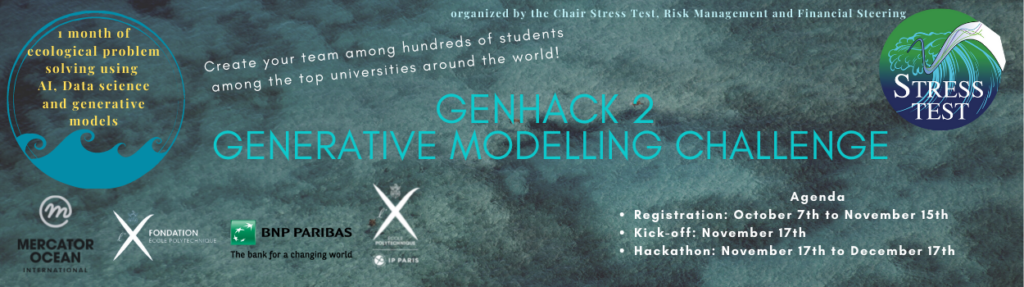
GenHack2 is a data challenge organised and managed by Ecole Polytechnique with the support of BNP Paribas and Mercator Ocean International. This hackathon aims to bring the brightest students from top universities around to world to work on the evolution of ocean temperature across the years in the context of the climate change.
Why studying ocean temperature is important?
The global average sea surface temperature has increased about 0.6 degrees Celsius since 1901, at an average rate of 0.08 degrees Celsius per decade. The continuing warming of Oceans will lead to increased frequency of marine heatwaves and accelerated rates of sea-level rise, ice-melting and ocean acidification, withconsequently having lasting impact on marine biodiversity, and the lives and livelihoods of coastal communities and beyond.
The challenge
The global data for near-surface temperatures come from ships, buoys and satellite measurements of the oceans. However, measuring in situ temperature on a fine mesh is often too expensive. Thus, developing a model able to provide fine-scale temperature map is of essence for better assessment of the climate risks.
A step closer to possible solutions
GenHack2 is a data challenge of generative models to study the evolution of ocean temperature across the years in the context of the climate change, based on real data provided by Mercator Ocean. This consists in augmenting and enriching the dataset by new data. More specifically, teams will try to work on the evolution of ocean temperature data (provided from Copernicus Marine Service) developing finer scale temperature maps.
Timeline
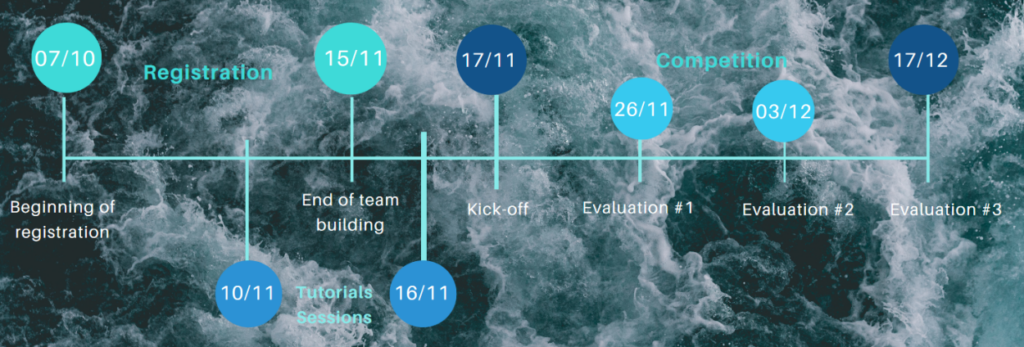
The registration, team building and kick-off already took place, while the event is now going through 3 phases of Evaluations which will end by mid-December.
About 300 students from 53 universities, representing 27 different nations, registered. 56 teams of 3 to 5 students have been assembled for this hackathon. Karina von Schuckmann, Muriel Lux and Benoît Hartmann selected Copernicus data for an exercise on Sea surface temperature (SST satellite ESA-CCI), whereas Jean-Michel Lellouche, Elisabeth Remy, Marie Drevillon and Yann Drillet act as mentors responding to the students’ inquiries.
To find out more about the challenge: click on the following link