This Call for International Mobilization is more than a statement—it is a commitment to collaborative, coordinated action. By joining this initiative, stakeholders worldwide pledge to strengthen international cooperation, share data openly, and co-develop tools and services that empower societies to sustainably manage the ocean and respond effectively to climate challenges.
You can be part of this transformative journey. Sign the Call for Action today and help us build a future where ocean prediction science serves everyone, everywhere.
Mercator Ocean, in partnership with OceanPredict/ForeSea, GOOS and EU4OceanObs, has launched a rallying call for international mobilisation to enhance Ocean prediction capabilities in response to growing societal and environmental challenges.
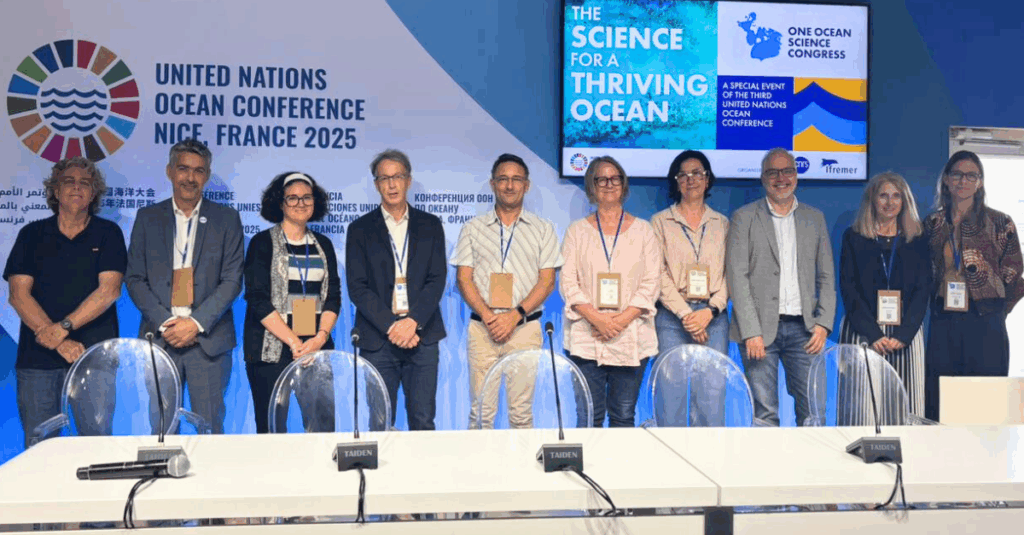
The call was presented at a Town Hall during the One Ocean Science congress, titled ‘Call for Action to Advance Ocean Prediction Capabilities for the Benefit of Society’. This high-level session, convened by Mercator Ocean’s scientific director Pierre-Yves Le Traon, featured a diverse panel of international experts and marked a strategic milestone in the global effort to strengthen Ocean prediction science and services.
Pierre-Yves Le Traon, reaffirmed the organization’s commitment to this global mobilisation:
” Ocean prediction systems offer evidence-based solutions for Ocean protection and sustainable development. A strong international mobilization of all Ocean observation and prediction stakeholders and users will put state-of-the-art science and technology at the service of society to address the critical challenges facing our Ocean.”
Innovations in Ocean prediction systems and services offer key solutions for Ocean protection and sustainable development. However, implementing these systems globally and ensuring their benefits are available and adapted to all remains a significant challenge and requires international support.
The Town Hall captured the momentum of the OceanPredict 2024 Symposium, which brought together over 350 in-person participants and 1500 online attendees to identify those challenges and potential solutions. Today’s event crystallized those discussions and formally launched the global call for action to promote knowledge transfer, capacity building and inclusive participation.
A Strategic Turning Point for Ocean Prediction
The call for action underscores the critical role of advanced Ocean prediction systems in addressing pressing threats, from climate change and biodiversity loss to coastal hazards and resource overexploitation. It highlights the transformative potential of innovations such as artificial intelligence, digital twins, and high-resolution modelling to deliver evidence-based solutions for sustainable Ocean stewardship.
Key steps identified to further enhance Ocean prediction include:
Improving interfaces between ocean, atmosphere, surface waves, sea ice, biogeochemical and ecosystem models;
Advancing the prediction of coastal and polar areas;
Improving ocean biogeochemistry and ecosystems prediction;
Filling gaps in the global ocean observing network, including implementing and sustaining the OneArgo array and preparing the required future satellite oceanography missions;
Developing and using tools to design and assess the impact of observing systems;
Developing higher resolution sub-mesoscale models and data assimilation;
Extending the forecast horizon up to 1 month, and extending seasonal, decadal prediction and climate projection to the marine environment;
Enhancing the intelligence of ocean prediction products by providing uncertainties and probabilistic forecasts;
Developing artificial intelligence modelling and data assimilation methods;
Harnessing digital twins to enhance the interaction between ocean prediction centres and users’ communities, including the co-design of “what-if” scenario tools to support planning for climate resilience, restoration, and ocean-based economies.
The call also emphasizes the need for inclusive participation, particularly from Small Island Developing States and Least Developed Countries, to ensure equitable access to Ocean prediction benefits.
Coordinated Global Action
The document outlines a series of coordinated actions that ocean prediction stakeholders commit to strengthening international cooperation and mobilization through:
OceanPrediction DCC, in collaboration with Ocean Data Sharing DCO and Ocean Observing DCOto define common architectures, standards, and best practices, advancing towards an integrated Digital Ecosystem, so that these forecasting services and decision-making tools are state-of-the-art, duly verified and fully accessible;
Global Ocean Observing System (GOOS), space agencies, GEO Blue Planet, WMO, and other relevant partners, to improve links between scientific and operational communities across the value chain from observations (GOOS, GCOS) to operational centres to final users (GEO Blue Planet), including with the weather forecasting community (WMO);
The climate communities (e.g., WCRP, CLIVAR, ESMO, CMIP, and other relevant partners), and the ocean prediction communities, to co-designrobust, fit-for-purpose ocean numerical models,ocean climate indicators and information that support climate adaptation strategies, sustainable development and a carbon-neutral ocean economy.
The international Ocean science community is united in its commitment to support the health of the Ocean through such actions. The launch of this call is one key activity during Mercator Ocean’s participation at the United Nations Ocean Conference. The organization is implementing the EU Digital Ocean Pavilion as well as hosting and participating in several events, with three key elements in focus:
Governance: Formalizing the accession of Member States to the future Mercator Ocean Intergovernmental Organization (IGO);
Infrastructure: Highlighting the European Digital Twin Ocean as a revolutionary tool for Ocean prediction;
Community: announcing cooperation agreements with the international Ocean Prediction community.
From left to right : Joaquin Tintore (CSIC), Pierre Bahurel, Daphné Lecellier and Pierre-Yves Le Traon (Mercator Ocean), Yannice Faugères (CNES), Susan Wijffels (WHOI), Marie Drevillon and Enrique Alvarez (Mercator Ocean), Joanna Staneva (HEREON), Jennifer Veitch (SAEON).To Learn More:
You can find out more about Mercator Ocean’s participation at UNOC on the website.