


Mercator Ocean has contributed to the newly released 2025 Indicators of Global Climate Change (IGCC) report, which delivers a stark warning: the world has just over three years left in its carbon budget to limit warming to 1.5°C. Published in Earth System Science Data and unveiled on 19 June 2025, the report is the most comprehensive annual update yet on the state of the global climate system.
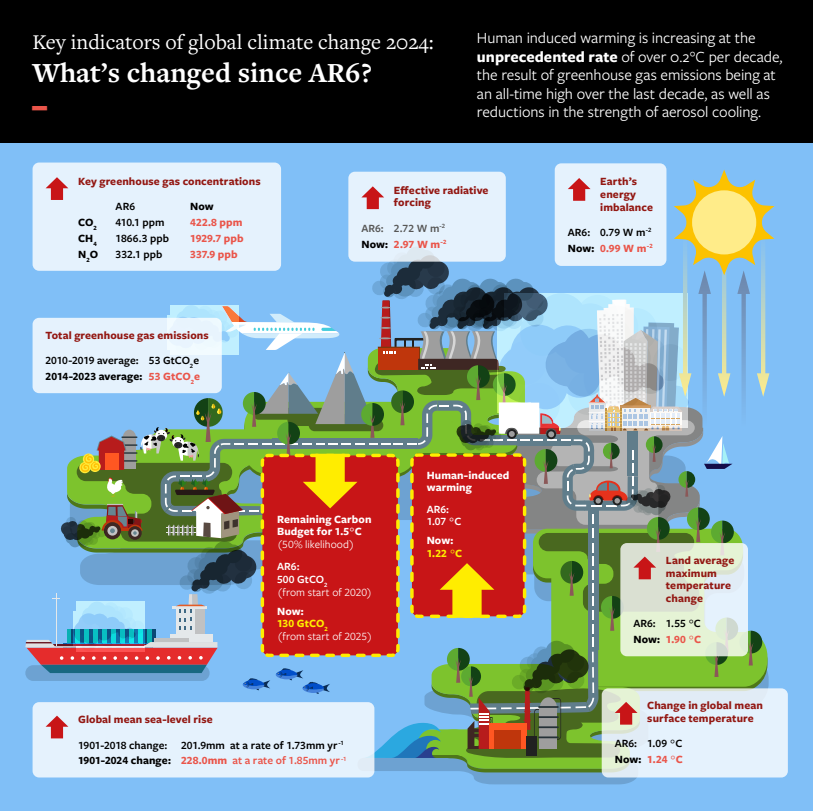
This year’s edition, produced by 61 scientists from 54 institutions across 17 countries, expands its scope to ten key climate indicators, including greenhouse gas emissions, global surface temperature, and, for the first time, global land precipitation and sea-level rise.
Among the most urgent findings:
- The remaining carbon budget for 1.5°C is estimated at 130 billion tonnes of CO₂, which could be depleted in just over three years at current emission rates;
- Sea levels have risen by 26 mm between 2019 and 2024—more than double the long-term average rate since 1900;
- The best estimate of global surface temperature rise in 2024 was 1.52°C, with 1.36°C attributed to human activity;
- Human-induced warming has accelerated to 0.27°C per decade (2015–2024), with the last decade being 0.31°C warmer than the one before.
Prof. Piers Forster, Director of the Priestley Centre for Climate Futures at the University of Leeds and lead author of the study, said:
“Our third annual edition of Indicators of Global Climate Change shows that both warming levels and rates of warming are unprecedented. Continued record-high emissions of greenhouse gases mean more of us are experiencing unsafe levels of climate impacts. Temperatures have risen year-on-year since the last IPCC report in 2021, highlighting how climate policies and pace of climate action are not keeping up with what’s needed to address the ever-growing impacts.”
Mercator Ocean’s contribution was led by Dr. Karina Von Schuckmann, Senior Advisor for Ocean Science for Policy, who emphasized the Ocean’s critical role in absorbing excess heat:
“The Ocean is storing about 91% of this excess heat driven by greenhouse gas emissions, which leads to Ocean warming. Warmer waters lead to rising sea levels and intensified weather extremes, and can have devastating impacts on marine ecosystems and the communities that rely on them. In 2024, the Ocean reached record values globally.”
This insight is vital. The report highlights how Ocean warming is not only a symptom of climate change but also a driver of further impacts, from rising seas to extreme weather events. The IGCC’s inclusion of Ocean indicators reflects growing recognition of the Ocean’s central role in climate dynamics.
Mercator Ocean’s leadership in this area reinforces its mission to deliver actionable Ocean science for policy and public good. As the climate crisis intensifies, the organization’s expertise is helping shape global understanding and response strategies.
The IGCC initiative continues to serve as a critical bridge between climate science and policy, tracking the causal chain from emissions to impacts. With the window to limit warming rapidly closing, the report calls for urgent, deep reductions in greenhouse gas emissions to meet the goals of the Paris Agreement.
About the IGCC Initiative
The Indicators of Global Climate Change (IGCC) initiative brings together an international team of scientists annually to provide the latest evidence on how the climate system is changing. IGCC offers updates on key indicators originally reported by the Intergovernmental Panel on Climate Change (IPCC), following methodologies from the IPCC Sixth Assessment Report (AR6).
The report follows the causal chain from greenhouse gas emissions to human-induced warming and its impact on the remaining carbon budget, demonstrating how human activity is affecting the physical climate system.
IGCC also collaborates with the Climate Change Tracker to offer a reliable, user-friendly platform for visualizing and understanding these indicators. More information is available on the IGCC website.