


New study unveils how young loggerhead turtles navigate the Pacific during their early life stages. By combining satellite tracking with Ocean data, the study illustrates how operational oceanography is contributing to a better understanding of marine species.
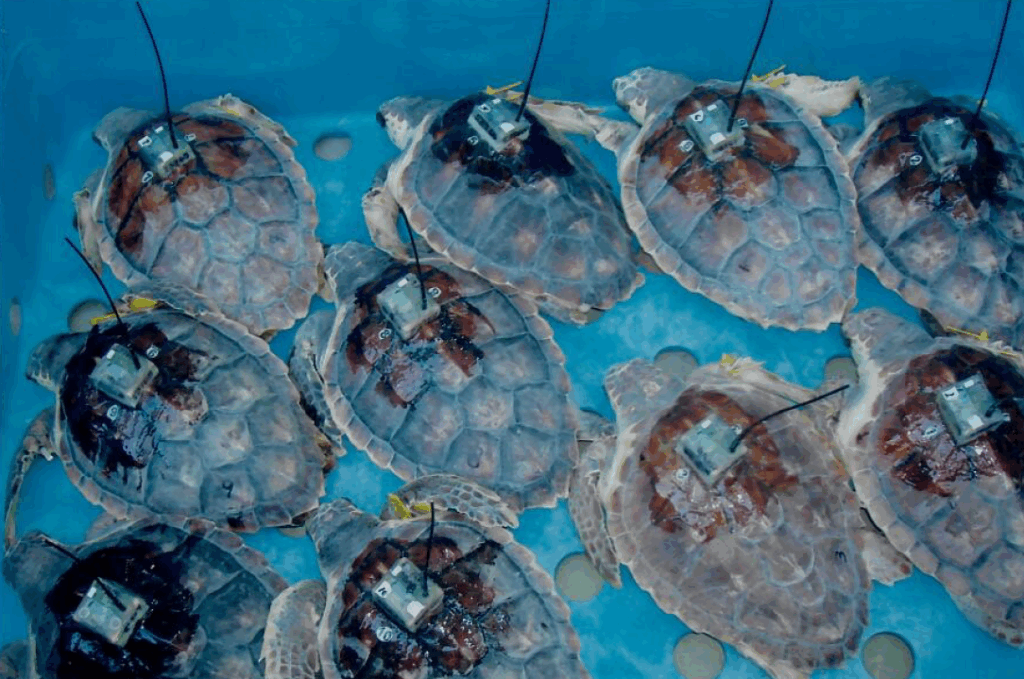
Rewriting the Story of the Turtles’ So-Called “Lost Years”
A new international study led by Philippe Gaspar and Julien Temple-Boyer from Mercator Ocean International, and US and Japanese marine biologists, provides fresh insight into the long-distance journeys of loggerhead turtles (Caretta caretta) in the North Pacific.
Published in Movement Ecology, the research focuses on the early life stage of these turtles, often referred to as the “lost years”. This period begins when hatchlings leave their nesting beaches and enter the open Ocean, and ends when they return to their natal place as young adults to reproduce. This period of the turtle’s life has been largely unobserved due to technological constraints in tracking small, fast-growing sea turtles over vast oceanic distances. Yet, it is during this period that turtles face high mortality at sea, as their small size and limited swimming ability make them vulnerable to predators. Understanding how and where they travel is key to anticipating their survival and supporting conservation measures tailored to this life stage.
Traditionally, it was assumed that juvenile sea turtles dispersed across Ocean basins by following surface currents, almost without swimming. However, this study challenges this view. By combining the largest existing satellite tracking dataset of juvenile loggerheads with complementary oceanographic information, researchers revealed a more complex and active swimming behaviour. The exceptional tracking dataset was gathered between 1997 and 2013 by the Marine Turtle Research Program of the NOAA Pacific Islands Fisheries Science Center, in collaboration with the Port of Nagoya Public Aquarium. The almost 2-decade long program was led by George Balazs, also a co-author of this paper.
The study found that small loggerheads perform large seasonal migrations, swimming northwards during spring and summer and southwards during fall and winter. As they do so, the prevailing eastwards currents push them across the North Pacific from Japan – their natal area – towards the coast of California. However, a shift occurs as turtles grow: larger individuals begin swimming westwards against the dominant currents, gradually making their way back to Japan. This homing phase is likely triggered by the need to reproduce, as individuals progressively reach sexual maturity, while the energy required for this gruelling journey against the currents is provided by the abundant food resources found in the rich waters the western Pacific.
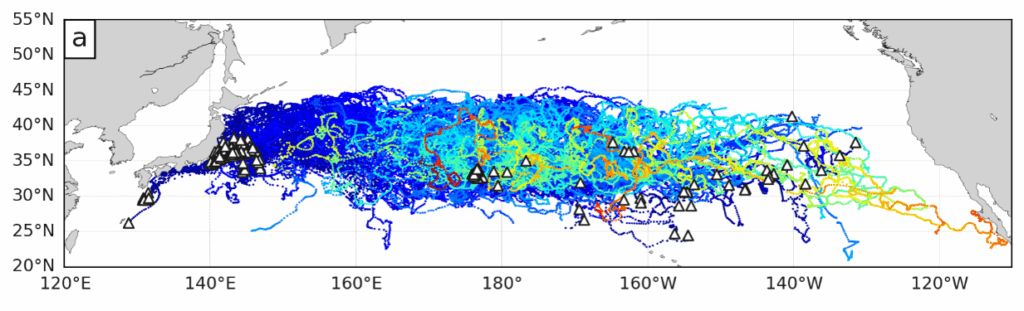
This study rewrites the narrative of the “lost years”, revealing that juvenile loggerhead turtles are far from passive drifters at the mercy of the currents, but active Ocean travellers undertaking purposeful, large-scale migrations across the Pacific.
Tracking Meets Ocean Modelling: a New Approach
To accurately assess how much the sea turtles’ trajectory is shaped by their active swimming, researchers compared the movements of satellite-tracked juvenile loggerheads with trajectories of surface drifters, which are floating instruments transported by surface Ocean circulation. By combining this information with the data on Ocean currents provided by the GLORYS12 global reanalysis model, which is developed by Mercator Ocean International and distributed through the Copernicus Marine Service, the team successfully separated the turtles’ swimming movement from the movement induced by Ocean currents.
This has long been a challenge in marine ecology, as tracking data shows the overall path of an animal but does not directly reveal how much of this movement is due to swimming or being pushed by the currents. Jointly using drifter data and modelled currents, the study significantly reduced errors in estimating the sea turtles’ swimming velocity and developed a clearer picture of their behaviour. This new approach introduces a methodology applicable to other marine species and guides future monitoring campaigns.
Mercator Ocean International: Supporting Marine Biodiversity with Ocean Data
The study illustrates how operational oceanography supports the scientific understanding of marine biodiversity. Mercator Ocean International, as the entrusted entity operating the Copernicus Marine Service, plays a key role in generating, validating, and distributing high-resolution Ocean data, including surface currents. These oceanographic products provide the environmental context needed to study animal movements and to reveal behavioural patterns at sea.
Mercator Ocean International’s modelling capabilities and science-driven services support a wide range of applications to help preserve marine biodiversity, from tracking migratory species to informing conservation policy and long-term environmental management.
Additional Resources
- Read the full paper: “Swim, baby, swim: the active dispersal scenario of juvenile North Pacific loggerhead turtles revealed by historical satellite tracking data and novel operational oceanography products”
- Read our past work regarding satellite tracking for young sea turtles: “New study led by Mercator Ocean expert highlights potential of miniaturised tags for tracking young sea turtles”
- Read more about oceanography in support of marine biodiversity: “How does Europe help preserve marine biodiversity? ”