

From Data to Decisions :
The Power of the Digital Twin Ocean
Home ⟩ Ocean Intelligence ⟩ The Digital Twin of the Ocean
A dynamic, science-based digital replica of the Ocean, offering seamless access to marine data and enabling advanced simulations to support sustainable Ocean management, climate resilience, and biodiversity.
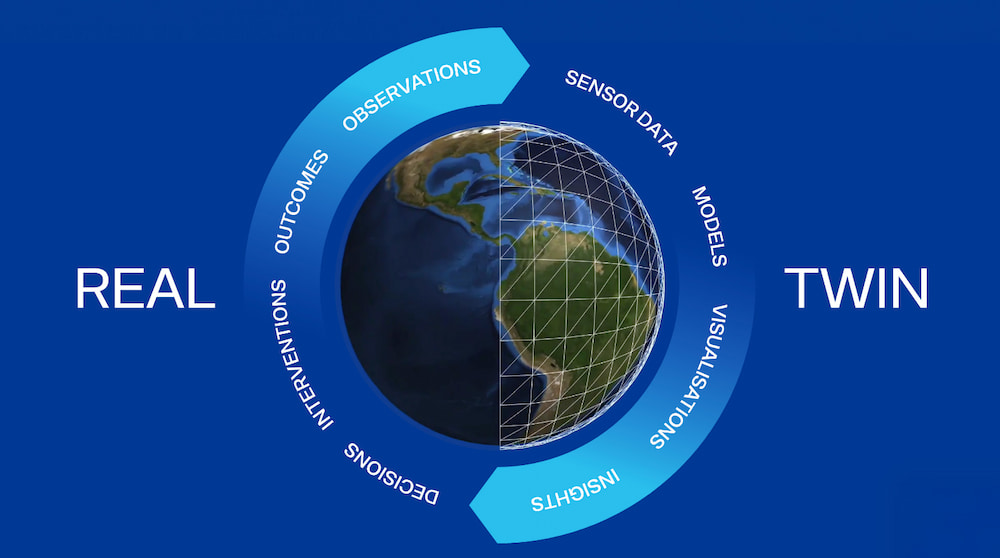
The Digital Twin Ocean (DTO) is a dynamic, AI-powered digital replica of the Ocean. By integrating real-time data, models, and simulations, it enables scientists, policymakers, industry, and citizens to monitor Ocean conditions, forecast changes, and explore future scenarios. These capabilities support informed decision-making for climate resilience, biodiversity protection, and a sustainable blue economy.
Designed as an open, collaborative platform, the DTO connects regional and global digital ocean initiatives, offering a shared and interoperable environment. It aspires to become a fully operational service and a global reference for digital Ocean solutions.
What If Scenarios and Applications
The Digital Twin Ocean offers an intuitive decision-support framework that translates Ocean data into tangible, foresight-driven actions, through three interconnected layers :
What Now : Current Ocean Conditions
Real-time monitoring using
satellites, sensors, and
operational models to track the ocean as it is today.
What Next : Advanced Forecasting Models
Advanced models provide short- and medium-term predictions to anticipate Ocean dynamics and risks.
What If: Exploring Future Scenarios
Simulations are able to assess impacts of climate and human activities to support resilient policies.
Applications span diverse sectors, including coastal risk and flood forecasting, marine ecosystem and biodiversity monitoring, plastic pollution tracking, climate adaptation planning, marine spatial planning, navigation and route optimization, fisheries and aquaculture management, and sustainable blue economy development.
Next-Generation Ocean Prediction with AI
The Digital Twin Ocean leverages both established physical models and Artificial Intelligence to provide fast, accurate, and scalable Ocean forecasts at global, regional and local scales:
-
High-resolution physical models
(e.g., GLORYS12, a global Ocean reanalysis system) simulate detailed Ocean dynamics from open Ocean to coastal areas in hours. -
AI-based global models
(e.g., GLONET, Mercator Ocean’s AI-driven forecasting system) compute key Ocean variables in seconds, enabling rapid, global-scale forecasts. -
Hybrid modelling blends physics,
machine learning, and data assimilation to enhance predictive skills. -
HPC and cloud
infrastructures support massive simulations and near real-time predictions.
Strengthening Global Ocean Observation
AI and digital twins depend on comprehensive, reliable data from a wide range of observing systems, from satellites to autonomous platforms, ships and coastal sensors. The Digital Twin Ocean reinforces the link between observation and prediction, enhancing Europe’s and the world’s ability to understand, monitor, and forecast Ocean changes.
Building a Global Digital Twin Ocean Community
Mercator Ocean, with decades of expertise in operational oceanography, coordinates the development of the European Digital Twin Ocean on behalf of the European Commission and works with partners across Europe. It also contributes to the global community, connecting European efforts with international initiatives, fostering collaboration, and ensuring alignment with initiatives such as the UN Ocean Decade’s DITTO Programme.