


A new international study, led by researchers from the Institute of Atmospheric Physics (Chinese Academy of Sciences), Mercator Ocean International (MOi), and the Laboratoire de Météorologie Dynamique at École Normale Supérieure (ENS-PSL), has demonstrated that large parts of the global Ocean are affected by simultaneous changes in multiple physical and chemical properties.
The study, published in Nature Climate Change, found that in the upper one kilometre of the global Ocean, up to 40% is already affected by these combined changes, with significant implications for marine ecosystems.
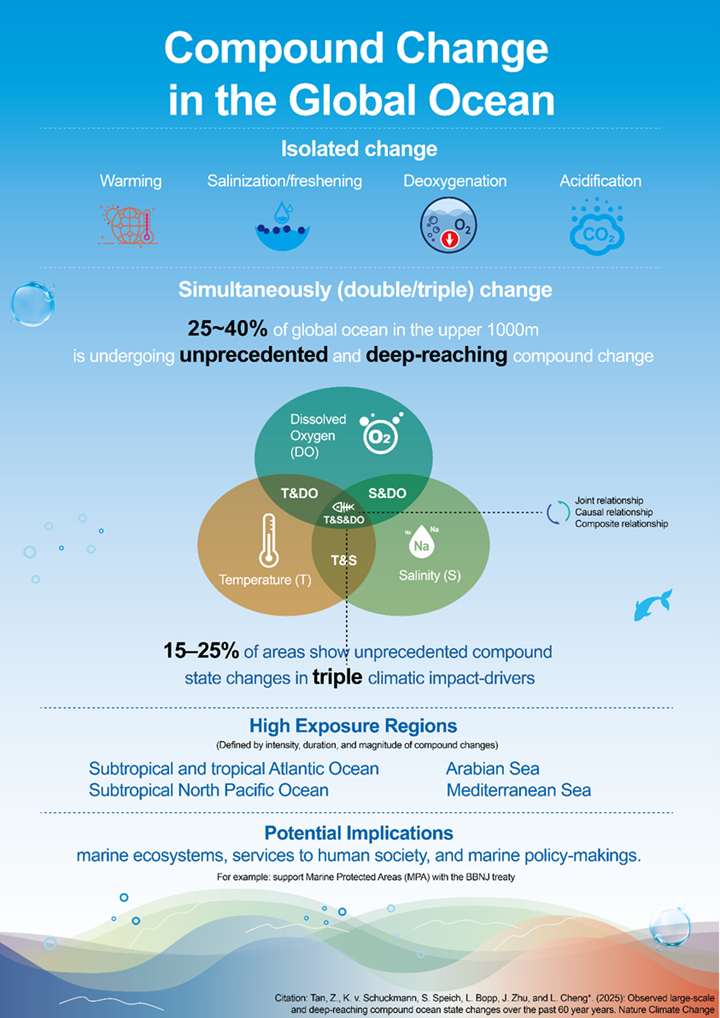
A New Picture of Ocean Transformation
Thanks to its major role in regulating climate, storing carbon, and sustaining marine ecosystems, the Ocean is often described as the Earth’s life-support system. However, it is undergoing profound transformation.
Researchers found that significant changes are occurring simultaneously in several key physical and chemical properties of large parts of the global Ocean which influence Ocean circulation, biogeochemistry, and ecosystem dynamics.
Vast regions are warming, losing oxygen, and becoming saltier or fresher and more acidic at the same time. Between 25% and 40% of the upper Ocean (down to around one kilometre deep) has already undergone significant changes to at least two of these variables, compared to six decades ago. The most intense shifts are taking place in the tropical and subtropical Atlantic Ocean, the subtropical North Pacific Ocean, the Arabian Sea, and the Mediterranean Sea.
Each of these changes affects marine life, and when they occur together, they can push ecosystems beyond their capacity to adapt. Additionally, these “compound changes” alter how the Ocean stores heat and carbon, weakening its capacity to regulate the Earth’s climate. These overlapping processes stress marine ecosystems, potentially disturbing food webs and threatening biodiversity.
By making direct observations, researchers identified where trends caused by human activity stand out from short-term variability. This has revealed that even the deep Ocean layers, once thought to be stable, are also being affected.
This approach enables scientists to determine both the depth and extent of the ongoing transformation, providing a strong foundation for monitoring the Ocean’s equilibrium and informing climate risk management strategies.
Mercator Ocean International’s Contribution to global Ocean Knowledge
This publication is part of MOi’s ongoing collaboration with ObsSea4Clim, an EU-funded project aimed at strengthening Europe’s framework for ocean observations to support climate assessments and sustainable development. The project brings together experts in Ocean observation, climate science, modelling, and data management to develop improved indicators of Ocean change and its impacts.
Mercator Ocean International contributed to this research by drawing on its core expertise in Ocean observations, reanalysis, and modelling, developed over the last 30 years. During this period, MOi has played a leading role in advancing Operational Oceanography, combining satellite data and in situ observations with numerical models and forecasts to deliver detailed representations of the Ocean’s physical and biogeochemical states.
Strengthening the Scientific Foundation for Global Action
The study demonstrates the importance of sustained international cooperation in Ocean observation. The framework developed “provides a scientific foundation for assessing climate risks and supporting policies, such as the expansion of Marine Protected Areas under the UN’s High Seas Treaty” – says Dr. Karina von Schuckmann (Mercator Ocean International).
Through its ongoing collaboration with academic and institutional partners, and leading initiatives such as the European Digital Twin Ocean, Mercator Ocean International contributes to global efforts towards climate adaptation and sustainable Ocean management, translating scientific data into actionable knowledge.
Read the full paper: Tan, Z., K. von Schuckmann, S. Speich, L. Bopp, J. Zhu, and L. Cheng. Observed large-scale and deep-reaching compound ocean state changes over the past 60 years. Nature Climate Change, 2025.