


Mercator Ocean International is intensifying its efforts to leverage the power of AI to deliver increasingly accurate ocean forecasting.
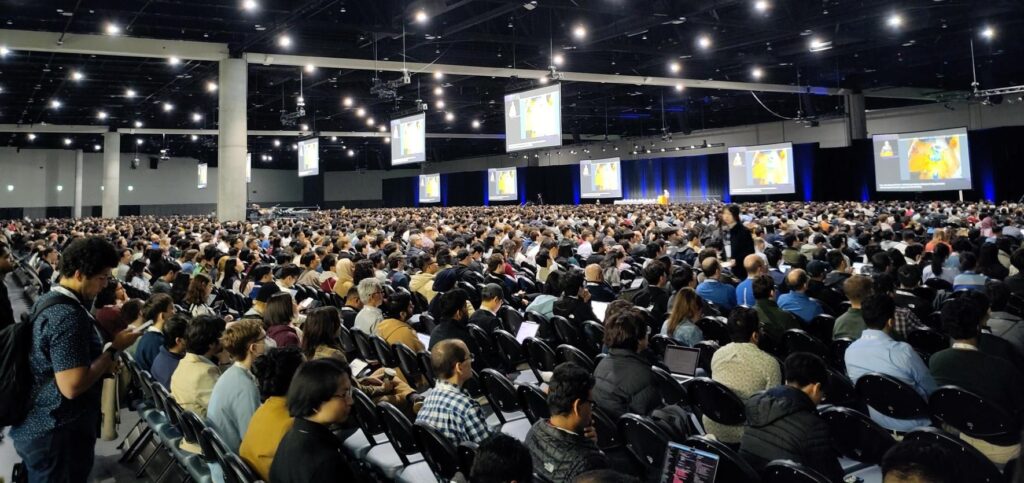
At the Annual Conference on Neural Information Processing Systems (NeurIPS2025) in San Diego, USA, our organization unveiled OceanBench, the first open benchmark designed to assess AI Ocean forecasting models. This represents a new major milestone after the launch of GLONET, Mercator Ocean’s global ocean neural network-based forecasting system last September.
Setting new standards for Ocean prediction with AI
OceanBench fills the gap in standardized quality, validation and physical consistency that so far has prevented wider operational adoption of AI in ocean forecasting, enabling AI to further advance this field. The new service will provide:
- Open data and open-source tools for reproducible evaluation,
- Three evaluation tracks: Model-to-Reanalysis, Model-to-Analysis, Model-to-Observations,
- Physical diagnostics that verify forecasts against known ocean dynamics.
The first benchmark round includes four global forecasting systems: the high-resolution physics-based GLO12, and three ML ocean emulators — GLONET, XiHe, and Wenhai.
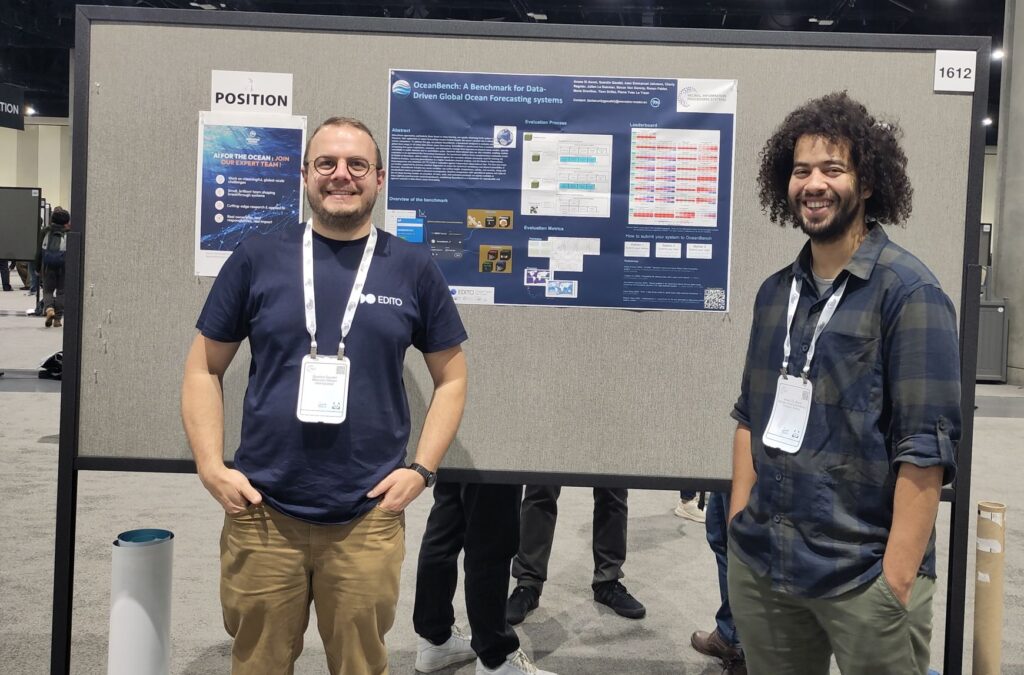
Anass El Aouni said: “OceanBench provides a transparent standard to evaluate AI-driven ocean forecasts. By comparing artificial intelligence with physics-based models, we can highlight strengths, identify areas for improvement, and guide the development of more reliable forecasting tools. There is no single ‘best’ model, but the benchmark ensures fair, science-based comparisons and helps users select the most suitable solution for each application.”
“Artificial intelligence is transforming the speed and scale of ocean prediction, but trust requires careful validation. OceanBench allows the community to rigorously measure performance while keeping AI models grounded in ocean physics. Combined with physics-based systems, AI can accelerate forecasts and broaden access to ocean information. This is critical for advancing operational forecasting and supporting Europe’s Digital Twin Ocean vision.” added Quentin Gaudel.
GLONET: Mercator Ocean’s own AI global forecasting system
With OceanBench, Mercator Ocean has finally validated its new AI global ocean neural network-based forecasting system (GLONET). GLONET was launched last September, and is now ready for operational deployment. Its main features include:
- 10-day global forecasts generated within seconds
- Forecast variables including sea surface height, temperature, salinity, and currents across 21 depth levels
- Trained on Mercator Ocean’s GLORYS12 reanalysis, ensuring physical consistency
“With GLONET validated through OceanBench, AI becomes part of our operational forecasting toolkit. These capabilities enable faster simulations, broader access to ocean information, and ultimately more robust, science-based decision support,” said Marie Drevillon, Head of Operations at Mercator Ocean and co-author of OceanBench.
Understanding and Predicting the Ocean using Artificial Intelligence
Mercator’s AI expertise had been previously highlighted during the workshop “Understanding and Predicting the Ocean using Artificial Intelligence” organized in Halifax, Nova Scotia, on 4 and 5 November 2025.
Hosted by the Canadian presidency of the G7 Future of the Sea and Ocean Initiative and in partnership with the Marine Environmental Observation, Prediction, and Response Network (MEOPAR), Canadian Integrated Ocean Observing System (CIOOS), Department of Fisheries and Oceans, and Innovation, Science, and Economic Development Canada, this workshop convened AI experts and ocean scientists to discuss case studies and important considerations for harnessing AI technologies to improve global-scale ocean understanding and prediction.
On the first day of the workshop, Dr. Yann Drillet, Head of the Research and Development Department at Mercator Ocean, delivered a keynote presentation on machine learning ocean models developed for the European Digital Twin. Later, Anass al Aouni, presented on Mercator Ocean’s GLONET as well as on OceanBench.
These presentations, along with the discussions and hands-on breakout groups throughout the workshop, allowed for a collective exploration of challenges and enablers for the responsible and scalable implementation of AI and data solutions in ocean science.
OceanBench and GLONET at the service of Europe’s digital ocean vision
The launch of OceanBench and the deployment of GLONET represent major advances toward Europe’s Digital Twin Ocean vision, enabling faster, more reliable, and physically robust ocean predictions. The new phase of the European Digital Twin Ocean (EDITO2) was presented in November at the Digital Ocean Forum 2025.
By providing a shared, community-driven standard for evaluating AI systems, OceanBench reinforces Europe’s leadership in trustworthy, operational AI for the ocean. As Mercator Ocean transitions into an intergovernmental organization (IGO), it will strengthen long-term European coordination and collective capacity to deliver this shared digital ocean ambition.
The paper “OceanBench: A Benchmark for Data-Driven Global Ocean Forecasting Systems” was published and presented at NeurIPS 2025. Authors include Anass El Aouni, Quentin Gaudel, Juan Emmanuel Johnson, Charly Regnier, Julien Le Sommer, Simon van Gennip, Ronan Fablet, Marie Drevillon, Yann Drillet, and Pierre-Yves Le Traon. OceanBench is implemented by Mercator Ocean International in collaboration with: Programme prioritaire de recherche Océan & Climat, IMT Atlantique, Université de Grenoble Alpes, IGEO Instituto de Geociencias.