


Following her previous engagement at earlier Conferences of Parties (COPs), Mercator Ocean International once again designated world-renowned oceanographer Dr. Karina von Schuckmann as its Special Envoy at COP30.
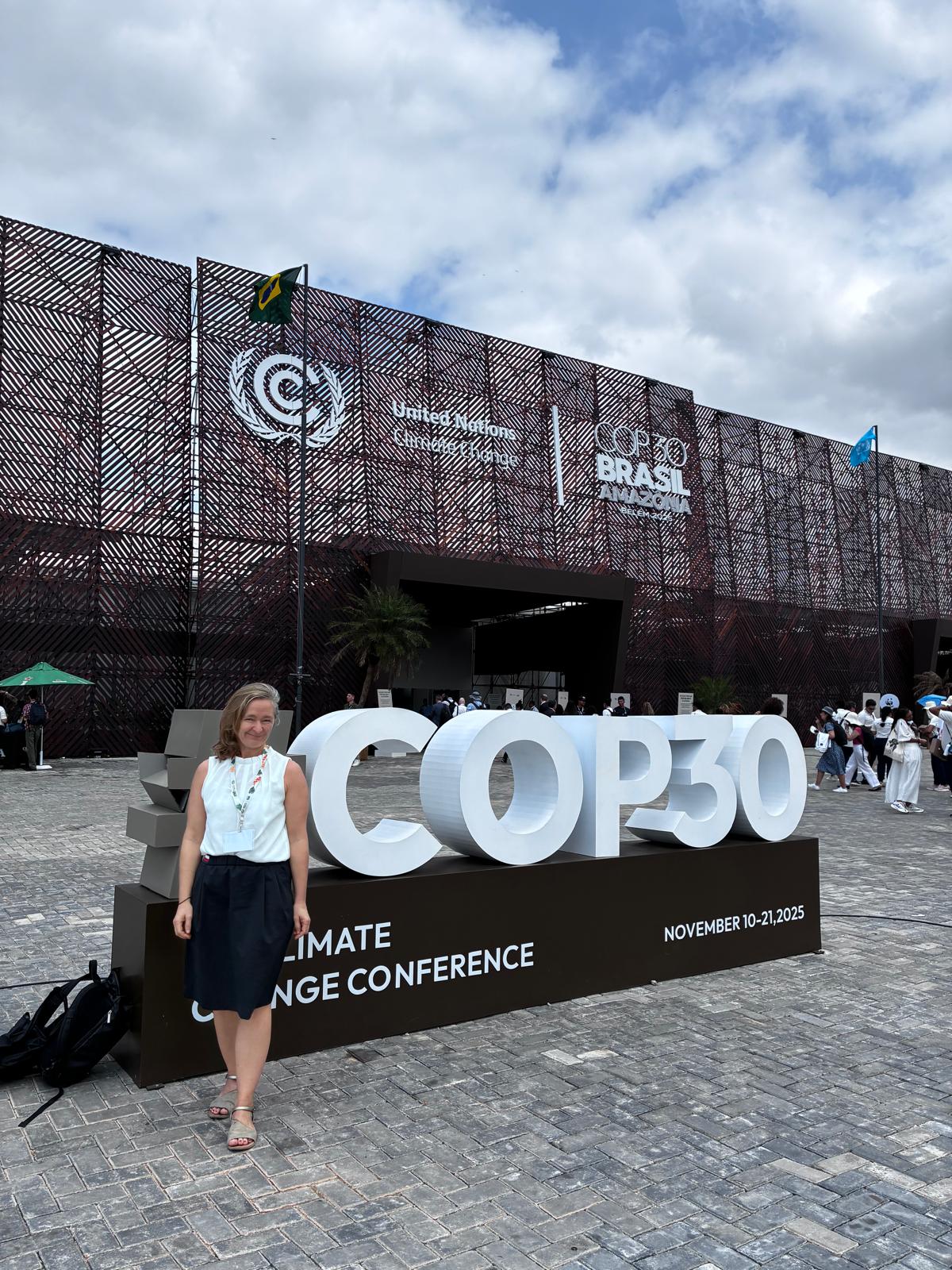
Key agenda highlights of Karina von Schuckmann, Mercator Ocean International Special Envoy for COP30
Recognised globally for her leadership in Ocean climate monitoring and her role as a lead author of flagship assessments such as those of the Intergovernmental Panel on Climate Change (IPCC), Karina participated in a wide range of high-level Blue events during the 30th edition of the Conference of the Parties, held this year in Belém, Brazil.
The Earth Energy Imbalance: A Fundamental Indicator for a Changing Climate, that is increasing faster than expected
- 10 November | COP Science Pavilion
- Karina von Schuckmann, Piers Forster
Karina brought her scientific expertise to the high-level talk “The Earth Energy Imbalance: A Fundamental Indicator for a Changing Climate, that is increasing faster than expected”, dedicated to the accelerating Earth Energy Imbalance (EEI), a core focus of her research.
She highlighted how this fundamental climate indicator, which measures the difference between the energy Earth absorbs and releases, shows that the planet is accumulating heat at an unprecedented rate. Drawing on her studies that reveal the increasingly rapid warming of the Ocean and the implications for sea-level rise, changing weather patterns and climate extremes, Karina underscored the urgent need to strengthen global observations and understanding of EEI.
The session explored the drivers behind the recent acceleration, from changes in atmospheric pollution to shifts in cloud behaviour, and discussed the Paris Agreement’s long-term temperature goal and future climate risks.
Earth Information Day 2025
- 10 November | Plenary 2, Area D
- Global Ocean Observing Systems (GOOS) Event
During Earth Information Day 2025, Karina contributed to high-level discussions on the state of the global climate system and advances in systematic Earth observation in the thematic breakout session: “Observations for supporting climate action, and the Ocean and Cryosphere”.
She delivered a presentation titled “Advances in ocean monitoring and experiences in enhancing prediction and modelling”, sharing insights on how sustained ocean observations and improved data integration strengthen climate prediction capabilities. The event provided a platform for dialogue on long-term climate observations, with plenary updates on the global climate system followed by thematic discussions on observations supporting climate action – particularly for the ocean and cryosphere – and on innovations in Earth observation, data access, and sharing.
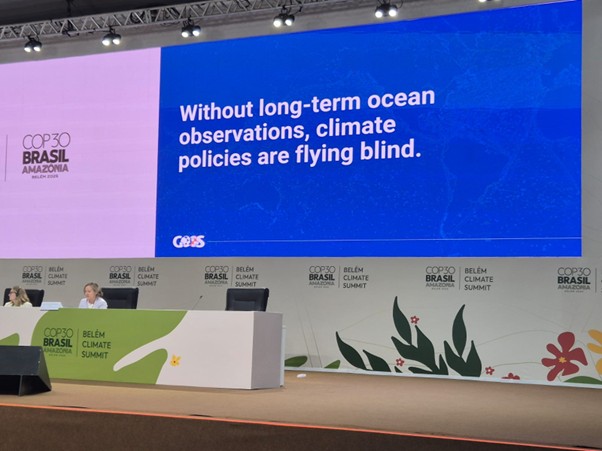
Outcomes of the One Ocean Science Congress (OOSC)
- 11 November | Ocean Pavilion
The following day, Karina represented Mercator Ocean International at a roundtable in the Ocean Pavilion during COP30 in Belém, organised by Ifremer. The discussion built on the outcomes of the One Ocean Science Congress (OOSC) and explored how ocean science can inform timely decision-making, anticipate irreversible change, and support equitable climate action. Karina highlighted the readiness of operational oceanography, with three decades of development, to deliver real-time forecasts, sustained monitoring, and advanced services through infrastructures such as Copernicus, progressing toward a Digital Twin of the Ocean.
She also stressed the role of global frameworks, including OceanPredict and the UN Ocean Decade, in translating scientific knowledge into policy-relevant action, and concluded by presenting key insights from the 9th Copernicus Ocean State Report.
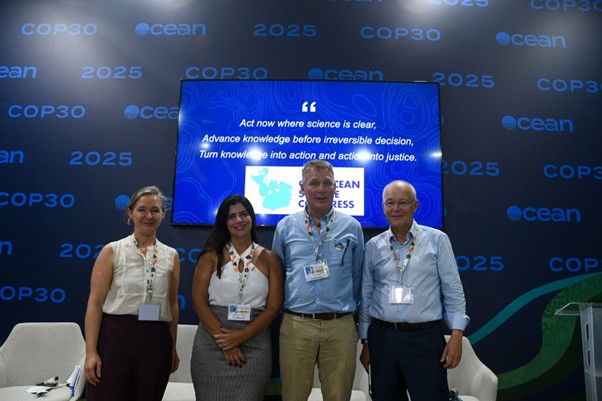
Securing Climate Knowledge: International Collaboration on Climate Data
- 11 November | Norwegian Pavilion
On the same day, Karina also took part in a session at the Norway Pavilion, where she further developed key messages from her work, including the importance of effective knowledge transfer between science and policy. The event was attended by Norway’s Minister of Climate and Environment, Andreas Bjelland Eriksen, providing an opportunity to reinforce the role of science in informing political decision-making.
Global Climate Observing System: Emerging Trends in Observations
- 13 November | Meri Pavilion
- GCOS WMO side event
Karina participated in an event organised by the Global Climate Observing System (GCOS) titled “Emerging Trends in Observations”, where she highlighted the fundamental role of observations in understanding, monitoring, and predicting Earth system cycles.
Her intervention stressed that systematic, long-term climate observations across all domains underpin our ability to capture the natural rhythm of Earth’s cycles, their underlying processes, feedbacks, and future evolution. Karina also underlined how sustained pressure from climate change is disrupting these natural rhythms, with human-induced greenhouse gas emissions pushing the Earth out of energy balance and driving unprecedented and committed changes to the Earth system, with far-reaching impacts on ecosystems and human societies.
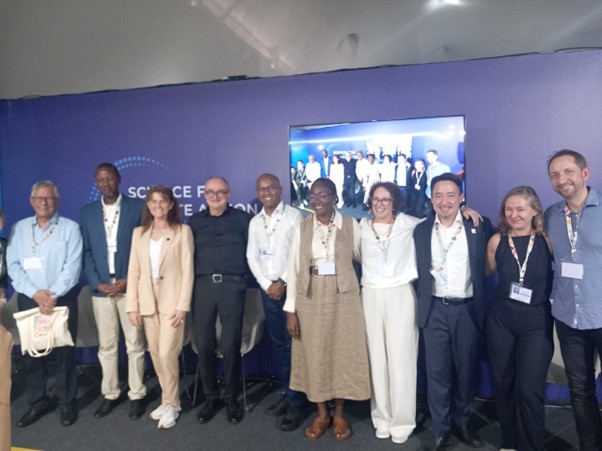
Adaptation across scales and sectors: the case for coastal and ocean adaptation
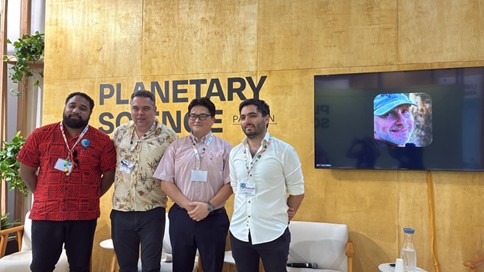
On the same day, in the context of COP30, the Group on Earth Observations (GEO) Blue Planet initiative, led by Mercator Ocean International’s Audrey Hasson, co-organized the side-event “Adaptation across scales and sectors: the case for coastal and ocean adaptation” at the Planetary Science Pavilion of the Conference, together with Climate Service Center Germany (GERICS).
In line with the messages conveyed by Karina across the previous events, the speakers highlighted the importance of evidence-based and inclusive approaches that integrate diverse knowledge systems for the benefit of local and coastal communities.
The event highlighted the growing recognition of coastal and ocean spatial planning within National Adaptation Plans and underscored practical ways to better integrate coastal and marine adaptation into national and sub-national climate frameworks. Key takeaways included the need to align adaptation objectives with coastal and ocean economies, strengthen evidence-based and locally relevant decision-making, and bridge scientific, local, and Indigenous knowledge.
Discussions also pointed to persistent data, capacity, and financing gaps, especially in African regions, and emphasized the importance of stronger coordination between national and sub-national actors to advance coastal resilience and contribute to the Global Goal on Adaptation.
Governance in the context of the climate crisis: Scientific committees and thematic reports
- 14 November | Science for Climate Action Pavilion
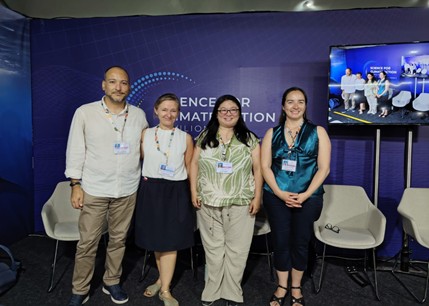
On 14 November, Karina participated in the session “Governance in the context of the climate crisis: Scientific committees and thematic reports”, at the Science for Climate Action Pavilion, which focused on Chile’s 2025 thematic reports, notably on Ocean–Climate–Biodiversity, as an example of effective science–policy interaction.
The session brought together representatives from the public sector and the scientific community to exchange experiences on institutional models for science advice and to discuss common challenges such as political will, financing, and communication.
Responding to questions on the importance of reporting on the ocean, Karina highlighted the ocean’s role as a climate regulator and sentinel of change, stressing the need for sustained monitoring to understand impacts such as ocean warming, sea-level rise, and acidification, and to anticipate long-term, committed changes.
She also emphasised the ocean’s role as a global connector requiring collective action, and the importance of effective knowledge transfer, from global to regional scales, drawing parallels between Chile’s thematic reports and European efforts such as the Copernicus Ocean State Report.
Global Ocean observations for climate resilience in a changing geopolitical landscape
- 18 November | Finland Pavilion
Concluding her busy agenda at COP30, Karina participated in a session at the Finland Pavilion, Blue Zone, titled “Global ocean observations for climate resilience in a changing geopolitical landscape”.
The interactive dialogue explored how ocean observations support climate and biodiversity action and emphasized the critical role of science, technology, and diplomacy in fostering international cooperation during turbulent times. The session showcased innovations from the Nordics to the tropics, discussed sustainable financing models for ocean monitoring, and highlighted how transparent data-sharing can strengthen global trust.
Lead author of the next IPCC Assessment Report (AR7)
Together with Angélique Melet, Head of the Ocean Climate team at Mercator Ocean, Karina was selected as lead author of the 7th IPCC report. Our scientists will work among 664 experts from 111 countries chosen from nearly 4,000 nominees. Last week, they were among ~550 authors who gathered in Paris for the first in-person meeting of all three IPCC working groups.
Additional Resources
- Learn more about COP30
- COP30 Side-event “Adaptation across scales and sectors: the case for coastal and ocean adaptation” – GEO Blue Planet
- Relive the One Ocean Science Congress 2025
- Learn more about the latest paper on Global Ocean Indicators led by Dr. Karina von Schuckmann: “Global Ocean Indicators: Marking Pathways at the Science-Policy Nexus”
- Learn more about Karina’s participation in the 7th IPCC report