


Greece signs the Convention establishing the Mercator International Centre for the Ocean, reinforcing Europe’s commitment to trusted digital ocean systems and intergovernmental cooperation.
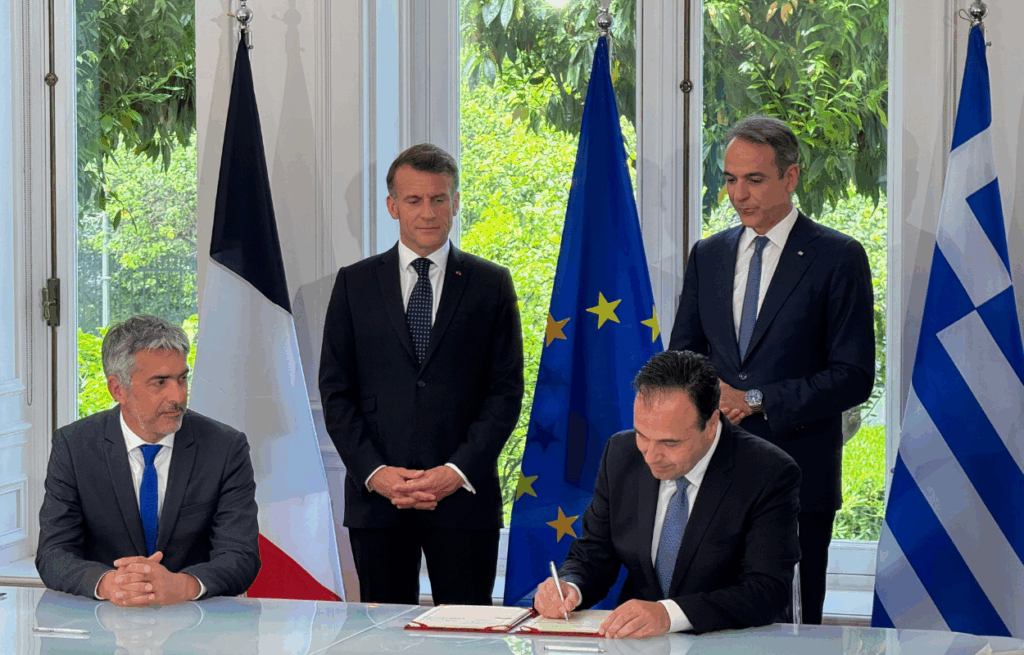
From left to right: Pierre Bahurel, Director General of Mercator Ocean, Emmanuel Macron, President of the French Republic, Dimitris Papastergiou, Minister of Digital Governance and Artificial Intelligence of Greece, and Kyriákos Mitsotákis, Prime Minister of Greece.
By joining the group of Convention signatories, Greece commits to building a shared European governance framework for next-generation digital ocean services, strengthening Europe’s capacity to deliver trusted ocean intelligence in support of climate action, maritime safety, environmental protection and the development of a sustainable blue economy.
Greece’s strategic commitment
Greece’s signature reflects its role as a major maritime nation and its emergence as a European leader in digital technologies and artificial intelligence. Through national investments, including the Pharos AI Factory and the Daedalus national supercomputer, Greece is strengthening its digital and AI capabilities as part of a broader strategy for data‑driven governance and innovation.
As a Member State, Greece will contribute to defining the organisation’s strategic priorities and to supporting coastal resilience, climate adaptation, biodiversity protection, maritime security and sustainable blue economy development. Membership also strengthens national competitiveness by reinforcing participation in EU‑level activities, notably through the Copernicus Marine Service, and by supporting the transformation of digital innovation into operational marine and maritime services.
Advancing Europe’s digital ocean governance
The Mercator International Centre for the Ocean is being established to deliver advanced environmental and climate services through state-of-the-art numerical modelling, digital twins, and artificial intelligence.
Operational oceanography is now an essential pillar of modern ocean governance. Digital ocean systems integrate satellite observation, in-situ measurements (buoys, ships and autonomous platforms), and advanced modelling and forecasting to deliver reliable, real-time ocean information services.
These services support a wide range of public and economic activities, including coastal monitoring, the sustainable management of marine resources, maritime routing and safety, aquaculture, environmental surveillance, defence, and security. Digital and AI technologies, including the European Digital Twin of the Ocean, are increasingly transforming how marine and maritime sectors plan, anticipate and respond.
Europe has already developed one of the world’s most advanced digital ocean infrastructures through the Copernicus Marine Service. The creation of the Mercator International Centre for the Ocean will further consolidate this leadership, with the support of the European Commission and in alignment with established intergovernmental governance models such as ECMWF and EUMETSAT.
From vision to delivery
The Convention establishing the Mercator International Centre for the Ocean was adopted in June 2025. At the United Nations Ocean Conference in Nice, France and Norway became the first signatories, while Greece and other European States committed to progressing towards signature through the Declaration of Lympia. Greece’s signature further strengthens the diplomatic momentum and the collective ambition to establish a politically representative and strategically robust intergovernmental organisation.
The future organisation will deliver upstream ocean data and modelling capabilities to support Greek marine stakeholders (research centres, start-ups, private companies, ports, coast guards and public authorities) for applications such as maritime safety, aquaculture monitoring, coastal risk assessment and enhanced maritime security. It will also help guide Europe’s major digital and environmental infrastructure investments, promoting coherence across high‑performance computing, scientific cloud infrastructures, satellite missions, observing systems and marine research programmes.
Welcoming the signature, Pierre Bahurel, Director‑General of Mercator Ocean International, highlighted Greece’s role in the future organisation, noting that Greece “will play a leading role in defining the priorities and actions of the future organisation, in support of ocean knowledge and the development of digital reference services and science-based international ocean governance”.
Additional Resources