


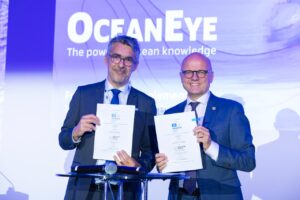
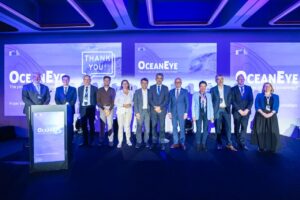
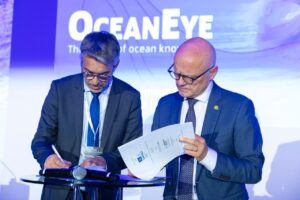
Mercator Ocean International and IOC-UNESCO signed a Cooperation Agreement as the European Commission’s OceanEye initiative moves from vision to action.
Brussels, 11 June 2026 - Europe’s ocean ambition took a step forward yesterday at the first Digital Ocean Week in Brussels. The event gathered European institutions, Members of the European Parliament, Member States and leading ocean and space organisations to collectively engage, for the first time, with the implementation of OceanEye – the European Commission’s initiative to build a sustained, coordinated global ocean observation and digital intelligence system, formally adopted on 3 June 2026.
With a €50 million investment to strengthen the Global Ocean Observing System (GOOS), OceanEye sets the ambition for the EU to provide 35% of global ocean observing capacity and become the world’s leading provider of ocean intelligence by 2035.
The Commission’s OceanEye Communication identifies Mercator Ocean International as a direct contributor to OceanEye through its implementation of the Copernicus Marine Service and its central role in developing the European Digital Twin Ocean.
At the event, Mercator Ocean International and the Intergovernmental Oceanographic Commission of UNESCO (IOC‑UNESCO) signed a Cooperation Agreement to strengthen GOOS and ensure that this emerging European digital ocean system, operated by Mercator, becomes a key European contribution to OceanEye.
Strengthening the Global Ocean Observing System
The Global Ocean Observing System, coordinated by IOC-UNESCO, underpins weather forecasting, climate science and maritime security worldwide, drawing on a vast network of autonomous floats, buoys, underwater gliders and drones to continuously monitor ocean conditions. These capabilities are becoming increasingly critical to support environmental monitoring, climate adaptation, a sustainable blue economy, and maritime security.
The Cooperation Agreement will deepen Mercator Ocean International’s engagement with IOC-UNESCO in building a rigorous scientific partnership to evaluate and optimize GOOS, identify monitoring gaps, and guide future investment – exploiting the synergies between satellites, in-situ sensors and Europe’s digital ocean infrastructures to make observation more efficient and its value more visible to decision-makers, users, and the public.
Europe’s ocean intelligence ecosystem behind OceanEye
OceanEye builds upon Europe’s unique combination of ocean observation and forecasting capabilities. Together, the Copernicus Marine Service, the European Marine Observation and Data Network (EMODnet), the EU Digital Twin Ocean, ESA Earth observation missions and EUMETSAT’s satellite systems form one of the most advanced ocean intelligence ecosystems, the operational foundation upon which OceanEye will be built.
At the event, Members of the European Parliament called for a dedicated “Blue MFF” within the 2028–2034 Multiannual Financial Framework to ensure long-term funding for Europe’s ocean observation and digital infrastructure, while Member States highlighted the importance of coordinated national contributions to the success of OceanEye.
A future intergovernmental organization for the Digital Ocean
Today’s agreement also comes as Mercator Ocean International advances its transformation into an intergovernmental organization: the Mercator International Centre for the Ocean.
The OceanEye Communication explicitly recognizes this transformation as providing the long-term stability and shared ownership required by Mercator’s strategic role within OceanEye. The future organization will provide Member States with direct governance over Europe’s ocean forecasting and digital ocean services, ensuring these capabilities remain trusted, independent, and built around the public interest.
Quotes
Costas Kadis, Commissioner for Fisheries and Oceans: “OceanEye has a clear vision and concrete proposals to transform how we observe and understand the ocean. To achieve the maximum that OceanEye can offer, it is important for all of us to act together. This is the moment to demonstrate true EU leadership in this global challenge. I am very pleased to be part of the Digital Ocean Week, which brings together the digital ocean community to advance Europe’s ambitions.”
Commissioner for Defence and Space Andrius Kubilius: ” Space is the ultimate vantage point for observing and understanding our planet and its oceans. Copernicus represents Europe’s eyes on the ocean, empowering OceanEye to enhance ocean intelligence, protect marine ecosystems, ensure maritime surveillance, and secure Europe’s strategic autonomy. Together, they transform ocean data into a force for climate resilience, sustainable growth, and global stability.”
Vidar Helgesen, Executive Secretary of IOC-UNESCO: “Strengthening the Global Ocean Observing System is not just a scientific challenge, it is a governance challenge. We need an optimised system that countries can sustain over time, and that will only be possible with much closer cooperation with governments. This new partnership with Mercator Ocean, as it becomes an intergovernmental organization, will help design a system that is responsive to Member States and focused on their priorities. And in turn, Mercator Ocean and the Digital Twin Ocean are critically dependent on the data provided by ocean observations.”
Pierre Bahurel, Director General of Mercator Ocean International: “OceanEye marks an important step in Europe’s commitment to the ocean. By working closely with IOC‑UNESCO and GOOS, Mercator Ocean will make Europe’s digital ocean system – from Copernicus Marine to the European Digital Twin Ocean – a concrete contribution to OceanEye and to a more robust, shared system for observing and understanding the ocean.”
Christophe Clergeau, Member of the European Parliament and President of the SEArica Intergroup: “With OceanEye, we have the opportunity to make ocean observation and digital ocean systems a strong pillar of EU ocean decision-making, and the next Multiannual Financial Framework must reflect that ambition.”