
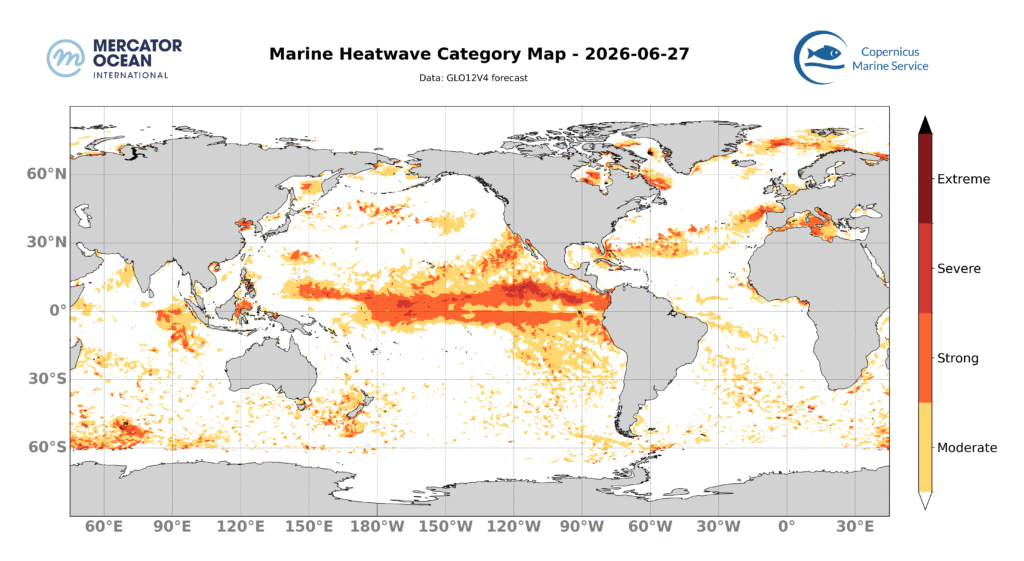
Marine heatwave category map for the 27 June 2026 forecast across the global ocean. GLO12 forecast. Source: Mercator Ocean International.
The marine heatwave affecting the Mediterranean basin from the Strait of Gibraltar to Greece is intensifying and is now mostly in the moderate to strong categories, with severe conditions in some local areas. South of Crete and Turkey, the marine heatwaves are decreasing in intensity and area, with only a few scattered areas remaining in the moderate category.
Off the coast of Norway, the marine heatwave is shrinking in area. The marine heatwave, which extends from the Bay of Biscay along the northern coast of Spain to the Azores archipelago offshore, is intensifying, with the “strong” category expanding in area off the coast of Spain. The marine heatwave off the coasts of Florida and Cuba is intensifying, with the “strong” category expanding in area. In the center of the basin around 55°W/30°N, the marine heatwave is losing intensity but expanding in area.
The marine heatwave near 180°W and 50°N is shrinking in area, and only two zones (one classified as moderate and the other as strong) remain. The marine heatwave in the Sea of Japan is shrinking in area and intensity, with only a few scattered areas of moderate and strong intensity remaining. The marine heatwave in the Yellow Sea is shrinking in area and intensity in the southern part of the basin, but in the north, it is increasing in intensity and has generally reached the strong category. The marine heatwave extending across nearly the entire equatorial axis from -10° to 15°N remains generally stable in area but is increasing in intensity off the coast of Central America, with the “strong” and “severe” categories expanding in area. The marine heatwave around the Philippines is decreasing in area, while the one around the island of Borneo is increasing in intensity with the development of “strong” categories.
The marine heatwave off the southern coast of New Zealand remains stable in terms of both area and intensity, with conditions still ranging from moderate to strong.
The marine heatwave, extending from 50°E to 90°E in longitude and 45°S to 60°S in latitude, remains stable in both extent and intensity, with conditions still ranging from moderate to strong.

Weekly temperature anomalies for the week 20 – 27 June 2026
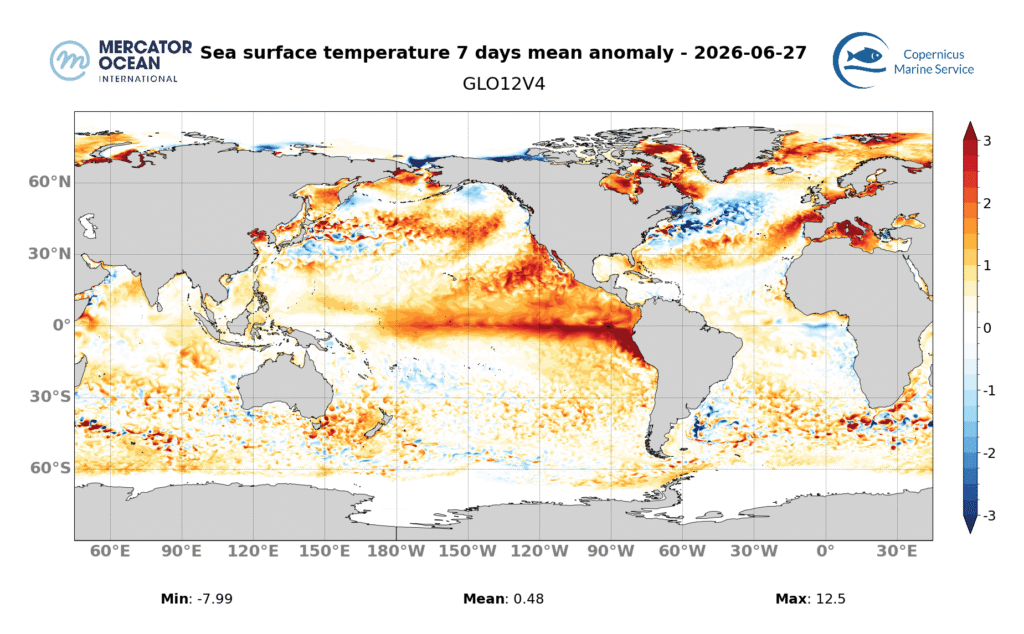
Weekly sea surface temperature anomaly map for the week of 20–27 June 2026. GLO12 forecast. Source: Mercator Ocean International.
| Mer Méditerranée | -3°C à >3°C |
| Atlantique Nord | -3 °C à 3°C |
| Pacifique Nord | -1.5°C à 3°C |
| Pacifique Sud | -1°C à >3°C |
| Océan Austral | 0°C à 1.5°C |