Sea Ice Bulletin
March 2026

Key Takeaways

Iceberg pictogram

Arctic


  • Maximum  sea ice extent in the Arctic was likely reached on 6 March 2026, at 13.96 million km², 1.05 million km² or about 7% below the average 1993-2010 for the same date.
  • 2026 winter maximum ranked second-lowest since 1993, following 2025 near record-low levels.
  • Regionally, the highest losses in sea ice are visible in the peripheral areas of the Arctic region, by the North Pacific and North Atlantic – in the Gulf of St. Lawrence and in the Barents Sea.
Iceberg pictogram

Antarctic

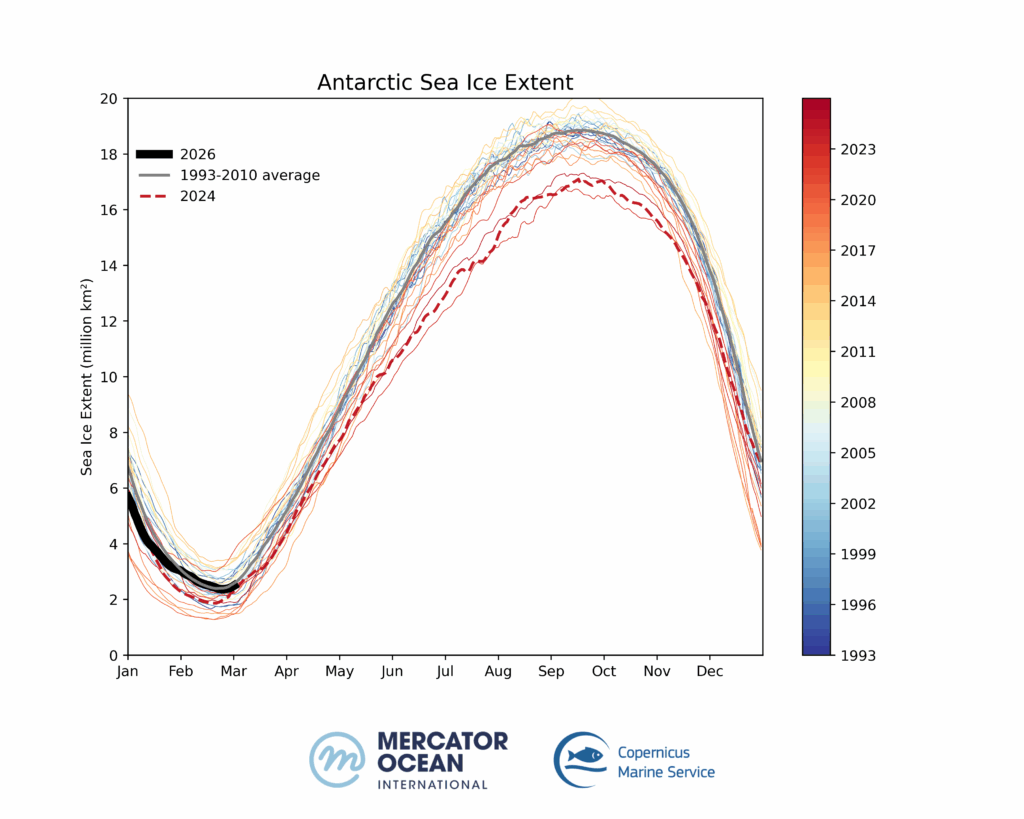
  • Sea ice extent in the Antarctic region likely reached its daily minimum value for the year on 25 February 2026, at 2.36 million km². 


  • This summer minimum extent follows very closely the long-term average of 1993-2010 for the same date (2.40 million km²). 


  • Regionally, an unusually larger sea ice extent is detected in the northwestern part of the Weddell Sea.  

See other bulletins:

Arctic sea ice extent 

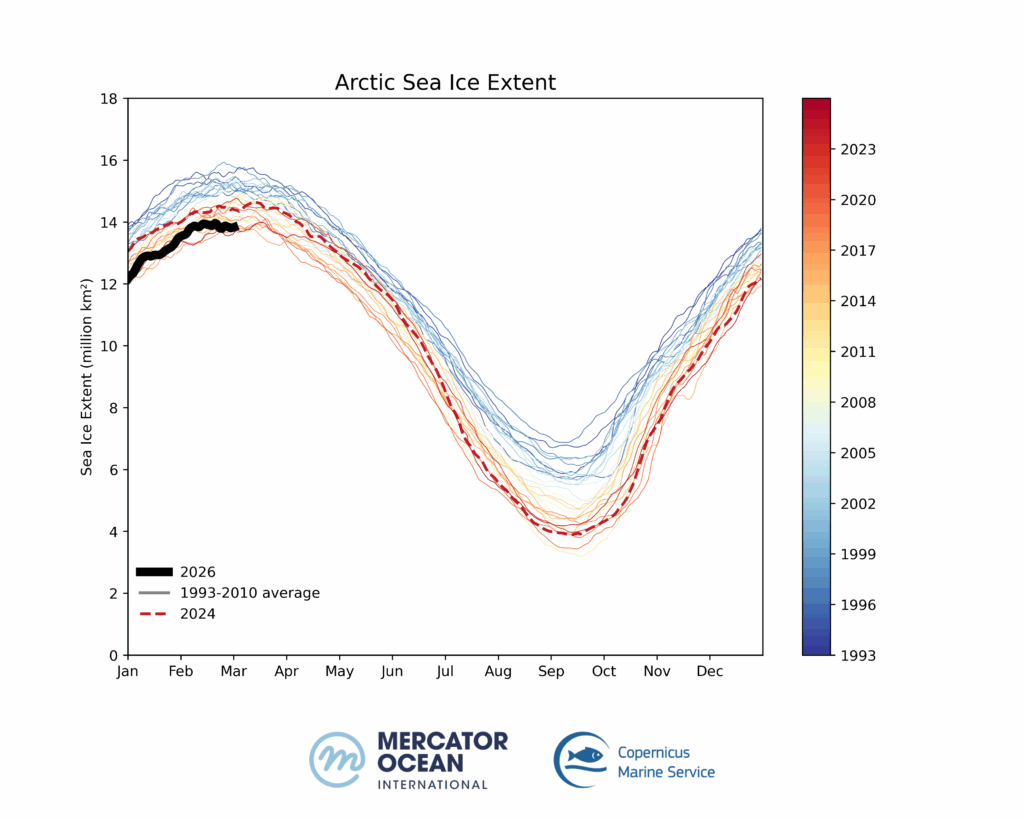
Left: Arctic sea ice extent (red) for 6 March 2026. The black line represents the 1993-2010 long-term average (climatology) for the same day of the year. Right: Daily Arctic Sea ice extent. between 1993-2026. Data: GLO12/GLORYS12. Source: EU. Copernicus Marine Service/Mercator Ocean International.

In the Northern Hemisphere, maximum sea ice extent was likely reached on 6 March, at 13.96 million km², 1.0 7% below the average. This winter’s maximum extent is the second lowest since 1993, continuing the concerning pattern of near record lows already seen in 2025 (5th lowest maximum extent). Since November 2025 Arctic sea ice extent has consistently remained among the three lowest levels on record for that time of year, highlighting persistently low sea ice even during the normal growth season.

The largest regional losses are occurring in the Arctic’s peripheral seas, particularly in areas connected to the North Pacific and North Atlantic. Significant deficits have been observed in the Barents Sea and the Gulf of St. Lawrence.

The Arctic remains one of the fastest-warming regions on Earth. Rising sea surface temperatures are delaying sea ice formation and accelerating melting, further reducing seasonal sea ice and reinforcing long-term climate trends.

* Note that the date of the minimum and sea ice extent values may vary between datasets, so different results may be obtained by the different operational systems around the world. Our operational systems cover the period 1993-2026 and ranks this year’s winter’s extent as the second lowest since 1993. 

Arctic sea ice volume

Sea ice volume in the Arctic is steadily declining, and since 2021 has been breaking records each year. Maximum sea ice volume should be reached in the coming days.

On 3 March 2026 it was measured at 14.29 thousand km3 – -12.59 thousand km³ (or around 47%) below the long-term average 1993-2020.
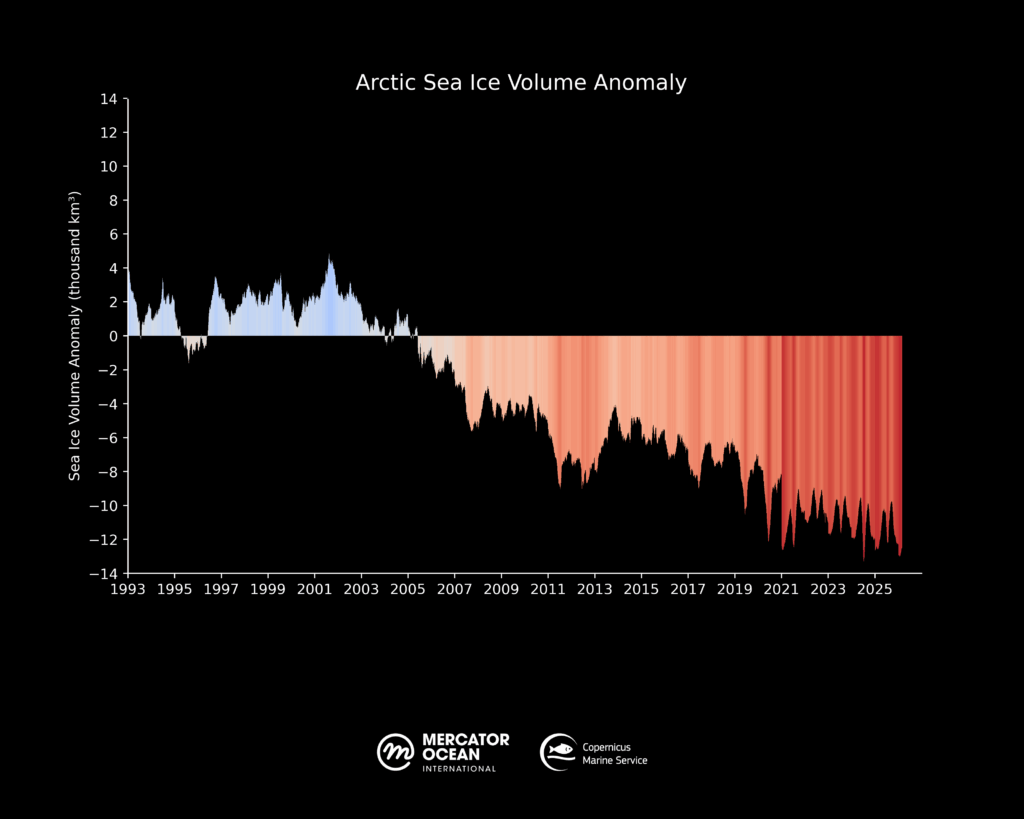
Daily Arctic sea ice volume anomaly between 1993-2026, relative to the 1993-2010 average. Data: GLO12/GLORYS12. Source: EU. Copernicus Marine Service/Mercator Ocean International.

Antarctic sea ice extent


Left: Antarctic sea ice extent (red) for 25 February 2026. The black line represents the 1993-2010 long-term average (climatology) for the same day of the year. Right: Daily Antarctic Sea ice extent. between 1993-2026. Data: GLO12/GLORYS12. Source: EU. Copernicus Marine Service/Mercator Ocean International.

Sea ice cover in the Southern Ocean likely reached its minimum for the year on 25 February 2026, with an extent of 2.36 million km². Globally, the 2026 summer extent follows very closely the long-term trend of 1993-2010 for the same date, with a difference of -0.039 million km², and -1.6% in sea ice. 

Regionally, in the northwestern part of the Weddell Sea, a significant sea ice extent survived the summer, contrary to what has been observed in the previous years (2023, 2024 and 2025). Positive anomalies are also detected in the Amundsen Sea and in various regions along the East Antarctic coast, in the areas of Cosmonauts Sea, Cooperation Sea and Dumont d’urville.  

*Note that the date of the minimum and sea ice extent values may vary between datasets. For instance, the Copernicus Climate Change Service system has detected a daily sea ice minimum value in the Antarctic on 22 February 2026. 

Antarctic sea ice volume

Sea ice volume around the Antarctica reached its minimum at 1.22 thousand km3 –  1.06 thousand km3 below the long-term average.
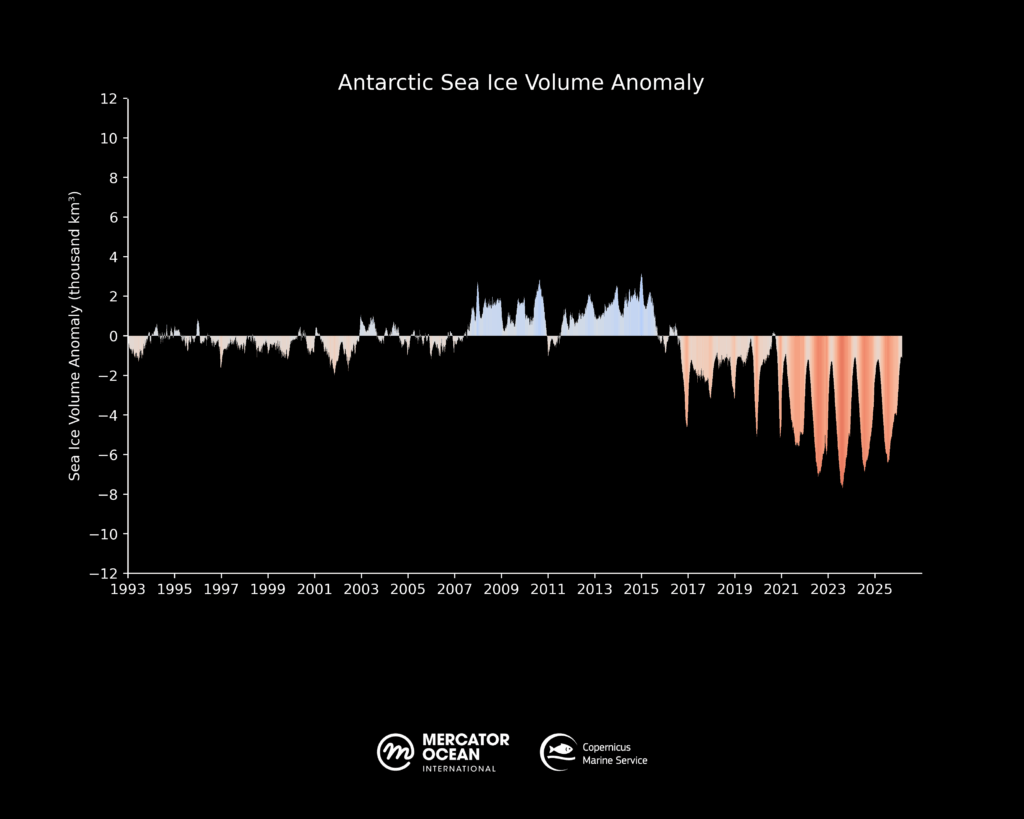
Daily Antarctic sea ice volume anomaly between 1993-2026 (using 1993-2010 climatology). Data: GLO12/GLORYS12. Source: EU. Copernicus Marine Service/Mercator Ocean International.

Notes

Definitions:
  • Sea ice concentration – percentage of sea ice cover within the data grid cell.
  • Sea ice extent – area covered by a significant amount of sea ice, at least 15% sea ice concentration (km²).
  • Sea ice volume – derived from sea ice concentration and sea ice thickness integrated over a respective area (km ³).
Notes:

Products and data used: 

Credits:

*Image citation: European Union, Copernicus Marine Service Data 2026 I © Mercator Ocean
All images in this article can be used freely and should be cited with the information above.

More on the topic: