

Sea Ice Bulletin
September 2026

Key Takeaways

Iceberg pictogram

Arctic

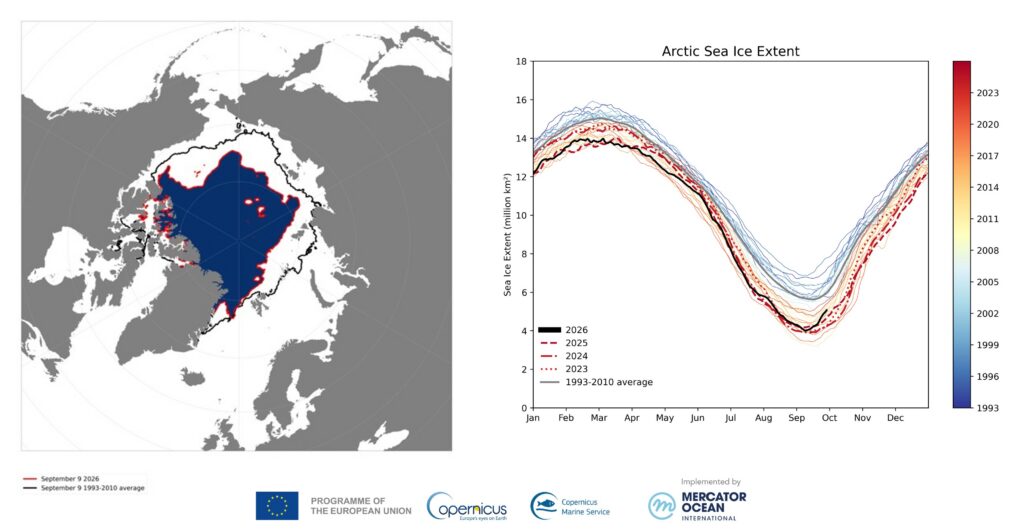
  • Arctic sea ice extent fell to its eighth-lowest level since 1993, reaching 4.0 million km² on 9 September, well below the long-term average. 
  • Sea ice losses were greatest around the Central Arctic Ocean, while the Northern Sea Route remained largely ice-free during summer. 
  • Arctic sea ice volume was among the lowest on record, dropping to 3.0 thousand km³ in September, nearly 10 thousand km³ below average.
Iceberg pictogram

Antarctic

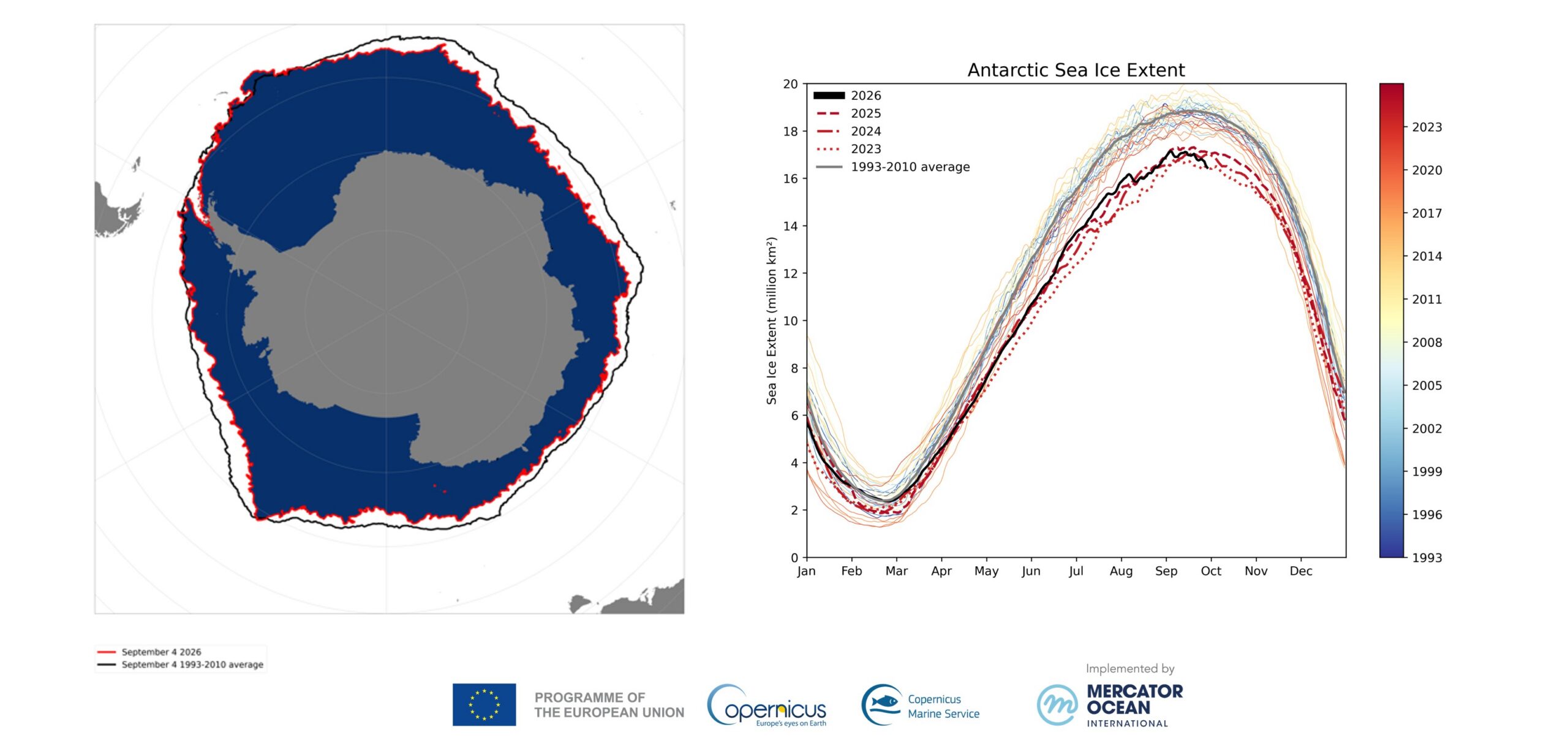
  • Antarctic sea ice reached its third-lowest winter maximum since 1993, peaking at 17.2 million km² on 4 September, well below the long-term average. 
  • 2026 marks the fourth consecutive year of exceptionally low Antarctic winter sea ice extent, highlighting a sustained period of reduced ice cover around the continent. 
  • Antarctic sea ice volume was also unusually low, ranking as the fifth-lowest since 1993, reflecting both reduced ice extent and widespread thinner sea ice. 

See other bulletins:

Arctic sea ice

Arctic sea ice extent (red) for 9 September 2026. The black line represents the 1993-2010 long-term average (grey line) for the same day of the year. Right: Daily Arctic Sea ice extent. between 1993-2026. Data: GLO12/GLORYS12. Source: EU. Copernicus Marine Service/Mercator Ocean International.


While the global ocean experienced its yet warmest summer in 2026, the Arctic summer sea ice shrank to the eighth lowest since 1993, according to the Copernicus Marine and Mercator Ocean’s monitoring systems. 

The Arctic sea ice extent reached the minimum cover for 2026 on 9 September, at 4.003 million km², 1.678 million km² below the long-term average obtained for the same date between the period 1993-2010. Regions edging the Central Arctic Ocean showed the highest sea ice losses for 9 September 2026. 

Similarly to previous years, the Northern Sea Route, the shortest shipping route between Europe and Asia, has become largely ice-free during the summer months.
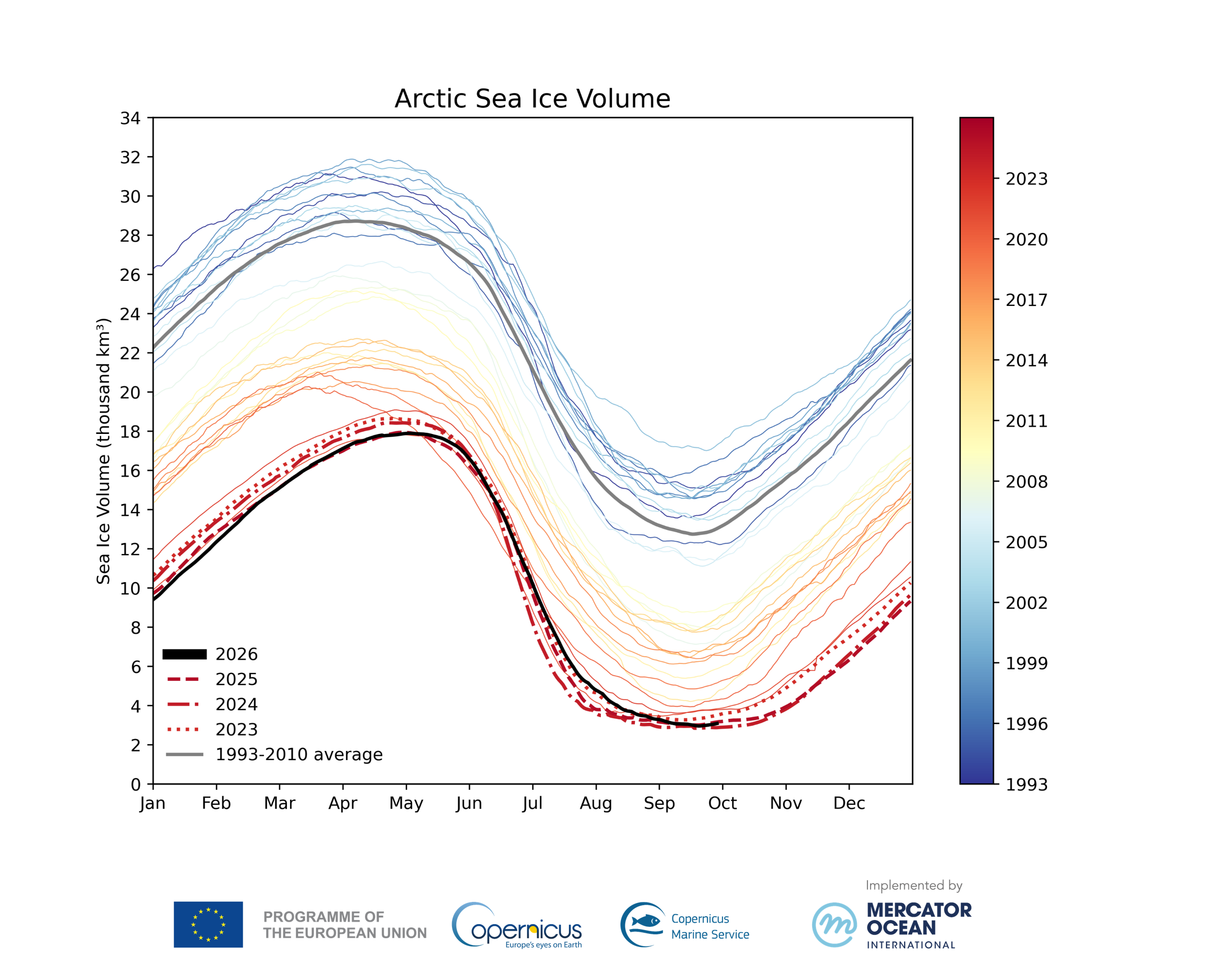
 

Daily Arctic sea ice volume between 1993-2026, relative to the 1993-2010 long-term average (grey line) for the same day of the year.. Data: GLO12/GLORYS12. Source: EU. Copernicus Marine Service/Mercator Ocean International.


In the Northern Hemisphere, sea ice volume, which combines ice thickness and concentration, reached its annual minimum on 20 September 2026. At 2.958 thousand km³, it was among the lowest values recorded since 1993. This was 9.817 thousand km³ below the long-term average for the 1993-2010 period. 
 

Antarctic sea ice

Antarctic sea ice extent (red) for 4 September 2026. The black line represents the 1993-2010 long-term average (grey line) for the same day of the year. Right: Daily Arctic Sea ice extent. between 1993-2026 (grey line). Data: GLO12/GLORYS12. Source: EU. Copernicus Marine Service/Mercator Ocean International.


Antarctic sea ice extent reached its winter maximum on 4 September 2026, covering 17.152 million km². This was the third-lowest winter maximum since 1993 and 1.591 million km² below the 1993-2010 climatological average for the same date. 

2026 marks the fourth consecutive year in which Antarctic winter sea ice extent has remained substantially below the long-term average, continuing a period of persistently low sea-ice coverage around the continent. 
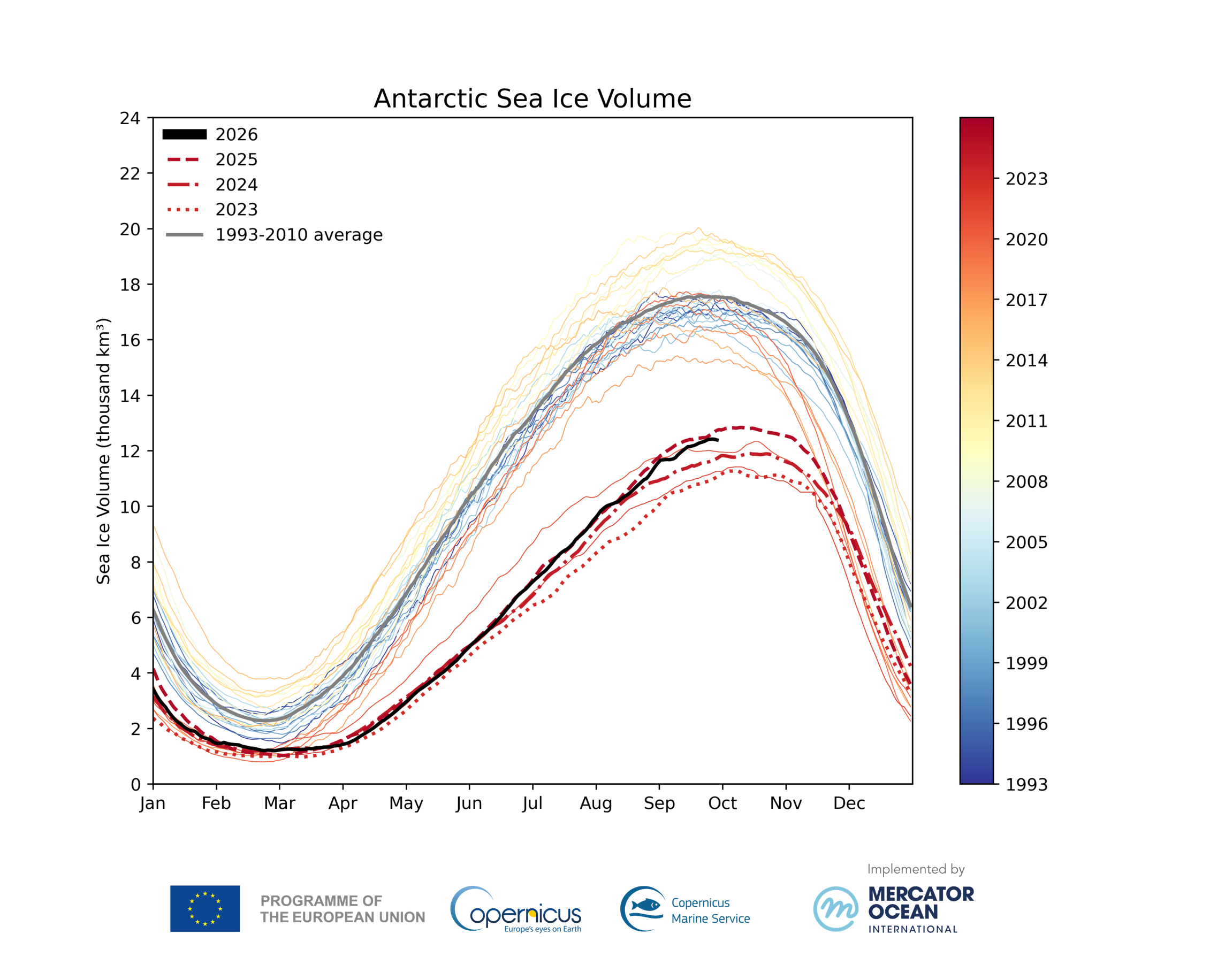
 

Daily Antarctic sea ice volume between 1993-2026, relative to the 1993-2010 long-term average (grey line) for the same day of the year. Data: GLO12/GLORYS12. Source: EU. Copernicus Marine Service/Mercator Ocean International.


Sea ice volume in the Southern Hemisphere also remained well below typical levels. On 12 September 2026, sea ice volume reached 12.556 thousand km³, ranking as the fifth-lowest value for this date since 1993. This is consistent with the widespread presence of thinner sea ice in the Antarctic region and reflects a decline not only in the extent of sea ice, but also in the total volume of ice present.

Notes

Definitions:
  • Sea ice concentration – percentage of sea ice cover within the data grid cell.
  • Sea ice extent – area covered by a significant amount of sea ice, at least 15% sea ice concentration (km²).
  • Sea ice volume – derived from sea ice concentration and sea ice thickness integrated over a respective area (km ³).
Notes:

Products and data used: 

Credits:

*Image citation: European Union, Copernicus Marine Service Data 2026 I © Mercator Ocean
All images in this article can be used freely and should be cited with the information above.

More on the topic: