


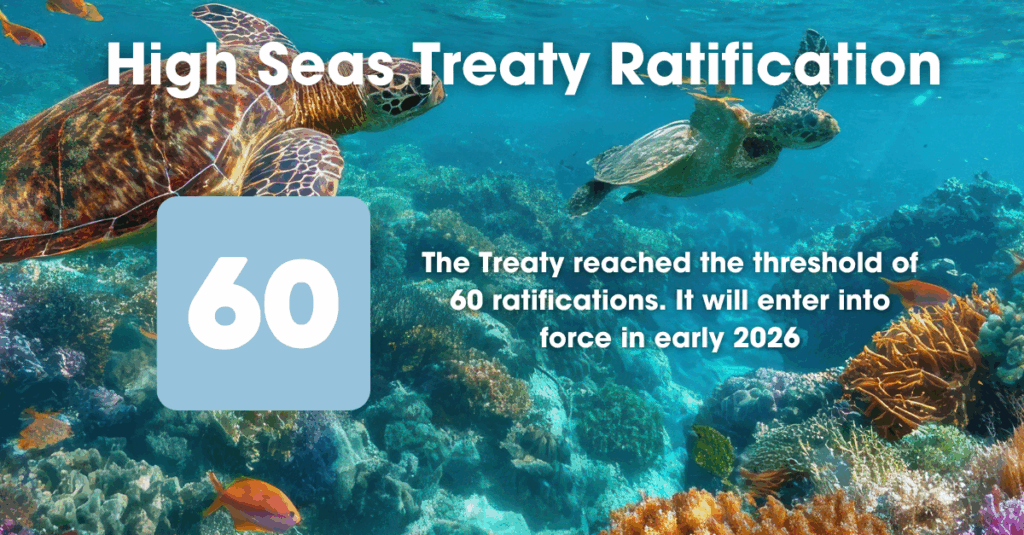
19 September 2025 marked a historic milestone for global Ocean conservation. The Marine Biological Diversity of Areas beyond National Jurisdiction (BBNJ Agreement), commonly known as the High Seas Treaty, officially reached the threshold of 60 ratifications during the United Nations High Level Week, triggering its entry into force on 17 January 2026. This landmark achievement follows nearly two decades of negotiations and represents a transformative step toward safeguarding marine biodiversity in areas beyond national jurisdiction, which comprise nearly two-thirds of the world’s Ocean.
What is the BBNJ Agreement?
Areas beyond national jurisdiction span almost two-thirds of the Ocean and harbour rich marine resources and biodiversity, delivering vital ecological, economic, social, cultural, scientific and food-security benefits to humanity. However, these areas face increasing pressures due to threats from pollution (including underwater noise), overexploitation, climate change and biodiversity loss.
The BBNJ Agreement is a legally binding international treaty adopted under the United Nations Convention on the Law of the Sea (UNCLOS) that aims to ensure the conservation and sustainable use of marine biological diversity in the high seas.
The treaty is built around four main pillars:
- Marine Genetic Resources (MGRs)
The treaty establishes mechanisms for the fair and equitable sharing of benefits derived from marine genetic resources, including access to samples, data and intellectual property.
- Area-Based Management Tools (ABMTs)
This includes the creation of marine protected areas (MPAs) on the high seas, a critical measure to meet the Kunming-Montreal Global Biodiversity Framework’s target of protecting 30% of the Ocean by 2030.
- Environmental Impact Assessments (EIAs)
The treaty mandates EIAs for activities in international waters, ensuring that economic ventures such as deep-sea mining and unregulated fishing do not harm fragile marine ecosystems.
- Capacity-Building and Marine Technology Transfer
Recognising the need for equity and inclusion, the agreement provides for robust support to developing countries through capacity-building initiatives and the transfer of marine technologies.
A momentous day for Ocean protection
On 19 September 2025, Morocco and Sierra Leone became the 60th and 61st countries to ratify the treaty, crossing the threshold required for it to enter into force. UN Secretary-General António Guterres hailed the development as a “historic achievement for the Ocean and for multilateralism,” emphasising that the treaty is a lifeline for both the Ocean and humanity. The Treaty will enter into force in early 2026, 120 days after the 60th ratification.
The European Union, a key driver of the BBNJ High Ambition Coalition, has committed €40 million through its Global Ocean Programme to support implementation, particularly in developing nations.
Contributing science and data to global Ocean efforts
At Mercator Ocean International, we welcome the ratification of the BBNJ Agreement as a pivotal moment for Ocean governance.
Our organization remains committed to:
- Providing state-of-the-art ocean data, monitoring and modelling tools
Essential for tracking biodiversity changes, supporting marine protected area designations and informing environmental impact assessments. - Supporting capacity building and marine technology sharing
We work with global partners in a spirit of capacity sharing, ensuring that all countries can access, exchange, and co-develop the knowledge and tools needed to benefit equitably from advances in Ocean prediction. - Collaborating globally for effective implementation
By working with governments, research institutions, and civil society, we aim to contribute to the treaty’s success and long-term sustainability.
Pierre Bahurel, Director General of Mercator Ocean International, said:
“The ratification of the High Seas Treaty is a historic milestone for the protection of the Ocean, with cooperation and science at its heart. At Mercator Ocean, we are scaling up from Ocean physics to the full scope of marine ecosystems, embracing a broader vision of the Ocean through observations, models, AI, digital innovation, and partnerships. This aligns with our aim to support global initiatives for Ocean sustainability, such as the treaty’s objectives.”
Stefano Ciavatta, Head of the Marine Ecosystems Service at Mercator Ocean International, added:
“Marine ecosystems are vital to the health of the planet and human well-being. Through advanced Ocean modelling and monitoring capabilities, we can provide the information needed to protect biodiversity in areas beyond national jurisdiction and to support both the establishment and monitoring of effective marine protected areas.”