


Marine pollution is a pressing issue that threatens the health of our Oceans. From plastic waste to chemical and agricultural runoff and microplastics, various pollutants are degrading marine ecosystems and impacting biodiversity.
The European Digital Ocean Pavilion at the Third United Nations Ocean Conference, which will be open to the public from 2 to 13 June 2025, will allow visitors to experience and interact with EU tools and contributions which reinforce Europe’s leadership in global Ocean governance and in the fight to mitigate and control marine pollution.
The INSPIRE area, part of the Pavilion, will host daily TEDx-like sessions. Audiences will come and listen to a range of experienced presenters, who will discuss the state of the Ocean, seafloor litter, oil spills, solutions for noise pollution, and so much more.
Coordinated by Mercator Ocean International, the Pavilion highlights the pivotal role of digital tools in monitoring, understanding, and combating marine pollution. The Pavilion will delve into various aspects of Ocean conservation, with marine pollution as a key theme.
Mercator Ocean has been at the forefront of efforts to combat marine pollution through international collaboration and by addressing real-life pollution events to protect marine biodiversity.
The EU Digital Twin Ocean
The EU Digital Twin Ocean (EU DTO) is an advanced digital representation of the Ocean designed to provide comprehensive insights into marine environments. Developed by Mercator Ocean International, the EU DTO integrates data from the Copernicus Marine Service and EMODNet, the European Marine Observation and Data Network, to create a detailed and interactive model of the Ocean.
In a time of rapid Ocean changes, increasing environmental threats, and climate disruptions, the ability to track pollution is more critical than ever. Mercator Ocean addresses this need by integrating artificial intelligence into its modelling systems and leading the way in developing the EU DTO.
By simulating “what if” scenarios under various climate or human pressure conditions, it serves as an invaluable tool for planning resilience and sustainability. For example, citizens will be able to contribute to biological and ecological observation campaigns (e.g. on plastics) to improve models and use them for personal reasons (like checking for clean swimming spots).
Tackling Marine Pollution
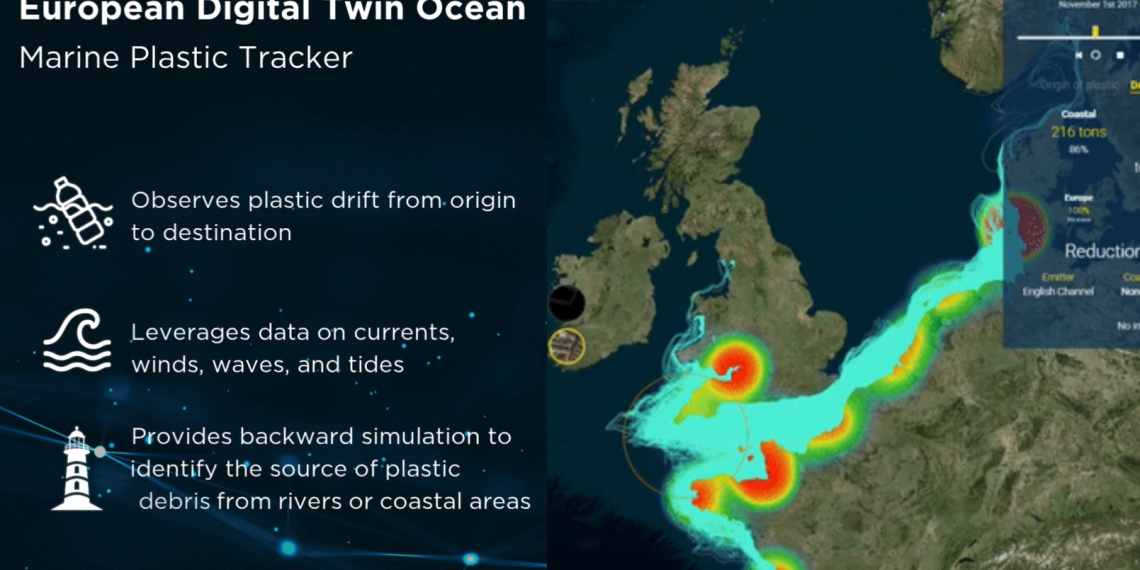
The European Digital Twin Ocean (EU DTO) is harnessing cutting-edge technology to address marine pollution through its innovative Plastic Tracker application. This tool allows users to visualise the origin or destination of plastic pollution for a specific area of interest, based on three-year drift model simulations. Additionally, it enables the launch of scenarios aimed at reducing plastic in rivers and coastal areas, thereby preserving marine environments and coastal communities from the detrimental effects of plastic pollution.
Visitors to the DECIDE area of the European Digital Ocean Pavilion will have the opportunity to explore the Plastic Tracker application first-hand. This interactive experience will showcase how advanced modelling and simulation can inform effective strategies for combating plastic pollution, highlighting the EU DTO’s commitment to fostering a cleaner, healthier Ocean.
Learn more at the European Digital Ocean Pavilion
Marine pollution is a critical issue that requires immediate and innovative solutions. The European Digital Ocean Pavilion at the Third United Nations Ocean Conference (UNOC3) will provide visitors with the opportunity to explore the importance of combating marine pollution. Coordinated by Mercator Ocean International, the pavilion will highlight the pivotal role of digital tools in monitoring, understanding, and addressing marine pollution.
Through interactive exhibits and state-of-the-art simulations, visitors will learn about the impact of marine pollution and discover innovative solutions to mitigate these risks and promote sustainable Ocean management and stewardship. This immersive experience will inspire collective action and highlight the importance of global collaboration in safeguarding our Oceans.
Join us in our mission to tackle marine pollution! Register here to participate in the online streaming of the European Digital Ocean Pavilion’s activities at UNOC3, or come visit us on-site to explore innovative solutions for sustainable Ocean management.
This article is part of a series of articles focused on the morning themes of the European Digital Ocean Pavilion. To read the previous article on Marine Biodiversity, click here.