

Mediterranean Sea saw its highest July average marine heatwave intensity

Press Release, Toulouse, France, 7 August 2025 – July 2025 has been marked by extraordinary marine heatwave (MHW) activity in the Mediterranean Sea, according to the latest ocean temperature bulletin released by Mercator Ocean International, operator of the EU’s Copernicus Marine Service. This comprehensive report analyses ocean temperature trends, heatwave extent, intensity, and duration, providing critical insights to the scientific, environmental, and climate monitoring communities worldwide.
Sea Surface Temperature Anomalies
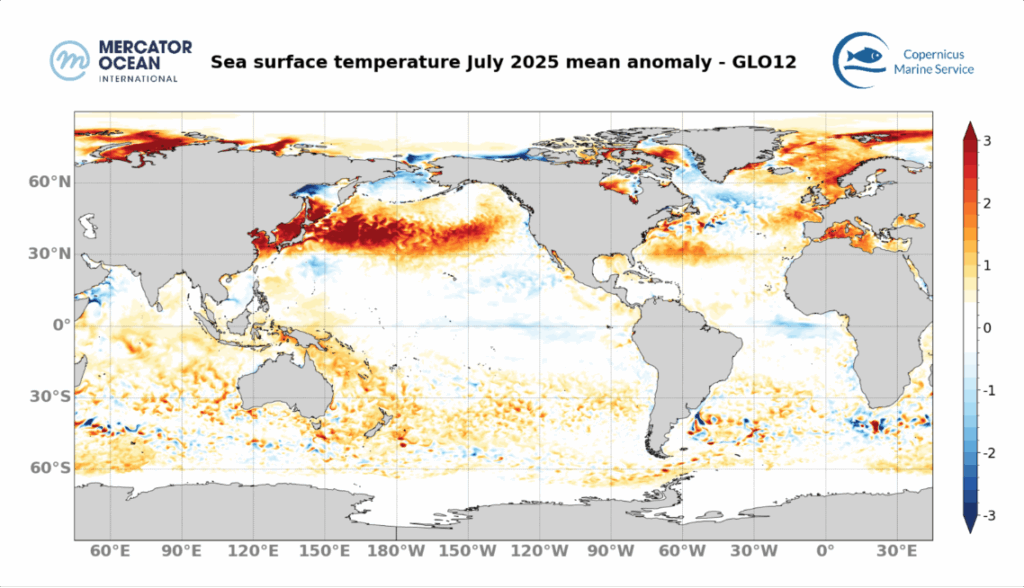
Figure 1: July 2025 Mean SST Anomaly relative to a 30-year climatology (1993-2022), calculated using daily data from Mercator Ocean International’s GLO12 analysis and forecasting system for 2025 and from the GLORYS12 reanalysis for the climatological mean
Global Ocean ranks third warmest July on record
- Approximately 71% of the global ocean experienced above-average temperatures, with 13% exceeding the average by at least 1°C, with high regional anomalies in the North Pacific, North Atlantic, and Indian Oceans (Figure 1)
- At the global scale, July 2025 ranked as the third warmest July on record, with a mean SST of 20.80 ± 0.07°C, behind only 2024 (20.91 ± 0.06 °C) and 2023 (20.93 ± 0.06 °C) (Figure 2)
Mediterranean Sea registers warmest July on record
- The mean sea surface temperature (SST) reached an unprecedented 26.68 ± 0.15°C, surpassing the previous July record set in 2023 of 26.65 ± 0.21°C.
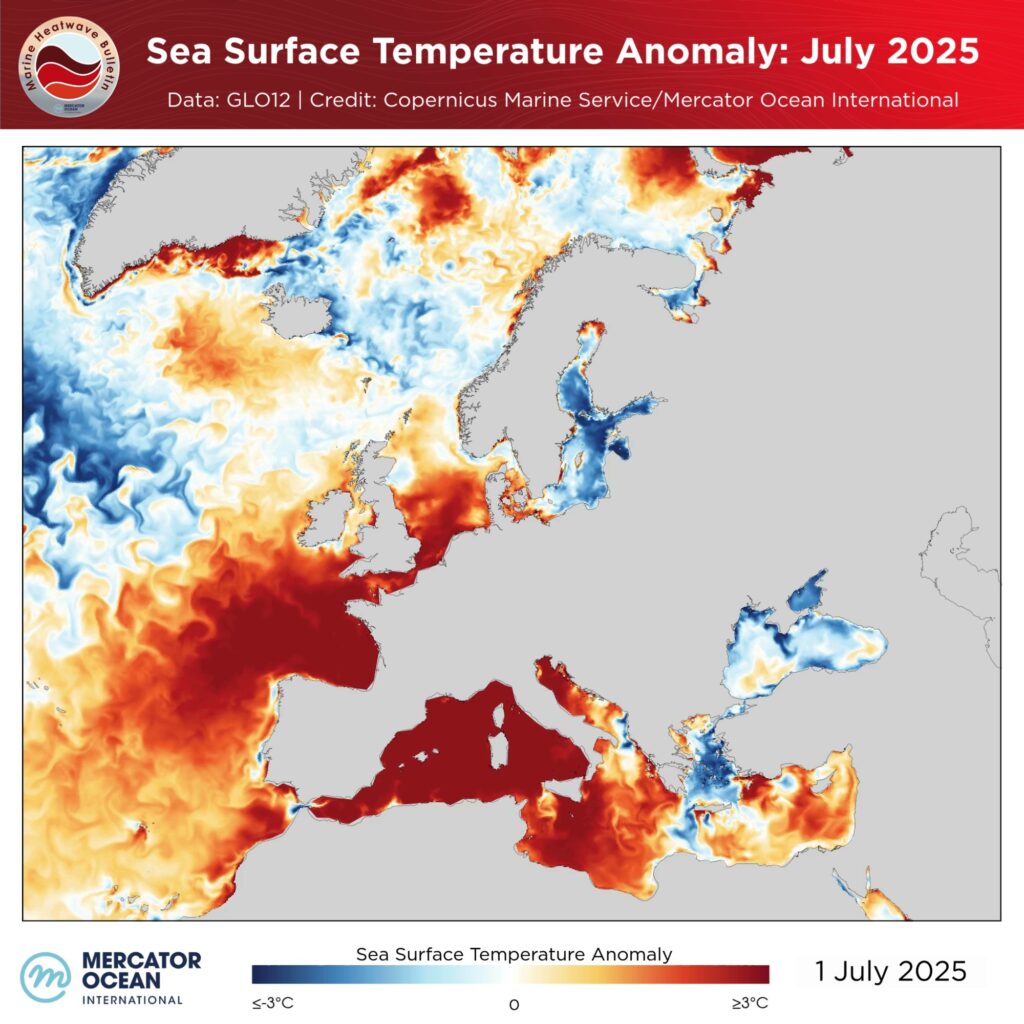
- The warming was widespread, with 95% of the Mediterranean displaying above-average temperatures and 63% of the basin exceeding the long-term average by at least 1°C, and 40% by at least 2°C. The western Mediterranean was most severely affected by these extreme anomalies.
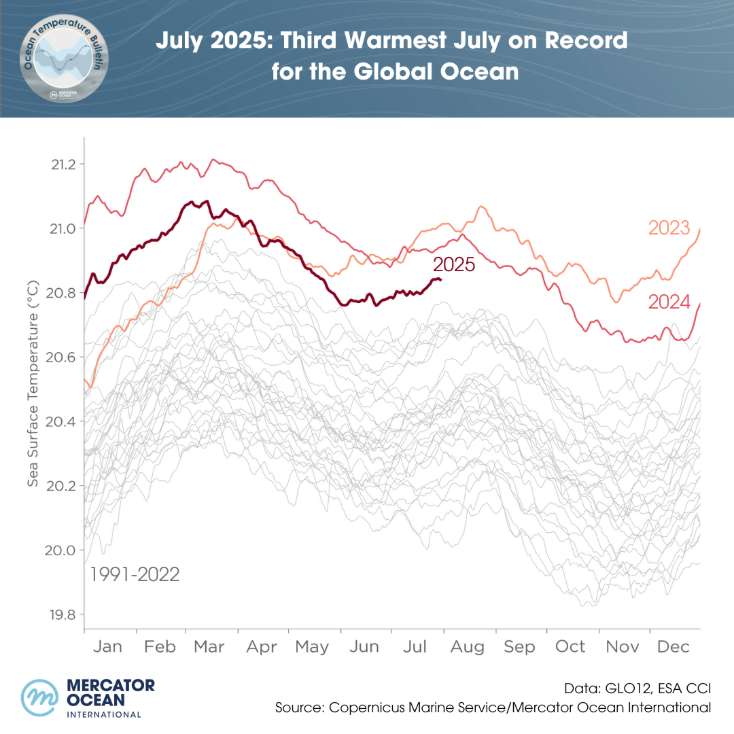
Figure 2: Daily sea surface temperatures averaged for the global ocean 1991-2020 using ESA’s Climate Change Initiative (grey shades), and between 2021-2025 (colored shades) using Mercator Ocean International’s GLO12 analysis and forecast.
Marine Heatwaves (MHWs) extent and intensity
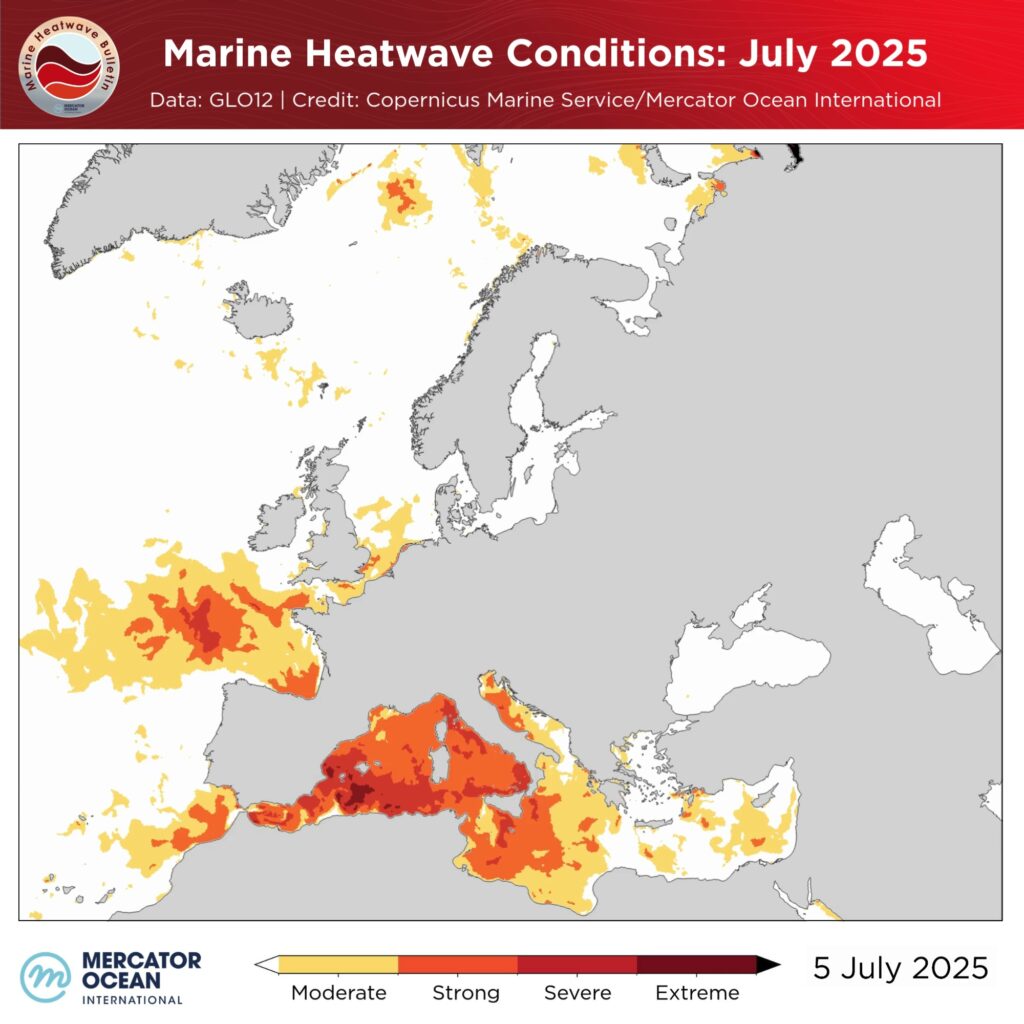
DOWNLOAD GLOBAL OCEAN ANIMATION
DOWNLOAD SST ANOMALY EUROPE ANIMATION
Global Ocean: July 2025 marks the 2nd highest marine heatwave intensity on record (after 2023) and the 4th longest duration (after 2015, 2024 and 2023)
- At global level, marine heatwaves mostly affected regions in the northern hemisphere (in their summertime). In total, 14 % of the global ocean was exposed to a strong-or-above MHW during July 2025, the 3rd highest extent after July 2023 and 2024.
- Note that only four months of July in the historical records (2015, 2023, 2024 and 2025) showed more than 10% of the basin exposed to strong-or-above MHWs.
Mediterranean Sea: July 2025 had the strongest marine heatwave intensity ever recorded in July, and the 2nd and 3rd for MHW extent and duration
- The Mediterranean Sea experienced a very high peak in MHW coverage in the first week of July, with up to 65% of the basin exposed. A situation also extraordinary for its intensity with 45% of the basin exposed to strong, severe, and even extreme categories, an area much larger than that in moderate category condition (20%). By the end of the month, the extent reduced notably to 15%, mainly with moderate intensity.
- 68% of the Mediterranean Sea was affected by strong or higher category marine heatwaves during July 2025, marking it as the second widest coverage on record for such intense conditions.
North Atlantic: July 2025 had the third strongest marine heatwave intensity on record for July
- The North Atlantic Ocean experienced moderate levels of MHW in July 2025 (in extent and intensity) following the record situations in July 2023 and 2024, with approximately 18% of the basin exposed to strong or more intense MHW conditions.
Other oceanic regions
- The Western North Pacific (Sea of Okhotsk) or at the boundary of the North Atlantic and the Arctic Ocean (Norwegian sea) saw very intense MHW events in July 2025, with implications for marine life and atmospheric interactions.
Media Resources
Access all the visual materials here: Fichiers – Mercator Ocean File Sharing Facility
Source: European Union, Copernicus Marine Service Data 2025 © Mercator Ocean
For more infographics and illustrations on Sea Surface Temperature anomalies and MHWs for July 2025, read this article on Mercator Ocean website.
For more information on Marine heatwaves forecasts in August, follow our weekly bulletins.
Visualize today’s the sea surface temperatures and anomalies on the Copernicus Marine Service viewer: Viewer_SST_today
Media Contact
Laurence Collet
Corporate Communications & Media Relations, Mercator Ocean International
Email: press@mercator-ocean.fr
About Mercator Ocean International
Mercator Ocean International is a world leader in digital oceanography, providing trusted ocean analysis, forecasting, and intelligence to advance science, policy, and societal needs. Founded in 1995 and headquartered in Toulouse, France, the organisation employs 120 staff and is led by Director General Pierre Bahurel. As a European organization registered in France, Mercator Ocean International operates the Copernicus Marine Service on behalf of the European Union and is recognised as a global ocean prediction centre. It co-develops the European Digital Twin of the Ocean with European partners and hosts the G7 Future of the Seas and Oceans Initiative Coordination Centre. More information on https://www.mercator-ocean.eu/
You can follow our publications on Linkedin: @MercatorOceanInternational
About Copernicus Marine Service
The Copernicus Marine Service is dedicated to ocean observation, monitoring and forecasting. It is funded by the European Commission (EC) and implemented by Mercator Ocean international. Copernicus Marine provides regular and systematic reference information on the state of the physical and biogeochemical ocean at the global and European regional scale. Mercator Ocean’s marine heatwave bulletins rely on Copernicus Marine data.