

On 3 November, Stefano Ciavatta, Head of the Marine Ecosystems Service at Mercator Ocean International, participated in the RISE Fr-UK 2025 event (Research and Innovation Excellence in Science for Europe – France–UK), where he presented the New Copernicus Capability for Trophic Ocean Networks (NECCTON) project.
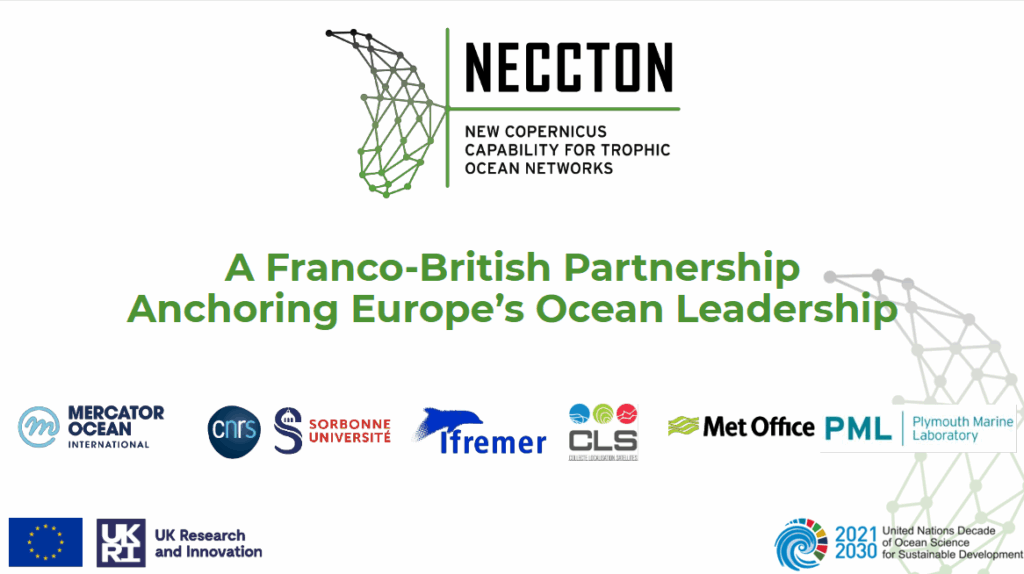
The NECCTON initiative involves a consortium of 23 partners from the EU and the UK; the project coordination and management bring together MOi’s leadership in operational oceanography and Plymouth Marine Laboratory (PML)’s world-leading capability in marine ecosystem modelling.
Protecting marine biodiversity and managing Ocean ecosystems together
The event took place on 3 November 2025 at the Royal Society in London, and brought together representatives from European policy, funding agencies, the scientific community, and industry leaders from France and the United Kingdom. Stefano Ciavatta, Senior scientist in ocean biogeochemistry modelling at Mercator Ocean International, presented the NECCTON project, a European partnership lead by a Faranco-British alliance funded through Horizon Europe and the UK Reasearch and Innovation.
NECCTON embodies the excellence of Franco-British scientific cooperation, but it is also a major scientific step forward for Europe’s ocean knowledge and predictive capability. The project delivers a new generation of models that, for the first time, represent marine mammals, fish, seafloor habitats and pollution within the Copernicus Marine Service, the EU’s operational framework for ocean monitoring and forecasting. NECCTON will provide 27 new products to Copernicus, including distributions of tuna and dolphins, carbon fluxes between the seafloor and ocean, the impact of fish trawling on seafloor, by means of consolidated marine models and innovative Artificial Intelligence tools.
By coupling these components within advanced biogeochemical and physical models, NECCTON is expanding the scientific foundations of operational oceanography. This integration allows researchers and decision-makers to better understand and anticipate how ecosystems respond to climate variability, human pressures and conservation measures. In doing so, NECCTON strengthens Europe’s capacity to monitor, assess, and manage marine biodiversity in a changing ocean. The project is on track to be completed by December 2026.
The two levels of Franco-British collaboration in NECCTON
In NECCTON, this Franco-British collaboration exists at two levels: through the project partners themselves, and through Mercator Ocean’s multinational governance, where French and British institutions such as Centre National de la Recherche Scientifique (CNRS), IFREMER and the UK Met Office are stakeholders.
PML leads the development of advanced biogeochemical models, which directly inform fish modelling coordinated by IFREMER. Meanwhile, CNRS and Sorbonne University focus on marine protected areas in the English Channel, and CLS on the modelling of mackerels in the North Atlantic. The Met Office ensures synchronisation of all simulations, working closely with Mercator to guarantee scientific consistency across NECCTON’s outputs. Collaboration also extends to outreach: Mercator leads dissemination efforts while PML spearheads communication activities, ensuring NECCTON reaches policy, scientific and public audiences alike.
Next steps: sustaining the Franco-British leadership with the Mercator Ocean IGO
Mercator Ocean International is evolving into a new intergovernmental organization, further strengthening its collaborating with European and global partners to advance digital Ocean systems and services for a sustainable Ocean.
At the UN Ocean Conference in Nice, France, in June 2025, 12 European countries endorsed a joint Declaration expressing their commitment to continue working together towards the creation of the Mercator International Centre for the Ocean, led by the governments of France and Norway, which were the first to sign its international Convention. All EU Member States, as well as Monaco, Norway and the United Kingdom were invited to participate in the discussions related to the new IGO.
A membership of the United Kingdom in the new IGO would be essential to sustain this Franco-British shared leadership in NECCTON and beyond, benefiting the health of our common Ocean and the future of our countries.