


In an era of accelerating Ocean change, rising threats to the environment and climate disruption, understanding and predicting the marine environment has never been more important. Mercator Ocean supports this by integrating artificial intelligence (AI) into its modelling systems and leading innovation with the development of the European Digital Twin Ocean (EU DTO).
Better Understanding and Predicting the Ocean in the Age of AI
Accurately understanding and predicting Ocean dynamics is crucial for safeguarding marine ecosystems and supporting sustainable decision-making.
Recent advances in digital technology, particularly in AI, are revolutionising the way experts can observe, analyse, and simulate the ocean. Where once scientists relied solely on conventional modelling, they are now equipped with tools which can generate complex, data-driven insights with greater speed and accuracy.
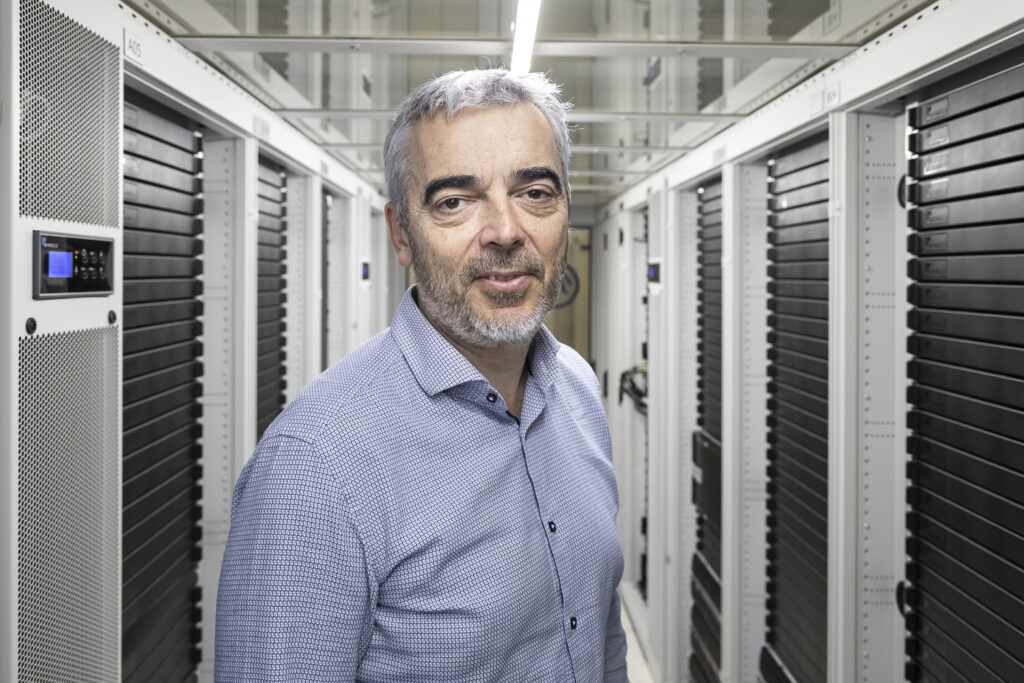
Alain Arnaud, Mercator Ocean’s Head of Digital Ocean, explains: “Artificial intelligence is not just a tool. It’s a game-changer that enables us to understand and predict the ocean with unprecedented accuracy and speed. At Mercator Ocean, we harness AI to turn vast amounts of marine data into actionable insights, paving the way for sustainable Ocean management.”
Conventional Ocean forecasting methods rely on sophisticated physical models built on fundamental laws of physics. These models have long been a cornerstone of operational oceanography, providing reliable simulations and forecasts of key marine processes and indicators. However, they require significant computing power and often take a long time to produce forecasts. At the same time, these models must deal with the rapidly growing volume and diversity of marine data, ranging from satellite observations to measurements collected by networks of in situ instruments deployed throughout the ocean.
This is precisely where AI proves its value. Capable of learning from historical data, including physical model outputs, recognising patterns, and producing rapid forecasts, AI opens new possibilities for predicting the state of the Ocean more responsively. When it comes to Ocean prediction, this means:
- Forecasts produced in seconds instead of hours;
- On GPU computers using far less resources than HPC centres.
- +20% improvement in Ocean current prediction accuracy, for example.
Harnessing AI for Ocean Forecasting at Mercator Ocean
In response to the growing need for more responsive and data-driven Ocean forecasting, Mercator Ocean has been actively exploring how AI can complement and strengthen its existing modelling capabilities. Building on decades of expertise in physical oceanography, and digital modelling and simulation, Mercator Ocean is integrating AI not as a replacement of traditional methods, but as an additional tool to support faster computation, broader data integration, and more flexible forecasting approaches.
At the heart of this transformation is the capacity of AI to process vast amounts of Ocean data collected from diverse sources. These include satellite observations, in situ sensors, and reanalysis datasets, which are simulations over long periods of time which provide consistent reconstructions of past Ocean states. Mercator Ocean has been producing and refining these reanalyses for decades, generating high-quality reference datasets which serve as the foundation for robust Ocean trend analysis. These data archives, such as GLORYS12 (GLObal ReanalYSes at 1/12 of degree), are not only key for operational forecasting but also constitute an ideal training ground for AI models, which require substantial and well-curated historical data to learn and decipher complex Ocean dynamics.
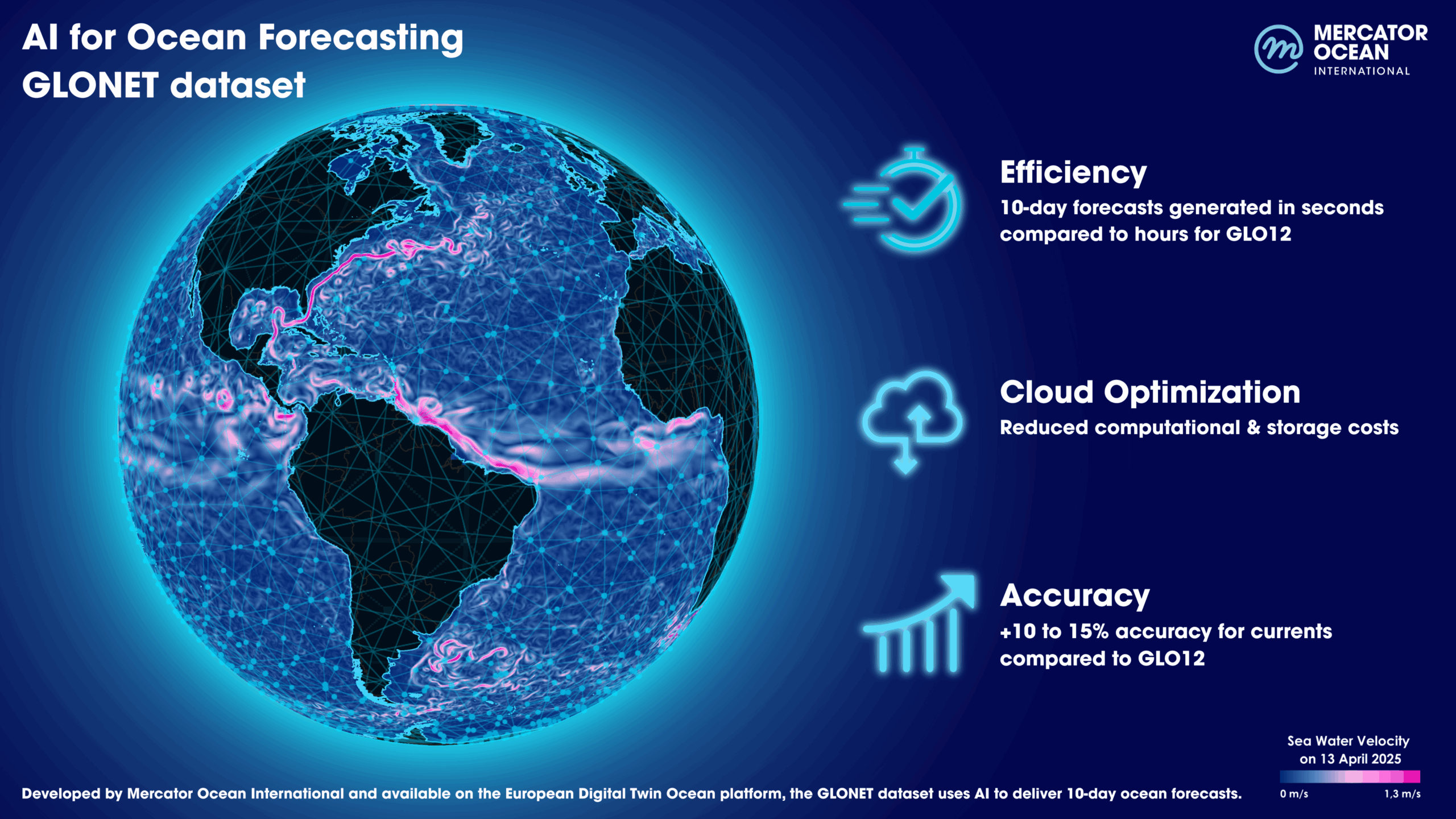
By applying machine learning and deep neural networks, Mercator Ocean has developed systems and tools capable of producing forecasts in a matter of seconds, compared to conventional methods which typically require several hours of computation. This does not come at the expense of scientific accuracy, operating in tandem with physical modelling to provide forecasts which are both timely and rooted in Ocean physics.
GLONET, Mercator Ocean’s flagship AI-based forecasting system, exemplifies this approach. Trained on many years of reanalysis data, it simulates Ocean currents, temperature, and salinity across 21 vertical levels at global scale, delivering 10-day forecasts in under ten seconds. Compared to traditional models, GLONET (GLObal Neural Network) delivers a 10 to 15% accuracy improvement in Ocean current predictions. The model brings flexibility to operational forecasting and provides a revolutionary opportunity to explore new methods of scenario analysis and climate response simulation.
Now in pilot phase within the European Digital Twin Ocean, GLONET illustrates Mercator Ocean’s commitment to science-based innovation. AI, within this context, is not a stand-alone solution but a catalyst and enabler for broader transformation in Ocean prediction.
Powering Ocean Intelligence with the European Digital Twin Ocean
The challenges facing our Ocean require both scientific understanding and the capacity to translate data into actionable knowledge. Responding to this imperative, the European Commission launched the European Digital Twin Ocean (EU DTO), a transformative initiative designed to support decision-making through an advanced digital replica of the ocean. This effort directly responds to global priorities such as the UN Ocean Decade Challenge 8, which calls for the development of a “digital representation of the ocean” to better connect knowledge with stakeholders and guide sustainable Ocean governance.
The European Digital Twin Ocean provides an interactive platform to observe current Ocean conditions, understand historical changes, and explore future scenarios. Its ability to simulate “what if” scenarios under different climate or human pressure scenarios makes it an invaluable planning tool for resilience and sustainability.
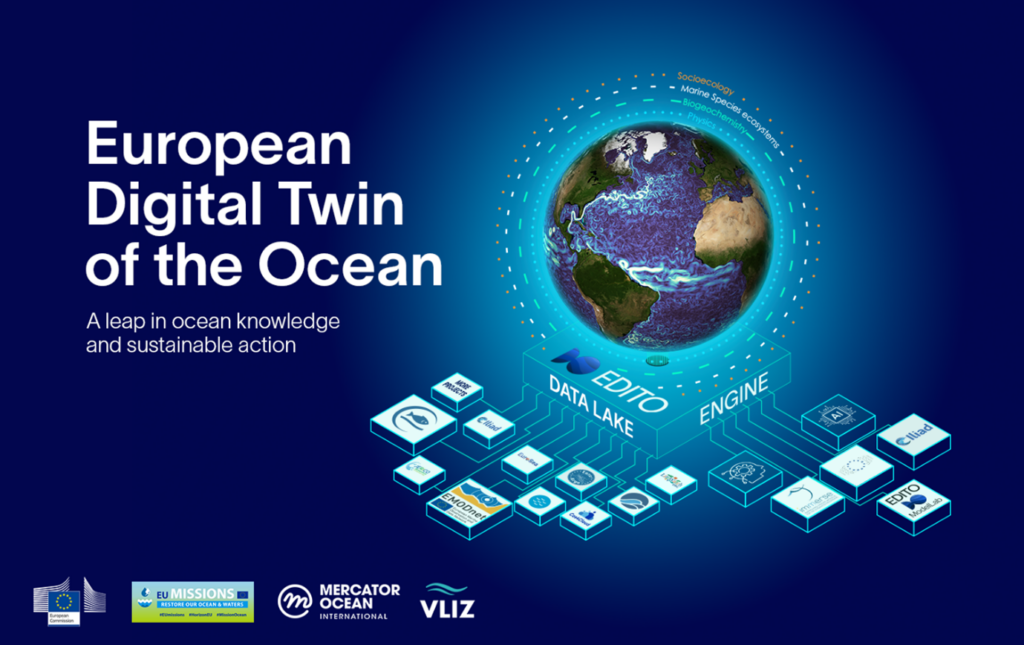
At the heart of the EU DTO is a sophisticated digital infrastructure combining AI, high-performance computing, and advanced numerical modelling. This integrated system enables not only rapid simulation but also the assimilation and interpretation of vast, multi-source data, an essential asset when modelling complex interactions.
A cornerstone of this system is its “data lake”, a flexible, scalable repository which stores marine data in various formats, including satellite and in situ observations to model outputs. This approach is particularly suited to AI applications, which depend on large, diverse and unfiltered datasets to function effectively.
Mercator Ocean plays a central role in building the EU DTO infrastructure, leading the integration of data and modelling services as part of the EDITO-Infra project. Together with partners such as the Flanders Marine Institute (VLIZ), Mercator Ocean is responsible for merging assets from the Copernicus Marine Service and EMODnet into a unified digital framework. In doing so, it brings its expertise in Ocean forecasting, its innovative AI models such as GLONET, and its long-standing commitment to scientific excellence to the heart of Europe’s Ocean intelligence ecosystem.
As a result, the European Digital Twin Ocean is more than a technological platform, it is an instrument for translating Ocean data into actionable knowledge. With artificial intelligence serving as a core enabler, and Mercator Ocean providing key expertise in Ocean forecasting and data integration, the initiative is redefining how Europe monitors, understands, and responds to the evolving state of the marine environment.