

As implementors of the Copernicus Marine Service, Mercator Ocean has unveiled the ninth edition of its flagship Ocean State Report. The report provides evidence that every part of the ocean is now affected by the triple planetary crisis of climate change, biodiversity loss, and pollution. It also offers a comprehensive scientific assessment of the ocean’s condition and its implications for ecosystems, economies and societies. In doing so, it provides solid scientific knowledge to inform ocean-related policies.
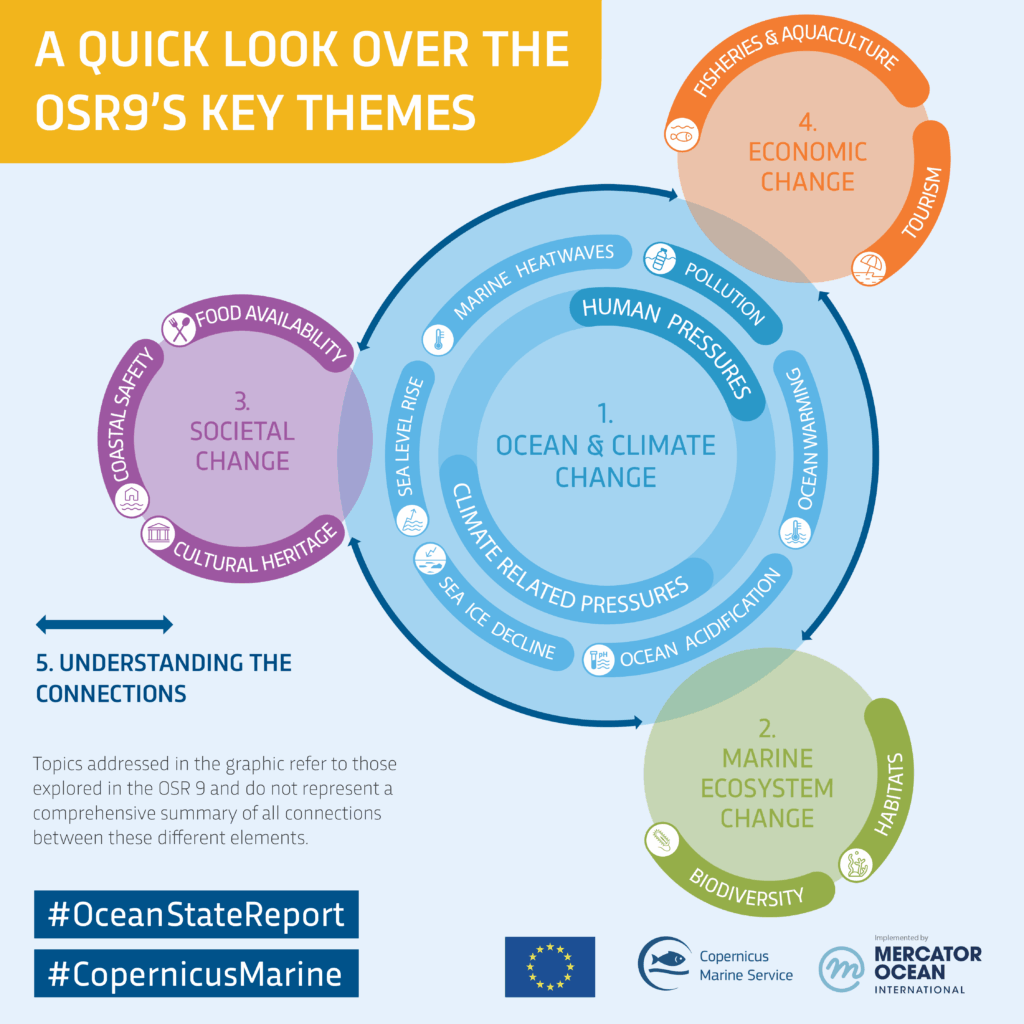
The key findings of the report
This year’s edition presents a sobering picture of accelerating ocean change.
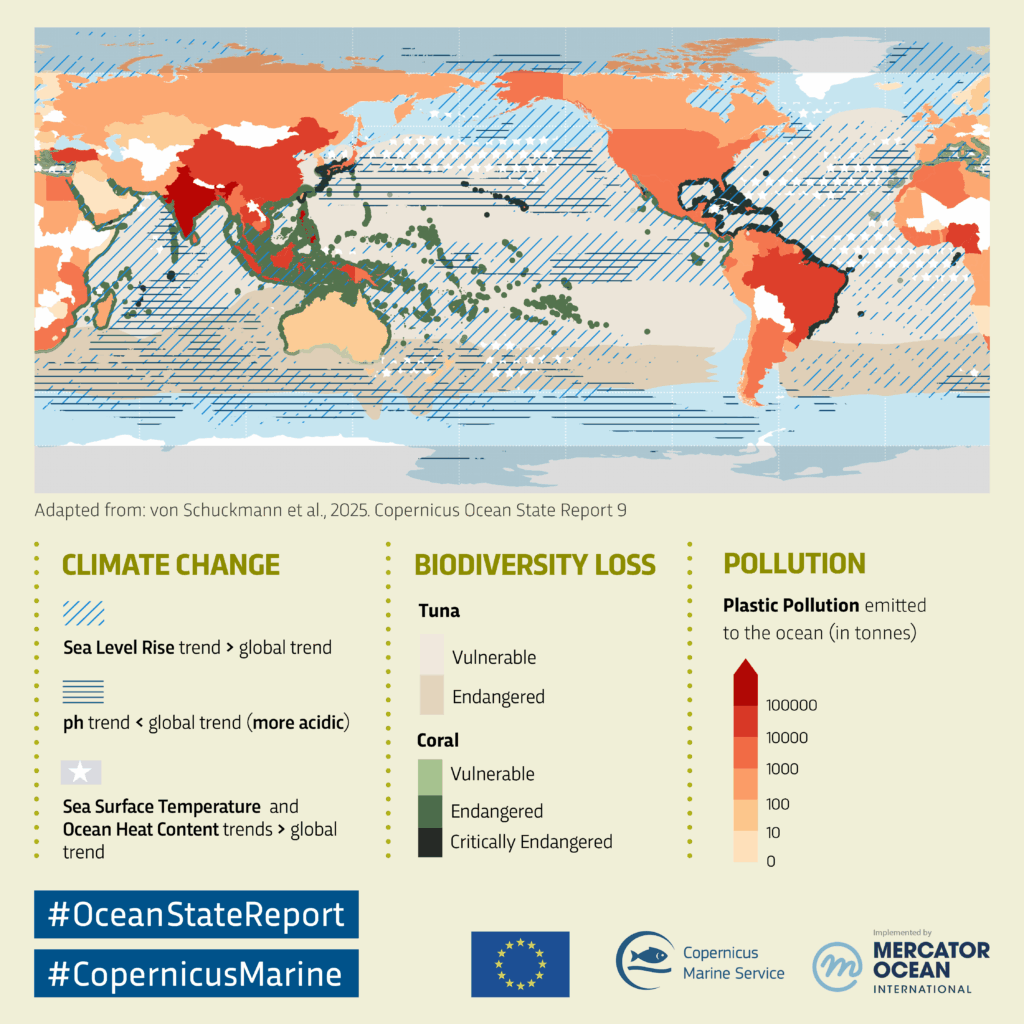
Global sea surface temperatures reached a record 21°C in spring 2024, with warming trends intensifying since the 1960s. Marine heatwaves in 2023 and 2024 were the most persistent and intense ever recorded, with some Atlantic waters experiencing heatwave conditions for over 300 days. Sea level rise has reached 228mm since 1901, threatening coastal infrastructure and cultural heritage sites across Europe. Acidification is progressing faster in biodiversity hotspots, while plastic pollution now affects all ocean basins.
Marine ecosystems are under increasing pressure, with warming waters shifting micronekton zones and invasive species disrupting fisheries, notably in the Mediterranean where Atlantic Blue Crabs and Bearded Fireworms caused severe damage to clam production and artisanal fishing.
Meanwhile, sea ice extent in both the Arctic and Antarctic has reached historic lows. As of March 2025, in the Arctic there was less sea ice than the long-term winter average, an area more than six times the size of Poland, while the Antarctic experienced its third consecutive year of low sea ice extent in 2024, after setting an all-time record low in 2023. In February 2025, there were 1.6 million km² less sea ice than the long-term winter average, an area almost three times the size of France.
“The findings of the Ocean State Report are an alarming reminder of the pressing challenges facing our ocean. At the same time, as European, I am reassured that Europe has a leading role in observing and forecasting different ocean state parameters through the unique Union-owned Copernicus Earth observation system and its services, in particular the marine service. The report provides a comprehensive overview of the global ocean’s state, trends, and natural variations, while showcasing innovative monitoring tools that enable sustainable coexistence with marine ecosystems. This fully supports the European Ocean Pact priorities, making the report a substantial contribution to the European ambitions in stewarding our ocean.”, said Andrius Kubilius, EU Commissioner for Defence and Space.
Pierre Bahurel, Director General of Mercator Ocean International said:
“The Ninth Copernicus Ocean State Report confirms that we are dangerously approaching planetary boundaries: every part of the ocean is now affected by the triple planetary crisis. In such a context, we need reliable science and operational tools more than ever. The Copernicus Marine Service – which Mercator Ocean has been implementing on behalf of the European Commission for nearly a decade – provides this unique foundation. Its annual report turns cutting-edge science into actionable knowledge, helping Europe and the world strengthen resilience, safeguard security, and protect the ocean for future generations.”
Dr. Karina von Schuckmann, Senior Advisor at Mercator Ocean International and Chair of Copernicus Ocean State Report activities, added:
“Protecting the ocean’s vital role in sustaining life and livelihoods starts with understanding how and why it is changing. The latest Copernicus Ocean State Report reveals record-breaking events, accelerating trends, and growing impacts on marine ecosystems and societies – providing the science needed to inform effective, forward-looking decisions. The science is unequivocal: the ocean is changing fast, with record extremes and mounting impacts. We know why, and we know what it means. This knowledge is not just a warning — it’s a blueprint for restoring balance between people and the ocean.”
The 9th Copernicus Ocean State Report features the Starfish Barometer for the first time: an annual, science-based and peer-reviewed assessment offering a clear overview of global ocean health, human pressures and their societal impacts. The Barometer complements the in-depth scientific data of the Ocean State Report and will feature in every future edition, reinforcing the report’s position as a trusted reference for ocean science and policy.
Launched by the research community on World Ocean Day 2025 during the 3rd United Nations Ocean Conference in Nice, the Barometer reflects a shared commitment to provide an updated picture of the ocean each year.
The European Publication of Reference on Ocean Trends
The Ocean State Report series is a reference publication of the European Union designed to support policy-makers, environmental agencies, regional sea conventions and international organisations such as the Intergovernmental Panel on Climate Change (IPCC) and the United Nations. It provides a four-dimensional view of the ocean through satellite data, in situ measurements, and advanced reanalysis systems, offering insights into the blue (hydrography, currents), white (sea ice), and green (chlorophyll) components of the global ocean and European regional seas.
Mercator Ocean International extends its sincere thanks to the scientists whose expertise and dedication made this report possible: Karina von Schuckmann, Gilles Garric, Simon Van Gennip, Amelie Loubet, Romain Bourdalle-Badie, Marie Drevillon, Patrick Lehodey, Aurélien Liné and Flora Gues. Their contributions continue to shape the future of ocean science and policy.