


Intergovernemental Transformation
Home ⟩ About us ⟩ Mercator Ocean ⟩ Intergovernemental Transformation
Mercator International Centre for the Ocean – A new intergovernmental organization for the development and exploitation of digital Ocean systems and information services.
Discover how Mercator Ocean International is evolving into a new intergovernmental organization, further strengthening its collaborating with European and global partners to advance digital Ocean systems and services for a sustainable Ocean.
At the UN Ocean Conference in Nice, France in June 2025, 12 European countries endorsed a joint Declaration expressing their commitment to continue working together towards the creation of the Mercator International Centre for the Ocean, led by the governments of France and Norway, which were the first to sign its international Convention.
All EU Member States, as well as Iceland, Monaco, Norway, and the United Kingdom, were invited to participate in the dialogues to agree on the terms of the Convention. These 31 Copernicus participating countries can now decide to join this new intergovernmental organization (IGO) and take part in a global collaborative initiative aimed at delivering digital Ocean systems and cutting-edge and science-based public services in support of a sustainable Ocean that serves society at large.
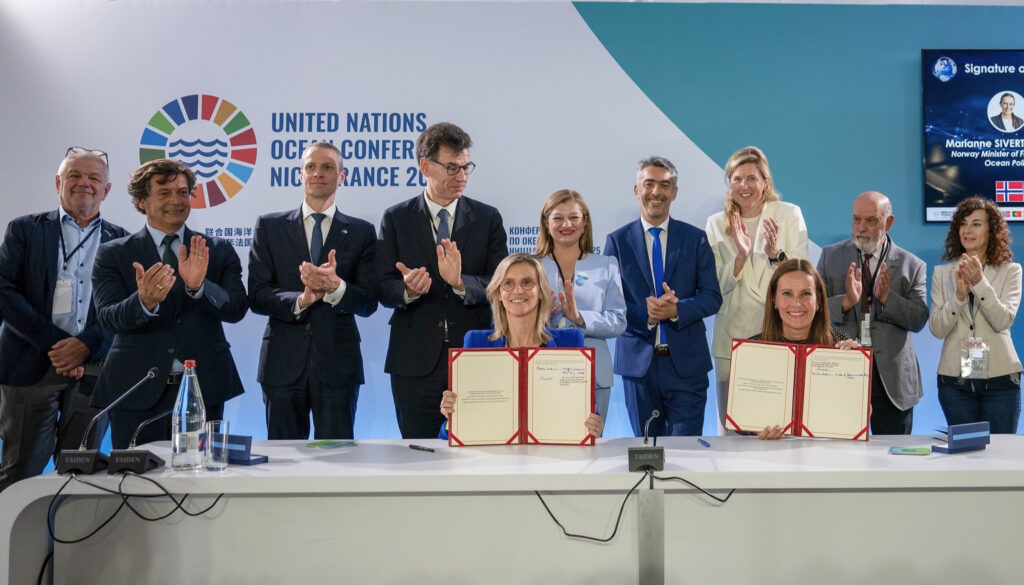
From left: Mitja Bricelj, Slovenian Ministry of Natural Resources and Spatial Planning; Salvador Malheiro, Portuguese Secretary of State for Fisheries and the Sea; ...
Serge Wilmes, Luxembourg Minister for the Environment, Climate and Biodiversity; Philippe Baptiste, French Minister of Higher Education and Research; Agnès Pannier-Runacher, French Minister of Ecological Transition, Biodiversity, Forestry, Sea and Fisheries; Dionysia Theodora Avgerinopoulou, Greek Prime Minister’s Special Envoy for the Ocean; Pierre Bahurel; Annelies Verlinden, Belgian Minister of Justice and the North Sea; Marianne Sivertsen Næss, Norwegian Minister of Fisheries and Ocean Policy; Aldo Drago, Professor in Oceanography, Malta College of Arts, Science & Technology; Rachele Nocera, Italian Ministry of University and Research.
Photo taken in Nice, on Monday, June 9, 2025. Photo: © France Ministry of Ecological Transition, Biodiversity, Forestry, Sea, and Fisheries.
Why is it important ?
- The Ocean plays a major role in global climate and biodiversity cycles, supports a 2.5 trillion-dollar economy and provides food security for an estimated 3 billion people worldwide. Digital Ocean systems provide vital information for a wide range of sectors: marine resources, climate and weather, coastal environment, marine safety, pollution, naval operations, offshore energy, marine area management, marine policies and public information.
- Revolutionary technologies such as artificial intelligence, big data, on-demand / user-driven predictions, and digital twinning will offer new solutions for Ocean protection, sustainable development, climate adaptation, disaster risk reduction, and international Ocean governance.
- These new digital Ocean technologies will drive a scientific and societal shift in how we generate, share, access, and validate unprecedented volumes of information. Addressing these challenges requires European-wide collaboration and governance to deliver and safeguard access to reliable Ocean information and authoritative evidence base generated by digital Ocean systems and services.
To address these challenges, a new intergovernmental organization is being established from the intergovernmental transformation of Mercator Ocean International, combining the capacity to coordinate highly technical multi-national partnerships with the scientific, technical, and operational capacity to deliver world-class Ocean information and services.
Purpose & Missions
The purpose of the intergovernmental organization (IGO) is to :
” Design, develop and operate world-class Digital Ocean Systems and contributions to a Digital Twin of the Ocean, encompassing marine physics, biogeochemistry and ecosystem sciences and to provide authoritative Digital Ocean Information Services of general interest to Member States and international ocean governance.”
Member States will therefore collaborate to:
- Promote research and innovation in operational digital ocean systems, including AI and digital twinning.
- Co-develop, maintain and tailor numerical and data-driven tools for operational oceanography (models, data assimilation, analysis, coupling, data and information assemblies and archives, data access portals, digital platforms, etc.) and support the Ocean components of Earth system models and environmental information services.
- Provide operational, scientifically validated digital Ocean information services on the state of the global Ocean, regional seas, and coastal environments, including forecasts, indicators, and impact assessments.
- Cooperate with national, regional, and global entities such as the European Union, United Nations and their agencies, bodies and programmes, and others who benefit from or contribute to this digital infrastructure.
A new intergovernmental organization
Evolving from Mercator Ocean International
As a leading organization in digital Oceanography, Mercator Ocean is driven by a pan-European network of hundreds of partners and contractors, delivering regular products and services to more than 100 000 registered users worldwide.
Mercator Ocean International is entrusted by the European Commission to operate the Copernicus Marine Service, to co-develop the EU Digital Twin of the Ocean, to implement the EU4OceanObs action to promote EU priorities at the intergovernmental level through global coordination actions of Geo Blue Planet and G7 FSOI, and to advance international capacity development initiatives in Africa and Costa-Rica through the OPERA and OP4CR programmes. Mercator Ocean International also hosts and operates the UN Decade of Ocean Science for Sustainable Development’s Decade Collaborative Centre for Ocean Prediction.
The intergovernmental legal framework will allow the new organization to further develop cooperation with states and other IGOs and to:
- Serve as a catalyser for enhanced national coordination and engagement across stakeholders that contribute to the development and exploitation of digital Ocean systems and information services.
- Create a recognized and trusted body for digital Ocean systems, capable of providing the necessary scientific and technical expertise for international agreements on new digital Ocean technologies and standards.
- Facilitate third-party collaborations with multilateral organizations and the UN system, ensuring that digital Ocean systems and operational Ocean prediction services are recognized as essential assets of global Ocean systems at the highest levels.
- Make the governance of the organization accountable to Copernicus Participating States and enable them to fully engage in and benefit from continued delegations from the European Commission.
THE TRANSFORMATION ROADMAP
2022
The IGO process is launched by six Iniating States (France, Italy, Norway, Spain and the UK, e.g., States whose national institutions are shareholders in Mercator Ocean International; and Portugal) at the One Ocean Summit.
October 2024
Dialogues and negotiations have begun with all Copernicus participating States and Monaco regarding the proposed draft Convention. To date, 26 States have engaged in these dialogues.
April 2025
France is hosting a diplomatic conference in Paris to reach a final agreement on the Convention among all eligible States.
June 2025
A UNOC Side Event is co-organized by France, Greece, Italy, Malta, Norway, Portugal and Spain during the UN Ocean Conference 2025 in Nice, to celebrate the IGO process and officially propose the Convention for the signature. 12 States (Belgium, Estonia, France, Greece, Luxembourg, Ireland, Italy, Malta, Norway, Portugal, Slovenia and Spain) endorsed a joint Declaration, reaffirming their commitment to continue working together towards the creation of the new organization, led by France and Norway who signed the international Convention.
From Then On
The Convention is now open for signatures by the 30 Copernicus Participating Countries and Monaco, to be followed by their ratification processes.
2027
The start-date of the intergovernmental organization should be early 2027. It will ensure full operational capacity to implement the Copernicus Marine Service moving into its 3rd phase (2028-2035) and to continue implementing delegations and missions, including the EU Digital Twin Ocean, EU4OceanObs, and OPERA. This timing will also coincide with the end of the UN Decade of Ocean Science for Sustainable Development, offering opportunities to capitalize on the innovations and partnerships established during the Decade to drive global mobilization aligned with the objectives of the new organization, including global cooperation as a legacy of the OceanPrediction DCC hosted by Mercator Ocean International.