


On 3 June, the European Commission adopted OceanEye as part of the European Ocean Pact, identifying Mercator Ocean as a direct contributor to the initiative and the European digital ocean system.
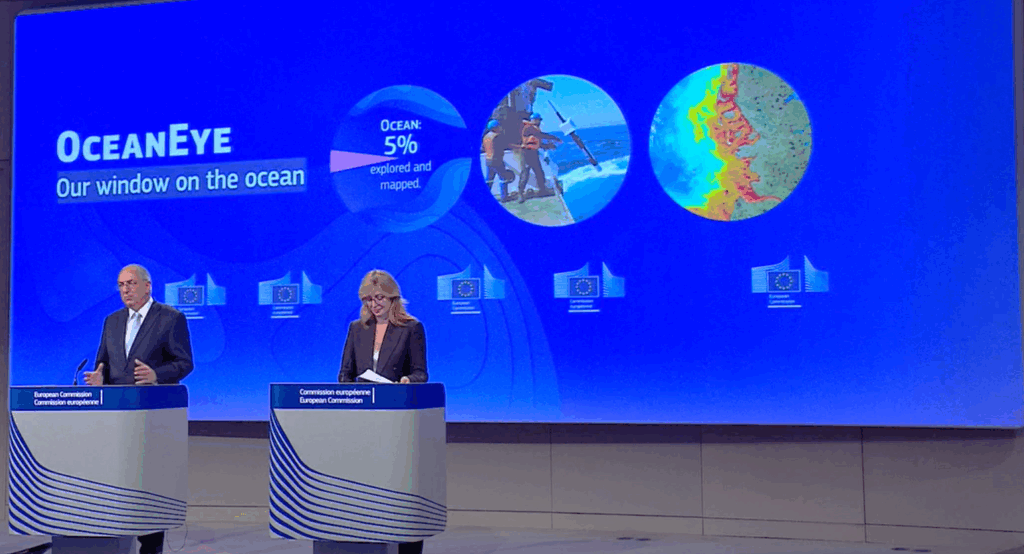
Announced by European Commission President Ursula von der Leyen at the EU Ocean Days in March, the OceanEye initiative aims to put the EU at the forefront of global ocean observation, contributing 35% to the global ocean observing system by 2035 and 35% to the market for observation technologies.
The initiative was launched by Commissioner for Maritime Affairs and Fisheries, Costas Kadis, and Commissioner for Startups, Research and Innovation, Ekaterina Zaharieva, at a press conference on the 3rd of June.
OceanEye will be guided by four pillars:
- Better governance for a more unified European approach
OceanEye aims to align priorities and investments of EU member states, European organizations and the industry, unifying European actions towards ocean observation with a more strategic approach.
- Global leadership through an international alliance and partnerships
The initiative foresees the launch of an international alliance to strengthen global ocean observation capabilities. In particular, the alliance aims to address gaps in the Southern Hemisphere, the Arctic, deep sea and coastal areas.
- The European Digital Twin of the Ocean, innovation and industry growth
OceanEye stands at the centre of European digital innovation and industry growth. From the EU Digital Twin of the Ocean, the EU’s virtual replica of the ocean, to investment opportunities and Horizon challenges, OceanEye will support the development of new ocean observation technologies.
- Engaging society and building skills
OceanEye will also feature a cultural dimension by linking ocean observation and related challenges and opportunities to culture, education and skills development.
Mercator Ocean’s IGO transformation to support OceanEye
In its OceanEye Communication, the Commission identifies Mercator Ocean International as a direct contributor to OceanEye and the future European digital ocean system, through our implementation of the Copernicus Marine Service and our role in developing the European Digital Twin Ocean (through EDITO) together with our partners.
The Communication also recognises that Mercator Ocean’s ongoing transformation into an Intergovernmental Organization will provide the institutional stability, shared ownership among Member States and the seamless connection with national digital ocean infrastructures.
The new Mercator International Centre of the Ocean will directly support OceanEye in achieving better governance and a more unified European approach to ocean observation.
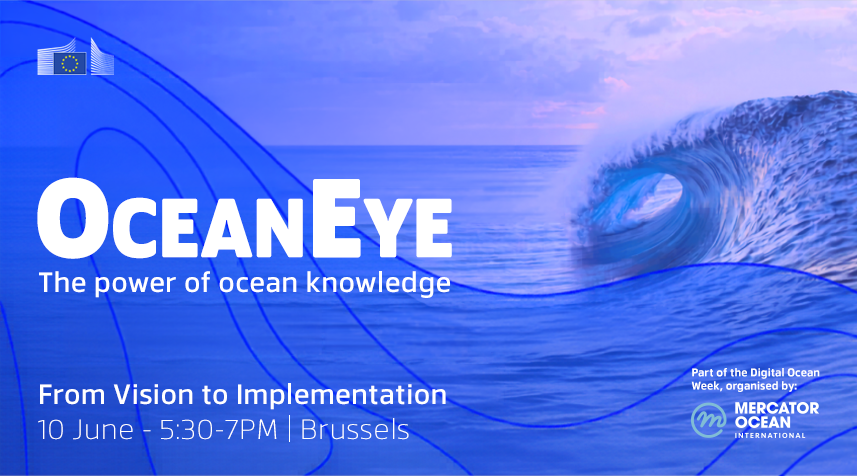
Next stop: Digital Ocean Week
OceanEye will be the focus of a dedicated event on the 10th of June, at the heart of the Digital Ocean Week. The event, titled “OceanEye: from Vision to Implementation”, will bring together the European Commission, Member States, European agencies, national ocean institutes, intergovernmental organisations and leading scientific partners across Europe in Brussels at the Nhow Hotel.
The event will provide a platform to discuss OceanEye’s strategic priorities and explore pathways to engage in the collective effort underpinning the International Alliance.